

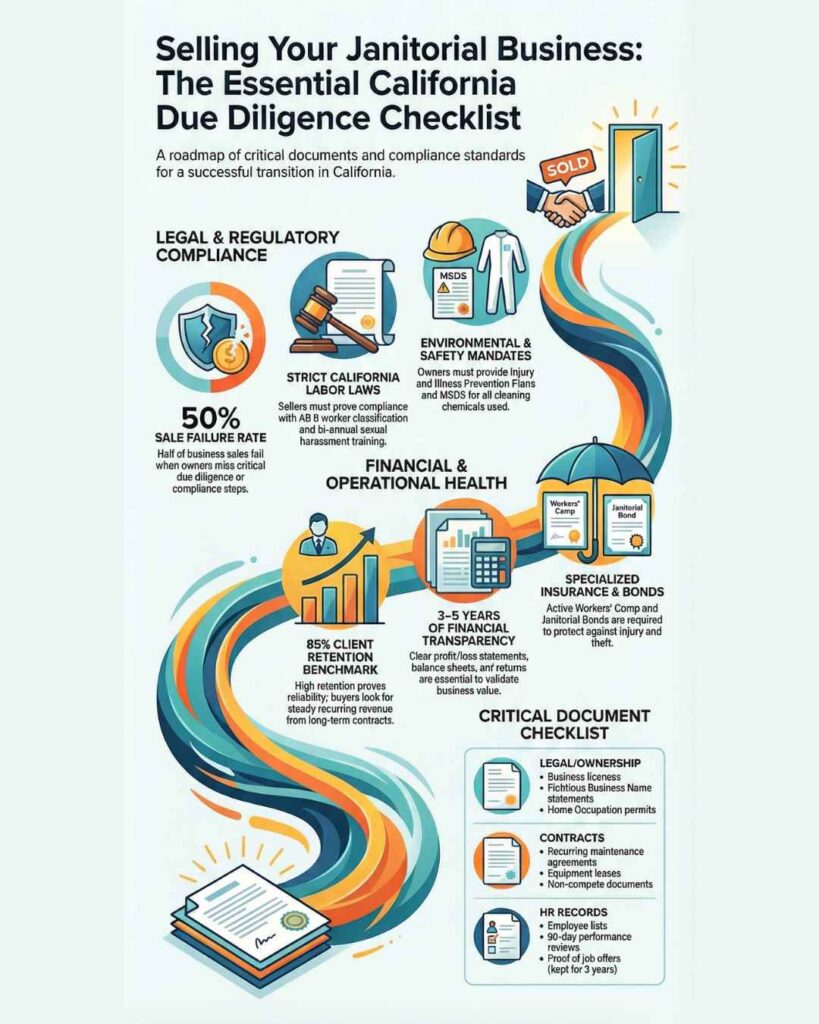
A due diligence checklist helps you keep track of key items when selling a cleaning or janitorial business in California. You collect financial statements, contracts, licenses, and safety records to show your business is doing well. Getting ready is important because half of sales don’t work out when owners miss steps in the due diligence checklist and the janitorial business process.
California law says you need workers’ compensation insurance and an Injury and Illness Prevention Plan. Keeping your legal, financial, and compliance papers in order helps buyers trust you. For expert help, talk to trusted professionals like Rogerson Business Services.
Is your business currently operating at the top of its game? Send a free inquiry today! Call Andrew Rogerson, Rogerson Business Services, toll-free (844) 414-9700 | Leave a message – I’ll call you right back
Key Takeaways
- Gather all necessary documents, including licenses, contracts, and financial statements, before selling your janitorial business. This helps buyers trust you.
- Make sure you comply with California laws, including workers’ compensation insurance and safety rules. This keeps your business safe and increases its value.
- Keep clear records about how happy your customers are and how many stay with your business. If many customers stay, your business looks reliable, and buyers will like it more.
- Create a comprehensive due diligence checklist to ensure you do not miss any steps when selling. This makes selling easier and prevents problems.
- Think about getting help from experts like Rogerson Business Services. They can help you negotiate and sell your business smoothly and smartly.
Prefer to watch a video?
Hit play and watch below!
Due Diligence Checklist Janitorial Business
Verify Business Entity and Ownership
Begin by checking your business entity and who owns it. Gather all papers that prove your business structure. These papers demonstrate to buyers that your janitorial business complies with California law. Collect your business licenses, partnership papers, and ownership certificates. If you work from home, get a home occupation permit from the Planning Department. Use the due diligence checklist janitorial business process to keep these files organized.
Tip: Keep copies of your fictitious business name statement if your company name is not your own name. This step helps stop confusion during legal due diligence.
Here is a table that shows the documents you need:
| Documentation Type | Description |
|---|---|
| Business Licenses | Needed for all businesses; includes FEIN or Social Security Number. |
| Home-Based Business Permits | Needed for home businesses; you must get a home occupation permit from the Planning Department. |
| Fictitious Business Name Statement | Needed if your business name is not your name or shows more than one owner. |
| Ownership Structures | Includes Sole Proprietor, Partnership, Corporation, and Non-Profit; each needs special documents. |
Confirm Legal Name and Addresses
Legal due diligence means you must check your business name and addresses. Make sure your legal name matches the name on your registration papers. Check that your business address is correct and matches the addresses on your licenses. The due diligence checklist for the janitorial business process says you must follow California rules for name and address changes.
Here is a table that lists the rules you must follow:
| Regulation | Description |
|---|---|
| 21006 | Lists things not counted when comparing business names, like business activity and name changes. |
| 21004 | List rules for telling names apart, with examples of names that are too close. |
| 21005 | Explains how to reserve a name and what proof you need for consent or court orders. |
Review Articles of Incorporation
Legal due diligence also involves reviewing your articles of incorporation. These papers prove that your business is real and in compliance with California law. Check that your articles are up to date and match your ownership records. The due diligence checklist for the janitorial business process requires including operating agreements, meeting notes, and consents to action.
Use this table to see what legal due diligence papers you should gather:
| Component Category | Key Components |
|---|---|
| Legal Documents | Operating or partnership agreement, meeting notes, consents to action |
| Debt/Equity Interest | Number of shares, names of holders, voting trusts, and agreements about equity interests |
| Business Activities | Type of business, addresses, business names, subsidiaries, and environmental checks |
| Material Documents | Contracts, licenses, customer agreements, and following franchise laws |
| Assets | Type and location of assets, security agreements, leases, and property interests |
When you use the due diligence checklist for janitorial businesses, you show buyers that your company meets all legal due diligence requirements. This helps buyers trust you and makes it easier to sell your business.
Licenses, Permits, and Compliance

Gather Required Licenses and Permits
You must collect all licenses and permits before selling. Buyers want proof that you follow the law. In California, cleaning services need the proper licenses. Some jobs, such as carpet cleaning or biohazard cleanup, require special permits. Local rules might require additional permits. Check with your city or county to be sure.
- General business license
- Janitorial license (costs $50 to over $200 yearly)
- Special permits for carpet cleaning or biohazard cleanup
- Local permits for hazardous waste removal
- Surety bond, if your state or clients need it
Tip: Keep copies of all licenses and permits in one folder. This helps buyers check your compliance quickly.
Check Regulatory and Environmental Compliance
You must demonstrate to buyers that your business complies with all rules. Many janitorial businesses in California break standard rules. Use this table to check your compliance and fix problems:
| Violation Type | Description | Solution |
|---|---|---|
| Improper storage | Storing waste in unsafe ways can cause danger. | Label containers and use secure storage areas. |
| Failure to adhere to the accumulation time limits | Ignoring time limits for waste can lead to fines. | Track waste dates and set disposal deadlines. |
| Incomplete or inaccurate hazardous waste manifests | Errors in paperwork can cause compliance issues. | Train staff to fill out forms and double-check entries. |
| Ignoring employee training requirements | Untrained staff can cause accidents and violations. | Create a training program that complies with state and federal regulations. |
| Disposing of hazardous waste in regular trash | Throwing hazardous waste in the trash is illegal. | Teach staff proper disposal steps and set clear protocols. |
| Overlooking emergency preparedness requirements | Not having a plan for emergencies increases risk. | Write an emergency plan that follows state guidelines. |
| Lack of regular inspections and maintenance | Skipping inspections can lead to problems. | Schedule regular checks of storage and equipment. |
| Not keeping proper records | Poor record-keeping can cause trouble during audits. | Set up a system to track all hazardous waste activities. |
| Not working with a certified hazardous waste transporter | Using uncertified transporters can result in improper disposal. | Always use a transporter certified by the state. |
Remember the Cleaning Product Right-to-Know Act. You must list all cleaning product ingredients on your website and on the product labels. Fines for missing this step can reach up to $2,500 per violation.
Review Industry Certifications
Industry certifications help your business look better. Buyers want these certifications because they show high standards. Here are some essential certifications:
| Certification Name | Description |
|---|---|
| Cleaning Industry Management Standard-Green Building | Helps customers who want LEED certification. |
| Custodial Technician Certification | Covers cleaning skills and customer service. |
| Registered Building Service Manager | Offers training on management and cleaning duties. |
| Certified Building Service Executive | Focuses on building management contracts. |
| Biohazard Cleanup | Needed for exceptional cleaning services. |
Note: Show your certifications when selling your business. This builds trust and can make your business worth more.
Is your business currently operating at the top of its game? Send a free inquiry today! Call Andrew Rogerson, Rogerson Business Services, toll-free (844) 414-9700 | Leave a message – I’ll call you right back
Contracts and Agreements
Compile Service and Vendor Contracts
Before you sell your janitorial business, gather all your contracts. Buyers want to see proof of your business relationships. These contracts should explain job duties, payment terms, and where work is performed. Check each contract to make sure it is correct and complete. Look at this table to see what contracts you might need:
| Type of Contract | Description |
|---|---|
| Recurring maintenance contracts | Covers long-term cleaning needs, such as routine upkeep and scheduled deep cleans. |
| Specialty add-on contracts | Includes additional services such as carpet cleaning and window washing beyond the standard scope. |
| Commercial cleaning contracts | Tailored for commercial properties with specific requirements, detailing access and compliance needs. |
| Construction / post-renovation contracts | Focuses on post-construction cleaning, including debris removal and safety protocols. |
| Industrial cleaning contracts | For factories and warehouses, addressing heavy-duty cleaning and hazardous materials. |
| One-time / event cleaning contracts | Designed for single jobs or special events, specifying scope and pricing. |
| Payment plans | Outlines payment schedules for larger jobs, helping clients manage costs. |
Tip: Keep all your contracts together in one folder. This makes it easy for buyers to check them.
Review Lease Agreements
Go over every lease agreement for your business property. Buyers want to know what your leases say. Check how long each lease lasts and if you can renew it. Look for any special rules in the lease. Make sure you have written approval for any subleases. If you rent equipment, add those papers too. California law says you must tell buyers about any lease changes. Keep these papers neat so buyers can see your rights and duties.
Prepare Non-Disclosure and Non-Compete Documents
Get non-disclosure and non-compete papers ready to protect your business. Buyers may want you to promise not to start a similar business nearby for a specific time. Non-solicitation rules prevent you from reaching out to former employees or clients. Non-compete papers must say how long and where you cannot compete. Confidentiality papers keep you from sharing secret business details.
- Non-compete papers may stop you from opening a similar business nearby.
- Non-solicitation rules prevent you from contacting former clients or employees.
- Confidentiality papers protect business secrets and customer lists.
Note: Clear and simple agreements help prevent legal trouble and help buyers trust you.
Financial Records and Tax Compliance
Organize Financial Statements
You need to collect your financial statements before selling. These papers show buyers how your business makes and spends money. Gather profit and loss statements, balance sheets, and cash flow reports. Get records from the last three to five years. Make sure each paper is clear and up to date. Buyers want to see steady income and honest numbers. When you organize your records, buyers trust your business more. This also helps the sale go faster.
Tip: Put all your financial papers in a digital folder. This makes sharing with buyers and your accountant easy.
Review Tax Returns and Payments
You must look over your tax returns and payment records. Buyers will check if you paid taxes on time. Janitorial businesses in California are subject to strict rules. Missing a tax payment or filing late can cause trouble. The table below shows common tax problems for janitorial businesses in California:
| Compliance Issue | Description |
|---|---|
| Annual Registration | Janitorial businesses must register each year to comply with state rules. |
| Penalties for Non-Registration | You can get fined $100 per day for not registering, up to $10,000. |
| Training Requirements | Employers must give in-person training every two years about sexual violence and harassment. |
| Fines for Contracting with Unregistered Employers | Fines can be $2,000 to $25,000 for hiring unregistered janitorial services. |
| Misrepresentation Penalties | You can be fined $10,000 for providing false information on applications. |
Check your records for missed payments or late filings. Fix any problems before showing your business to buyers.
Assess Debts and Liabilities
You should list all debts and liabilities your business has. Buyers want to know if you owe money to banks, suppliers, or the IRS. Honest answers help you avoid surprises during the sale.
“A potential client wanted to sell his regional janitorial company. But when asked about basic financial details, the seller said the company was in debt and owed money to the IRS.”
Is your business currently operating at the top of its game? Send a free inquiry today! Call Andrew Rogerson, Rogerson Business Services, toll-free (844) 414-9700 | Leave a message – I’ll call you right back
Make a list of all loans, credit lines, and unpaid bills. Include payment schedules and amounts owed. When you show buyers a clear list of debts, you build trust and make selling easier.
Employee and HR Documentation
Employee Contracts and Records
You need to keep clear records for every worker. California law says you must write down each job offer. You have to keep these papers for at least three years. When you sell your janitorial business, you must provide buyers with a list of available workers. The new owner must hire from this list for 6 months after the sale. You also need to post a written notice of the change within 5 business days. This notice must stay up for six months. After 90 days, you must give a written review of each worker’s performance. You have to keep this review for three years. You cannot punish workers for using their rights.
| Requirement | Description |
|---|---|
| Hire Eligible Employees | The new owner must hire from the list of workers for six months after the sale. |
| Retain Employment Offers | Keep proof of each job offer for at least three years. |
| 90-Day Retention | Keep workers for at least 90 days; do not fire without a good reason during this time. |
| Performance Evaluation | Give a written review after 90 days and keep it for three years. |
| Notice of Change | Post a written notice of the sale within 5 days and keep it posted for 6 months. |
| Anti-Retaliation | Do not punish workers for using their rights. |
Payroll and Benefits Compliance
You must sign up your janitorial business with the Labor Commissioner’s Office. California law requires you to provide sexual harassment training every 2 years. You need to keep good records of hours worked, pay rates, and breaks. The law also requires you to follow the California IWC Wage Orders. These rules set pay, hours, and work conditions. Make sure you follow all safety and health rules, especially if workers handle dangerous materials.
| Requirement | Description |
|---|---|
| Registration | Sign up with the Labor Commissioner’s Office. |
| Training | Give sexual harassment training every two years. |
| Record-Keeping | Keep good records of hours, pay, and breaks. |
| Wage Orders | Follow California IWC Wage Orders for pay and work rules. |
| Safety Standards | Meet all safety and health rules for dangerous jobs. |
Tip: Keep all payroll and benefits papers neat and current. This helps buyers check your records fast.
Labor Law Adherence
You must follow all labor laws when selling your janitorial business. California’s AB 5 law tells you how to classify workers. If you call workers contractors when they are really employees, you could owe back pay and expenses. Your contracts must have sufficient funds to cover all labor law requirements. New rules say you cannot make deals with janitorial contractors who do not have enough money for the rules. Always check your contracts and worker types before you sell.
- Check how you classify workers under AB 5.
- Make sure contracts have sufficient funds to cover labor law requirements.
- Do not make deals with janitorial contractors who do not follow the rules.
If you do these things, buyers will see that your business complies with California’s employment and HR laws. This helps buyers trust you and makes it easier to sell your business.
Insurance and Risk Management
Document Insurance Policies
You need to collect all your insurance policies before you sell your janitorial business. Buyers want to see proof that your company is protected from risks. In California, you must have different types of insurance. Use this table to help keep your policies organized:
| Insurance Type | Description |
|---|---|
| Workers’ Compensation | Pays for medical bills and lost wages if workers get hurt. |
| Commercial Auto Insurance | Protects your business cars from damage and lawsuits. |
| General Liability | Pays for property damage, medical bills, and lawsuits from accidents. |
| Business Owner’s Policy (BOP) | Combines property and liability insurance, usually for less money. |
| Janitorial Bonds | Promises clients they will not lose money if a worker steals. |
| Commercial Crime Insurance | Protects your business from theft and employee theft. |
| Cyber Liability | Pays for losses if your business gets hacked or loses data. |
| Inland Marine Insurance | Covers cleaning tools and equipment when you move them. |
| Boiler and Machinery Insurance | Pays for damage to big machines if you use them. |
Tip: Keep both digital and paper copies of your insurance papers in one spot. This makes it simple for buyers to check your coverage.
Workers’ Compensation Coverage
California law says you must have workers’ compensation insurance if you have employees. This rule is valid even if you only have one worker. You need to show buyers that your policy is active and in compliance with state rules. Check this table for a quick look:
| Requirement | Details |
|---|---|
| Coverage Requirement | You must have workers’ compensation insurance. |
| Minimum Employees | This rule is for any business with at least one worker. |
| Applicability | All janitorial businesses in California must follow this law. |
If you do not have this insurance, you could get fined or have legal problems. Buyers will want to see proof that you follow this law.
Liability and Other Relevant Insurance
You also need to show buyers that you have regular liability insurance. General liability insurance protects your business if someone gets hurt or property is damaged. Property insurance covers your cleaning tools and supplies. Business interruption insurance helps you pay bills if you have to close after an accident. Workers’ compensation insurance pays for work-related injuries.
| Insurance Type | Description |
|---|---|
| General liability insurance | Pays for accidents, injuries, or damage your business causes. |
| Property insurance | Protects your cleaning tools, supplies, and other things from loss or damage. |
| Workers’ compensation insurance | Pays for doctor bills and lost pay if workers get hurt at work. |
| Business interruption insurance | Helps you pay bills and get money back if your business closes for a while. |
Note: Having good insurance helps buyers trust you and shows you run your business the right way.
Safety and Operational Processes
Health and Safety Records
You need to keep health and safety records up to date. This is required to comply with California rules. These records show buyers that your business keeps workers safe. They also show you how to follow the law. You must register with the Division of Labor Standards Enforcement each year. When you register, you give business details and report any wage problems. You must have current workers’ compensation insurance. You also need to pay all fees on time. Janitors must get sexual harassment training every two years for free. Workers must get minimum wage, overtime pay, and breaks for meals and rest.
Key health and safety records include:
- Annual registration documents
- Workers’ compensation insurance certificates
- Sexual harassment training logs
- Wage and hour records
Tip: Put these records in a digital folder. This makes them easy to find and review.
Material Safety Data Sheets (MSDS)
Material Safety Data Sheets (MSDS) help you use chemicals safely. California law says you must keep an MSDS for each cleaning product. Each sheet must have important information:
- Name of the substance and who made it
- Hazards and label warnings
- What is in it, and any trade secrets
- First aid steps if someone is exposed
- How to fight fires and fire dangers
- What to do if there is a spill
- How to handle and store it safely
- Limits for exposure and safety gear needed
- Physical and chemical facts
- How stable it is and how it reacts
- Toxic details
- How it affects the environment
- How to throw it away safely
- How to move it
- Rules you must follow
- When the sheet was made or changed
Note: Keep MSDS sheets in one main spot. Update them when you get new products.
Standard Operating Procedures (SOPs)
Standard Operating Procedures (SOPs) outline how your team performs its jobs. You should make clear SOPs for every cleaning job. Store these SOPs online so everyone can see them. Include timekeeping, the job location, and the disinfectants used. Update SOPs regularly to align with new ways of working or new rules. Ask your team to help improve the SOPs. Use version control to track changes and ensure everyone uses the latest SOPs.
- Write simple steps for each cleaning job
- Keep SOPs online for easy access
- Update SOPs often
- Let workers help write and change SOPs
- Track changes with version control
Good SOPs show buyers your business is safe and well run.
Customer Relationships and Reputation

Customer Contracts and Retention Rates
You need to show buyers your business has loyal customers. Start by collecting all current customer contracts. These contracts prove you have steady work and income. Buyers want businesses with clients who stay for a long time. High retention rates mean customers trust your service. They come back again and again. In California, many janitorial companies use recurring contracts. This helps keep demand steady.
A strong retention rate sets your business apart. Most successful janitorial businesses in California keep at least 85% of their clients. This number means you keep most customers every year. When you share this information, buyers feel confident about your business.
- High retention rates mean customers trust your service.
- Recurring contracts help you earn steady money.
- An 85% retention rate is perfect for janitorial businesses.
Tip: Make a list of your oldest clients. This list shows your business is reliable and trusted.
Satisfaction Metrics and Reviews
Buyers want to see that your customers are happy. You should keep track of customer satisfaction data. Use surveys, feedback, and reviews to measure how well you do. In California, buyers expect clear records of customer satisfaction.
Here are common ways to measure satisfaction in the janitorial industry:
| Metric | Description |
|---|---|
| Client Satisfaction Surveys | Surveys show how happy customers are with your services. |
| Number of Client Complaints | Count complaints to find things you can improve. |
| Number of Client Compliments | Counting good feedback to show what you do well. |
| Quality Audits | Checks if your team meets cleaning standards and follows rules. |
You should collect positive reviews and testimonials. These reviews help buyers see that your business has a good reputation. When you show strong satisfaction metrics, buyers will like your business more.
Assets and Liabilities Overview
Inventory Equipment and Property
Make a complete list of everything your business owns. Start with cleaning tools, vehicles, and supplies. Write down the brand, model, age, and condition for each item. Add computers, phones, and office furniture to your list. Take pictures of your equipment to show buyers. In California, you must keep records for leased or financed equipment. Buyers want proof you own or can use these items. Put your inventory in a spreadsheet so it is easy to check.
Tip: Update your inventory list before meeting buyers. This helps you answer questions fast.
Review Outstanding Loans
Look at all the loans and debts your business has. List each loan, who gave it, how much you owe, and when you pay. Add credit cards, lines of credit, and unpaid bills. Buyers want to know if your business has money problems. In California, you must show all debts when selling. Clear records help you avoid surprises and build trust. If you have liens on equipment or property, include those details as well.
- List every loan and debt.
- Show when payments are due.
- Include liens or claims.
Assess Leases and Obligations
Check all leases and business agreements. Leases can be for your office, warehouse, or equipment. Each lease type has its own rules. For example, a triple-net lease means you pay rent and additional costs. A full-service gross lease covers most services in one payment. You need to know what each lease includes and what you must pay.
Here is a table to help you understand key lease points:
| Lease Type | Key Considerations |
|---|---|
| Triple Net (NNN) | Add the rent and extra costs to get the total price. |
| Modified Gross | Set the base year and protect against high extra costs. |
| Full Service Gross | Know what services are included and limit future cost increases. |
| Percentage Lease | Agree on percentage rates and sales breakpoints. |
| Essential Lease Terms | Focus on rent, expenses, and audit rights for good deals. |
Check for other agreements, such as service contracts or vendor deals. Make sure you can transfer these to the new owner. In California, you must follow all lease rules and inform buyers of any changes. Careful review helps you avoid legal trouble and makes your business more appealing to buyers.
Intellectual Property and Intangibles
Trademarks and Branding
You must protect your business name and logo. Trademarks help stop others from using your brand. In California, you can register your trademark with the California Secretary of State. You can also register with the United States Patent and Trademark Office (USPTO) for more protection. Make a list of all trademarks, logos, and slogans your business uses. Show proof that you registered them or applied for registration. Buyers want to see that you own your brand.
Tip: Keep copies of trademark certificates and renewal notices in your records. This step helps buyers trust your business identity.
Is your business currently operating at the top of its game? Send a free inquiry today! Call Andrew Rogerson, Rogerson Business Services, toll-free (844) 414-9700 | Leave a message – I’ll call you right back
Here is a table to help you organize your branding assets:
| Asset Type | Registration Status | Renewal Date | Notes |
|---|---|---|---|
| Business Name | Registered | 2026-03-15 | California, USPTO |
| Logo | Pending | 2025-11-01 | Application filed |
| Slogan | Not Registered | N/A | Consider registering |
Website and Digital Assets
Your website and digital assets show your business to everyone. You should make a list of all domain names, social media accounts, and online profiles. Make sure you own each domain and have login details ready. Buyers want proof that you control your online presence. In California, you must comply with privacy laws such as the California Consumer Privacy Act (CCPA). You need to show buyers your website has a privacy policy and follows these rules.
- List all domain names and renewal dates.
- Gather usernames and passwords for social media.
- Save copies of website content, graphics, and videos.
- Check that your website has a privacy policy.
Good digital records help buyers see your business is modern and ready for growth.
Buyer Vetting and Negotiation
Screen Potential Buyers
You want buyers who can complete the purchase of your business. Ask each buyer if they have worked in janitorial before. Check if they have enough money to buy your business. Ask for proof, such as a bank letter or a loan approval. Look at their past jobs and business history. In California, you must follow privacy laws when sharing private information. Use a non-disclosure agreement before giving out business details. This keeps your business safe and lowers risks.
Negotiate Terms and Price
Set clear rules for selling your business. Pick the price, payment type, and the date the sale will take place. Discuss which assets and contracts will transfer to the new owner. Make sure you follow California rules for contracts and disclosures. Be ready to answer buyers’ questions. Listen to what buyers worry about and give honest answers. Use written agreements to avoid confusion. Good negotiation helps everyone feel sure about the deal.
Engage Rogerson Business Services
You can get help from Rogerson Business Services during your sale. Andrew Rogerson and his team know a lot about selling businesses in California. They help you find good buyers, set fair prices, and do paperwork. Their skills in business brokerage, valuations, and consulting make things easier. Rogerson Business Services helps you from start to finish. They help you avoid mistakes and keep your sale moving forward.
Tip: A trusted advisor like Andrew Rogerson of Rongerson Business Services can help you sell your business faster and safer.
Is your business currently operating at the top of its game? Send a free inquiry today! Call Andrew Rogerson, Rogerson Business Services, toll-free (844) 414-9700 | Leave a message – I’ll call you right back
Sale Finalization and Transition
Draft Purchase Agreement
Work with a business attorney to write your purchase agreement. This paper shows the sale price and payment rules. It lists what assets you will give to the buyer. In California, you must add all needed disclosures. These include debts, lawsuits, and environmental problems. Go over every part with your attorney. This step keeps you and the buyer safe from mistakes.
Tip: Always use a written agreement. Verbal promises do not protect you in California.
Transfer Licenses and Contracts
After that, move all business licenses and contracts to the new owner. California says you must update licenses with the city or county. Some permits, such as hazardous waste or janitorial licenses, require special forms. Call your local agencies to find out what to do. Review all service contracts and vendor agreements. Many contracts need written approval before you can transfer them.
Checklist for Transfers:
- Update the business license with the city or county
- File transfer forms for special permits
- Tell vendors and clients about contract changes
Notify Clients and Vendors
Tell your clients and vendors about the sale right away. Clear messages help build trust and keep business steady. Write a letter or email to explain the change. Identify the new owner and provide contact information. Answer questions and let clients know the service will not stop.
Complete Closing Checklist
Finish the sale by using a closing checklist. This list helps you track each step and not miss anything. Here is a sample checklist:
| Task | Status |
|---|---|
| Sign the purchase agreement | ☐ |
| Transfer licenses and permits | ☐ |
| Notify clients and vendors. | ☐ |
| Settle outstanding debts | ☐ |
| Hand over business records | ☐ |
| Complete final walkthrough | ☐ |
A full checklist helps you finish the sale smoothly and follow all California rules.
If you use a complete due diligence checklist, you can sell your business more easily. Keeping good records and complying with California laws helps buyers trust you. This also makes your business worth more money. Stay neat and keep your records up to date. Do not forget any crucial steps. If you need help, you can ask Rogerson Business Services. They will help you with every part of selling your business so that things go well.
Is your business currently operating at the top of its game? Send a free inquiry today! Call Andrew Rogerson, Rogerson Business Services, toll-free (844) 414-9700 | Leave a message – I’ll call you right back
FAQ
What documents do I need to sell my janitorial business in California?
You need business licenses, tax returns, employee records, contracts, insurance policies, and safety documents. Put these papers together before meeting buyers. This helps you prove your business follows California laws.
How do I transfer business licenses to a new owner?
Call your city or county office. Fill out transfer forms for each license. Some permits need special approval. Always check local rules. Change all records to show the new owner’s name and address.
Do I need to tell my employees about the sale?
Yes. California law requires you to post a written notice within 5 business days after the sale. Keep the notice up for six months. Give the new owner a list of current employees.
What insurance must I have before selling?
You must have workers’ compensation insurance if you have employees. Buyers also want to see general liability, property, and business interruption insurance. Keep all policies up to date and ready for review.
How can I make my janitorial business more attractive to buyers?
Keep good records and renew all licenses. Show high customer retention. Update your equipment list and highlight industry certifications. A clean, organized business helps buyers feel confident about their purchase.