

By Andrew Rogerson, Founder, Rogerson Business Services
Certified Business Broker (CBB), M&A Master Intermediary (MAMI)
Last updated: May 10, 2026
Author Note: This guide reflects common SMB sell-side practice in California Testing, Inspection, Certification, and Compliance (TICC) business transactions. It is not legal, tax, or investment advice.
Disclaimer: This tutorial provides general information for California sellers in the Testing, Inspection, Certification, and Compliance (TICC) niche. Requirements and forms vary by jurisdiction. Confirm current rules with your regulators and consult qualified legal counsel and environmental professionals for your specific deal.
Closing represents the final stage of selling a TICC business in California. While reaching this milestone triggers celebration, it also introduces critical operational risks. In the Testing, Inspection, Certification, and Compliance (TICC) sector, a transaction involves more than the transfer of capital and real estate; it requires the seamless handoff of regulatory integrity. If you mismanage this phase, you risk disrupting client contracts and compromising vital agency accreditations.
Andrew Rogerson, founder of Rogerson Business Services, frequently emphasizes that a TICC sale lives or dies by its transition framework. As a five-time successful business owner, author of four books on business ownership, and a Mergers & Acquisition Master Intermediary (M&A MI), Andrew utilizes an ethical, meticulous approach to safeguard long-term enterprise value during California mid-market divestitures.
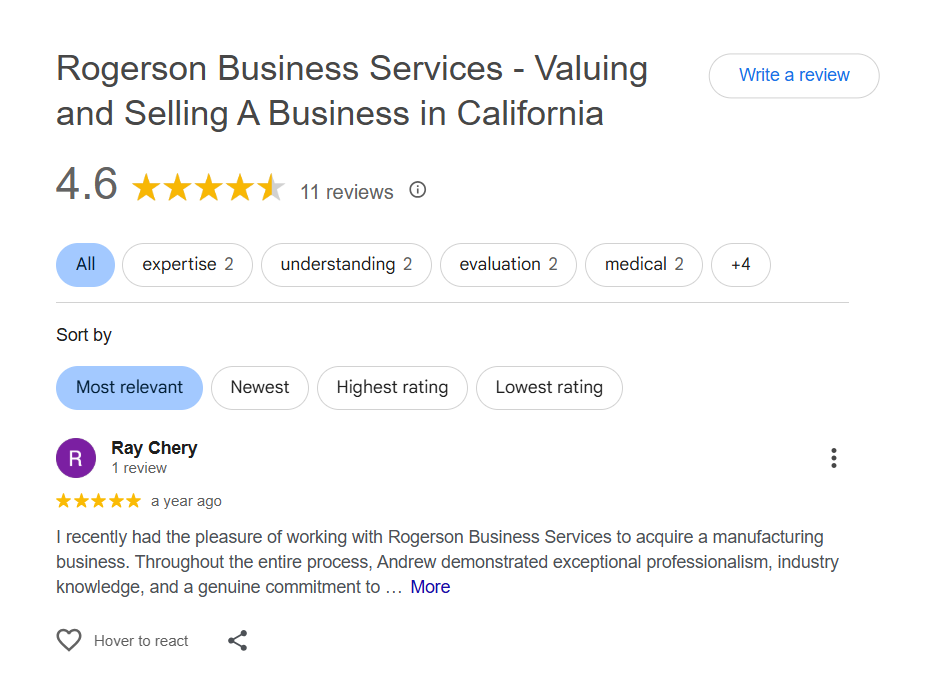
Testimonials
Mark DiPietro
“Andrew, I wanted to send you a short note to say thanks for all your help and support over the last year while my business was for sale. Even though we encountered difficult situations along the way, you always made it as smooth as possible. I always felt like I was working with a friend who had my best interests in mind rather than someone trying to make a commission from me. For anyone trying to buy or sell a business , I would definitely say you give five star effort and service.“
Mark DiPietro – Folsom, CA
See more reviews and testimonials.
Is your business currently operating at the top of its game? Send a free inquiry today! Call Andrew Rogerson, Rogerson Business Services, toll-free (844) 414-9700 | Leave a message – I’ll call you right back
The Accreditation Imperiled
Imagine you stand inches from the finish line. The buyer signed the Letter of Intent (LOI), and your legal teams finalized the purchase agreement. However, beneath the surface of this apparent success, a quiet crisis brews.
TICC firms operate on a foundation of trust, backed by rigorous certifications such as ISO/IEC 17025 for testing laboratories or ISO 17020 for inspection bodies. Because these accreditations belong to the entity and are directly tied to specific Key Technical Personnel (KTPs), any sudden shift in management can trigger an automatic audit by entities such as the ANAB National Accreditation Board (ANAB).
If you fail to structure the handoff of these technical roles before the close, the business enters a regulatory gray area. Buyers quickly realize that they are not just buying equipment; they are buying the legal permission to operate.
Key Takeaway
A smooth closing depends on rigorous TICC due diligence. You must map out every regulatory dependency and key personnel requirement months before execution, because California regulatory bodies do not pause enforcement for a change in ownership.
When Poor Planning Halts Operations

To understand the stakes, consider a scenario involving an environmental testing laboratory in Southern California. The seller assumed that the buyer’s internal team could immediately assume operational control post-closing. Consequently, they omitted a formalized transition plan from the final purchase agreement.
The day after closing, the laboratory’s technical director resigned. Because the buyer had not secured an approved successor, the laboratory fell out of compliance with the California Department of Public Health’s Environmental Laboratory Accreditation Program (ELAP).
Case Study: The Cost of Improper Planning
| The Operational Breakdown | The Financial Fallout |
| ELAP temporarily suspended the facility’s testing license. | The firm could not legally issue compliance certifications for 45 days. |
| Key municipal clients invoked contract breach clauses. | The buyer withheld the first structural earn-out payment from the seller. |
| The transaction stalled in post-closing litigation. | Legal fees erased a significant portion of the seller’s net proceeds. |
This standoff highlights a fundamental truth of the TICC industry: operational continuity dictates financial value. Without explicit, legally binding transition structures, a transaction can degrade into a costly dispute.
What Happens at Closing: The California TICC Framework
Closing a TICC transaction in California requires simultaneous execution of legal finalization and operational handoff. Because the state enforces rigorous regulatory oversight, parties cannot treat closing as a mere signing ceremony. Instead, you must execute a coordinated sequence of legal, financial, and operational steps to ensure the business retains its market value the moment ownership shifts.
1. Legal & Financial Steps
In California, asset and stock transfers typically move through an independent, specialized escrow holder. The escrow officer protects both parties by ensuring all closing conditions are met before distributing funds.
- Lien Cleansing and UCC Filings: The escrow officer conducts comprehensive Uniform Commercial Code (UCC) searches to identify existing liens against laboratory equipment, spectrometry tools, or fleet vehicles. Sellers must clear these obligations via UCC-3 Termination filings so the buyer receives an unencumbered title.
- Corporate Resolutions and Filings: Both entities must file formal corporate resolutions authorizing the transaction. If the sale involves an asset purchase, the parties must submit the appropriate ownership updates to the California Secretary of State.
- Purchase Price Allocation: The buyer and seller must agree on the tax-basis allocation of the purchase price using IRS Form 8594. This step carries significant weight in California, where state income tax rates heavily affect the net proceeds from capital asset sales under non-compete covenants.
2. Accreditation Continuity & Regulatory Handoff
A TICC business cannot generate revenue without its regulatory credentials. Therefore, the closing process must legally bind the seller to assist with agency notifications.
If you operate an environmental testing facility, you must immediately notify the State Water Resources Control Board’s Environmental Laboratory Accreditation Program (ELAP) regarding the change in ownership and any shifts in Key Technical Personnel (KTP). Similarly, calibration and product safety testing labs must submit administrative updates to organizations such as the International Accreditation Service (IAS), headquartered in Brea, California.
Unless you file these notifications within the state-mandated windows—frequently within 10 to 30 days of the material change, the governing bodies may suspend the laboratory’s operating license, halting all client testing.
3. Transition Planning
A successful transition demands an explicit written framework that dictates how operational custody transfers from the seller to the buyer. Andrew Rogerson utilizes a specialized transition matrix to prevent operational drift during this vulnerable window.
California TICC Closing & Transition Matrix
| Milestone Phase | Primary Action Item | California-Specific Risk Factor |
| Financial Escrow | Disburse funds and file UCC-3 terminations. | Unresolved equipment liens delay title transfer. |
| Regulatory Notification | Submit ownership updates to ELAP, IAS, or OSHA. | Missing the 10-day notification window triggers automatic audits. |
| Technical Transfer | Re-assign administrative access to the LIMS software. | Loss of data integrity invalidates active client test batches. |
| Personnel Stabilization | Execute retention agreements for Key Technical Personnel. | Competitors poach certified technicians during management gaps. |
Furthermore, the transition plan must detail the migration of proprietary Laboratory Information Management Systems (LIMS). Because these software platforms house historical calibration data and active testing pipelines, any interruption in software access can cause costly project delays for municipal and corporate clients.
4. Seller Consulting Agreements (TSA)
To bridge the operational gap, sophisticated market participants utilize a formal Transition Services Agreement (TSA). In California, structuring this post-closing advisory period requires extreme precision due to strict labor compliance laws.
Regulatory Compliance
When crafting a TSA in California, you must structure the seller’s compensation and duties to comply with independent contractor guidelines. Andrew Rogerson recommends defining the seller as a specialized corporate advisor with a fixed termination date, clear milestones, and an autonomous schedule. This explicit structure prevents the California Department of Industrial Relations from misclassifying the transferring founder as a standard employee.
The TSA should explicitly outline:
- The exact hourly or monthly consulting compensation.
- The defined scope of work includes introducing the buyer to tier-one clients or guiding the firm through its next scheduled ISO audit.
- The maximum number of advisory hours per week, ensuring the seller tapers off as the buyer’s team gains operational autonomy.
The Result: Preserving Enterprise Value
When you execute a structured closing framework, you eliminate transaction friction. The buyer assumes control of a fully operational, compliant TICC asset, while the seller successfully mitigates post-closing liabilities. By anchoring the transaction in clear legal protocols and precise transition timelines, you protect the business’s long-term legacy and secure the full financial reward of your exit.
Do not navigate this complex regulatory and financial landscape alone. Professional oversight shields you from post-closing liabilities and ensures you walk away with your wealth entirely intact.
Professional Resources for California Business Owners
To further validate your transaction steps and maintain total compliance with state frameworks, consult these primary regulatory reference points:
- California Secretary of State Business Entities: Verify corporate standing and file required transition amendments via the California Secretary of State Portal.
- Environmental Laboratory Accreditation Program (ELAP): Review change-of-ownership notification timelines directly through the State Water Resources Control Board.
- Uniform Commercial Code (UCC) Search: Access the official California index to review or terminate equipment liens through the California UCC Certified Search.
Get Support Closing Your Sale
Are you ready to transition out of your Testing, Inspection, Certification, and Compliance firm? Put your exit strategy into the hands of a proven expert.
Andrew Rogerson and the specialized team at Rogerson Business Services bring decades of West Coast brokerage expertise, master-level intermediary credentials, and a rigorous ethical framework to your closing table. We manage the heavy regulatory lifting so you can focus entirely on your next chapter.
Contact Rogerson Business Services Today to schedule a confidential, comprehensive consultation and secure your optimal California exit.