

By Andrew Rogerson, Founder, Rogerson Business Services
Certified Business Broker (CBB), M&A Master Intermediary (MAMI)
Last updated: April 25, 2026
Author Note: This guide reflects common SMB sell-side practice in California Testing, Inspection, Certification, and Compliance (TICC) business transactions. It is not legal, tax, or investment advice.
Disclaimer: This tutorial provides general information for California sellers in the Testing, Inspection, Certification, and Compliance (TICC) niche. Requirements and forms vary by jurisdiction. Confirm current rules with your regulators and consult qualified legal counsel and environmental professionals for your specific deal.
Business Owners: Testing, Inspection, Certification, and Compliance (TICC) in California
You have built a Testing, Inspection, Certification, and Compliance (TICC) business that thrives on consistency. Unlike many industries sensitive to economic shifts, your company likely benefits from non-discretionary demand driven by rigorous California regulations. Whether you operate a laboratory testing facility in Silicon Valley or an industrial inspection firm in Los Angeles, your “moat” consists of long-term client relationships, technical expertise, and hard-to-acquire accreditations.
However, the qualities that make your business stable also make its sales complex. Buyers in the TICC sector do not just look at your bottom line; they scrutinize the durability of your compliance revenue and the risk of your technical dependencies. If you are considering an exit, you must understand that California’s unique regulatory environment—from CARB standards to Cal/OSHA requirements—adds a layer of scrutiny to every deal.
To navigate this high-stakes environment, you need an expert who understands the nuances of the California market. Andrew Rogerson, founder of Rogerson Business Services, brings the authority of a 5-time successful business owner and a Certified Mergers & Acquisition Professional (CM&AP). As a Mergers & Acquisition Master Intermediary (M&AMI), Andrew utilizes his deep industry knowledge to ensure California TICC owners maximize their value while protecting their legacy. If you’re unsure how buyers evaluate your company, start by understanding how TICC businesses are valued in California.
Testimonials
Gordon Greve
“Andrew, I must compliment you on such a complete package.
I will review and chat about any questions.
“
Gordon M. Greve, Managing Principal – SIGMA ACQUISITIONS, LLC
See more reviews and testimonials.
Is your business currently operating at the top of its game? Send a free inquiry today! Call Andrew Rogerson, Rogerson Business Services, toll-free (844) 414-9700 | Leave a message – I’ll call you right back
What Buyers Look for in a TICC Business
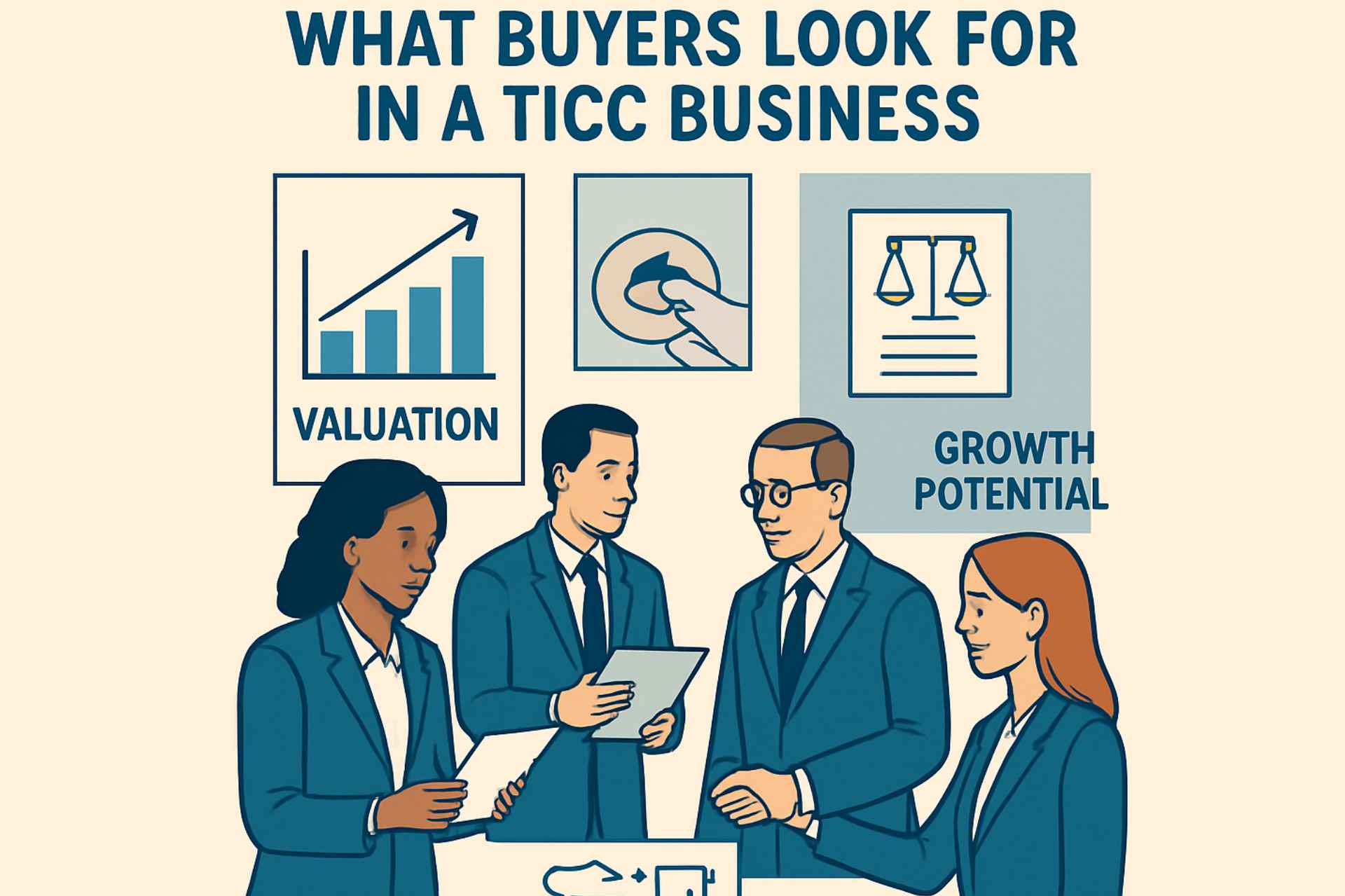
In a testing inspection certification company sale, buyers aren’t just purchasing equipment or a client list; they are acquiring a trusted compliance infrastructure. To command a premium price, your firm must demonstrate strength in the following five areas:
1. Recurring Compliance Revenue
Acquirers prioritize companies with “sticky” revenue. While project-based work provides a boost, buyers pay the highest multiples for ongoing inspection contracts and certification renewals. Because compliance is mandatory, this revenue stream serves as a predictable annuity, significantly reducing the buyer’s perceived risk.
2. Accreditation & Certification Stability
This remains the ultimate differentiator in compliance business acquisition. Buyers will conduct deep due diligence on your ISO/ANSI accreditations. They look for “institutionalized” certifications that belong to the company, rather than those tied to the personal credentials of a single owner or a few key individuals.
3. Backlog Visibility & Contract Structure
A robust, documented backlog provides a roadmap for future earnings. Buyers analyze your renewal rates and the length of your existing service agreements. If you cannot clearly demonstrate your future pipeline through a structured contract management system, you may face a lower valuation.
4. Technical Team & Key-Person Risk
TICC firms rely on specialized talent, including engineers, lab technicians, and certified inspectors. Acquirers assess the depth of your team and the redundancy of your technical expertise. If the business cannot function without your daily presence or the involvement of one specific “expert,” buyers will view this as a high accreditation risk during M&A.
5. Customer Concentration
High concentration is a deal-killer. If a single client accounts for more than 20% of your revenue, buyers will likely discount your valuation or insist on an earn-out structure to hedge against the risk of that client leaving post-sale. Diversification equals stability in the eyes of a strategic buyer.
Want a quick video explanation?
Hit play
How TICC Businesses Are Valued in California
Valuation in the TICC sector represents a blend of financial performance and risk mitigation. While revenue growth matters, California buyers focus heavily on the quality and durability of that revenue. Most sophisticated acquirers, including private equity groups and strategic global players, primarily use EBITDA multiples to determine the enterprise value of a laboratory testing business.
For smaller, owner-operated firms, we may look at Sellers Discretionary Earnings (SDE), but as a company scales toward the middle market, EBITDA remains the gold standard. In California’s competitive M&A landscape, inspection company multiples typically range from 4x to 8x EBITDA, though premier firms with specialized “moats” can exceed these figures.
What Drives Higher Multiples?
To achieve a top-tier valuation, you must demonstrate that your business operates as a scalable platform rather than a localized practice. Buyers pay a premium for:
- Recurring Compliance Revenue: Non-discretionary testing mandated by California law ensures a steady floor for earnings.
- Strong Accreditation Structure: Your ISO/IEC 17025 or similar accreditations must be embedded in the company’s operational framework, not just with the owner.
- Documented Backlog: A clear view of signed contracts and upcoming inspection cycles reduces the buyer’s transition risk.
- Scalable Operations: Firms that utilize automated laboratory information management systems (LIMS) often command higher prices due to their efficiency.
What Reduces Your Value?
Conversely, several “red flags” can cause a buyer to walk away or slash their offer:
- Accreditation Tied to Individuals: If your lab’s certification depends entirely on a single “Key Man” who might leave post-sale, the risk is often too high for traditional financing.
- Project-Heavy Revenue Mix: One-off environmental assessments or construction inspections are less valuable than multi-year service agreements.
- Weak Documentation: Inconsistent audit trails or messy financial records trigger grueling due diligence and price chips.
- Regulatory Risk: Any history of compliance failures with California state boards significantly devalues the brand.
Before going to market, most owners need to understand how to prepare a TICC business for sale to avoid these common valuation traps. Andrew Rogerson leverages his status as a Mergers & Acquisition Master Intermediary (M&AMI) to conduct rigorous financial “stress tests” on your business. By identifying these value-killers early, he helps you rectify weaknesses and present a cleaner, more profitable company to the market.
California-Specific Risks in TICC M&A
Operating a TICC business in California requires navigating a complex web of state-level mandates that often exceed federal requirements. While these regulations create a “barrier to entry” that protects your market share, they also introduce specific risks that buyers scrutinize during due diligence. If you intend to sell a TICC business in California, you must address these three primary risk categories to protect your valuation.
1. Intense Regulatory Oversight (CARB, Cal/OSHA, and DTSC)
California enforcement agencies maintain some of the most stringent oversight in the world. Buyers will investigate your standing with:
- California Air Resources Board (CARB): If your testing services involve emissions or environmental compliance, any past violations can stall a deal.
- Cal/OSHA: Buyers demand proof of impeccable safety records. In the TICC sector, where inspectors often work in hazardous environments, a single pending safety citation can trigger a significant “holdback” in the purchase price.
- Department of Toxic Substances Control (DTSC): For laboratory-based businesses, waste management protocols must meet strict California standards to avoid environmental “successor liability” for the buyer.
2. Accreditation Renewal & Audit Cycles
In a compliance business acquisition, the buyer essentially purchases your reputation and your “license to hunt.” California-based TICC firms often face more frequent or rigorous audit cycles from accreditation bodies. Acquirers look for:
- Audit History: Consistent, “clean” audit reports from the last three to five years.
- Technical Director Stability: California law often requires specific licensed professionals to oversee operations. If your firm lacks a “deep bench” of certified staff, buyers perceive a high risk of accreditation issues in M&A.
- Transferability: Some California-specific certifications do not transfer automatically upon a change of ownership. You must verify these transfer protocols before signing a Letter of Intent (LOI).
3. Professional Liability & “Prop 65” Exposure
California’s legal climate remains highly litigious. Acquirers analyze your “Errors and Omissions” (E&O) claims history with extreme care. Furthermore, if your testing services involve consumer products or environmental hazards, buyers assess your exposure to Proposition 65 litigation. A history of inaccurate testing or certification validity issues doesn’t just reduce your price—it often makes the business uninsurable and, therefore, unsaleable.
To understand how these state-specific risks impact your specific deal, you should explore your TICC exit strategy options early in the process. Andrew Rogerson applies his decades of experience as a Certified Business Broker (CBB) to help owners identify these liabilities before they reach the buyer’s desk. His analytical approach ensures you resolve “deal-killers” during the preparation phase, enabling a smoother transition and a higher closing probability.
Step-by-Step Process to Sell Your TICC Business
Transitioning from operations to an exit requires a disciplined, multi-stage approach. In the TICC sector, the process moves beyond simple financial audits; it involves verifying the “integrity” of your technical output and the resilience of your certifications. Because the California market attracts both national strategic acquirers and private equity “roll-up” firms, you must follow a structured path to ensure you don’t leave money on the table.
Working with specialized TICC M&A advisors in California provides the necessary buffer to maintain confidentiality during aggressive marketing. Below is the roadmap to a successful California TICC exit.
1. Valuation and Baseline Assessment
You cannot plan an exit without an accurate starting point. A formal valuation determines your enterprise value by analyzing your EBITDA, asset health, and “quality of earnings.” In this stage, Andrew Rogerson reviews your historical financials to ensure your discretionary expenses are properly added back to reflect the firm’s true profit potential.
2. Strategic Preparation
Once you establish a price range, you must “clean the house.” This involves organizing your ISO documentation, ensuring your LIMS data is exportable, and reviewing employment contracts for your key technical staff. Preparation ensures that when a buyer asks for an accreditation trail, you can provide it instantly.
3. Confidential Marketing
TICC businesses are sensitive; if your clients or staff hear about a sale prematurely, it can trigger “contract flight” or talent loss. We develop a Blind Profile (CIM) that highlights your firm’s strengths—such as high recurring revenue or niche laboratory capabilities—without revealing your identity. We then know how to confidentially market your TICC business to a curated list of qualified buyers who have already signed Non-Disclosure Agreements (NDAs).
4. Negotiation of Terms
Price is only one component of a deal. You must also know how to negotiate a TICC business sale by focusing on deal structure. This includes the “cash at closing,” earn-outs based on contract retention, and your ongoing role during the transition.
5. Due Diligence
This is the most grueling phase of a TICC sale. Buyers will bring in technical experts to audit your lab results, safety protocols, and accreditation compliance. Understanding what to expect during TICC due diligence helps you anticipate their questions about your technical “bench strength” and California regulatory standing.
6. Closing and Transition
After the buyer verifies the data, the legal teams finalize the Asset or Stock Purchase Agreement. You then execute the transition plan, which involves transferring certifications and introducing the new owner to key accounts. Knowing how to close a TICC business sale effectively ensures that your legacy—and your staff—remain protected.
TICC Sale Milestone Checklist
| Phase | Key Objective | Critical Deliverable |
| Discovery | Determine Fair Market Value | Certified Valuation Report |
| Packaging | Highlight “Sticky” Revenue | Confidential Information Memorandum (CIM) |
| Vetting | Filter Strategic vs. Financial Buyers | Signed NDA & Proof of Funds |
| Execution | Formalize Buyer Intent | Executed Letter of Intent (LOI) |
| Verification | Validate Compliance & Financials | Clean Due Diligence Report |
Expert Tip: In California, the “successor liability” for environmental testing or safety inspections is a major concern for buyers. Ensure your professional liability insurance (E&O) has a “tail” policy to cover your operations post-sale.
Key Takeaways
- Confidentiality is Paramount: Use a blind profile to protect client and staff relationships.
- Terms Over Price: A higher offer with a risky earn-out may be less valuable than a slightly lower, all-cash deal.
- Anticipate the Technical Audit: Due diligence in TICC is significantly more “hands-on” than in general service businesses.
Resources for Further Research:
- The M&A Source: Professional resources for middle-market M&A.
- International Business Brokers Association (IBBA): Standards for ethical business brokerage.
- California Secretary of State Business Search: Essential for verifying an entity’s standing in California.
Common Mistakes That Reduce Your Sale Price
Selling a TICC business in California involves navigating a high-stakes environment where any oversight can lead to “price chips” or a collapsed deal. Many owners spend decades building a reputable firm, only to lose significant value during the final 10% of the journey. To ensure you exit at the peak of your valuation, you must avoid these five critical pitfalls that frequently derail TICC transactions.
1. Failing to Document Recurring Compliance Contracts
In the TICC sector, “verbal agreements” or “handshake deals” carry zero weight during due diligence. Buyers pay for certainty. If your laboratory testing or inspection revenue isn’t backed by signed, evergreen contracts or clear renewal schedules, a buyer will categorize that income as “at-risk.”
- The Fix: Formalize your client agreements at least 12–24 months before going to market.
2. Over-Reliance on Key Technical Staff
If your firm’s ISO/ANSI accreditation or specialized California permits are tied solely to the credentials of one or two individuals, you have a “Key-Man” risk. If those employees leave, the business cannot legally operate.
- The Fix: Institutionalize your expertise by cross-training staff and ensuring the company—not just the individual—holds the primary certifications.
3. Neglecting California’s Regulatory Paper Trail
California buyers are hypersensitive to environmental and safety liabilities. Any “sloppiness” in your records with the California Air Resources Board (CARB) or Cal/OSHA will trigger aggressive demands for indemnification or escrow holdbacks.
- The Fix: Conduct an internal “mock audit” to ensure every inspection report and safety filing is current and easily accessible.
4. Waiting Too Long to Initiate the Exit Process
Selling a specialized business takes time—often 6 to 12 months from listing to close. Owners who wait until they are “burned out” or facing a health crisis lose their leverage. Buyers sense urgency and will structure deals that favor their own risk mitigation over your payout.
5. Engaging a Generalist Business Broker
A generalist broker who sells dry cleaners and retail shops lacks the technical vocabulary to defend your EBITDA multiples to a private equity group or a global TICC acquirer. You need an intermediary who understands the difference between a “one-off” test and a mandatory compliance cycle.
Impact of Preparation on TICC Valuations
| Value Driver | The “Unprepared” Seller | The “Strategic” Seller (Best Practice) |
| Accreditation | Dependent on the owner’s license. | Institutionalized across a broad technical team. |
| Revenue Mix | 70% project-based/one-off tests. | 80% recurring compliance/long-term contracts. |
| Financials | Mixed personal/business expenses. | Clean, audited, or reviewed by a CPA. |
| Regulatory Standing | Pending OSHA or CARB inquiries. | Zero active violations; documented compliance. |
| Transition | OwThe ownerust stay for 3+ years to ensure stability. | Owner exits within 6–12 months. |
Expert Call-Out: The “Due Diligence Trap”
Andrew Rogerson often reminds TICC owners that “due diligence is where deals go to die, or where they get discounted.” In California, the buyer’s attorney will look specifically for “Successor Liability.” If your documentation is weak, they will demand a larger portion of the sale price stay in an escrow account for years to cover potential future claims.
Key Takeaways for TICC Owners
- Cleanliness is Profit: In California, regulatory tidiness directly correlates to your multiple.
- Diversify Technical Expertise: Ensure your lab or firm can pass an audit without your presence.
- Lead Time Matters: Start your preparation 24 months before your desired exit date.
Authority Resources
- California Air Resources Board (CARB) – Verification Programs: Essential for verifying compliance status for California environmental labs.
- Cal/OSHA Enforcement Branch: Check for any outstanding citations that could hinder a sale.
- ANSI National Accreditation Board (ANAB): The gold standard for verifying the depth and stability of your certifications.
- M&A Source – Code of Ethics: Ensures your advisor meets the high-integrity standards required for mid-market TICC deals.
Get a Confidential Valuation
Deciding to sell your Testing, Inspection, Certification, and Compliance (TICC) business is a significant milestone. Still, you should never enter the California market without a precise understanding of your company’s value. In the TICC sector, “guessing” at your multiple or relying on generic online calculators leads to two outcomes: either you price yourself out of a deal, or you leave millions on the table for the buyer.
Because California’s regulatory environment is so specialized, you need an intermediary who understands how to translate your compliance data into financial value. Andrew Rogerson, founder of Rogerson Business Services, offers the expertise of a 5-time successful business owner and a Mergers & Acquisition Master Intermediary (M&AMI). His ethical, data-driven approach ensures that California TICC owners receive a valuation that reflects both their current cash flow and their future growth potential.
A professional valuation provides the leverage you need to negotiate from a position of strength. Whether you operate a niche laboratory or a statewide inspection firm, knowing your numbers is the first step toward a successful exit.
👉 Get a confidential TICC business valuation in California
Valuation Methodology Comparison: Professional vs. Generic
To illustrate why a specialized TICC valuation is necessary, consider how different approaches impact your final number:
| Valuation Approach | Focus Area | Impact on TICC Sale |
| Market-Based (Generic) | Historical sales of “similar” businesses. | Often misses the premium value of California-specific accreditations. |
| Income-Based (EBITDA) | Future earnings and cash flow reliability. | The Industry Standard. Rewards firms with high recurring compliance revenue. |
| Asset-Based | Fair market value of lab equipment and real estate. | Generally acts as a floor; ignores the “Blue Sky” value of your brand. |
| Specialized TICC Audit | Regulatory Standing & Accreditation. | Highest Value. Factoring in CARB/OSHA compliance and technical team depth. |
Call-Out: The Cost of an Incorrect Valuation
In the California M&A market, an overpriced TICC business becomes “stale” on the market, signaling to buyers that the owner is unrealistic. Conversely, an underpriced business attracts “vulture” buyers who seek to exploit hidden value. A certified valuation by a Certified Mergers & Acquisition Professional (CM&AP) eliminates these risks by providing a defensible, market-ready price point.
Final Takeaways for Your TICC Exit Strategy
- Precision Matters: Use EBITDA multiples adjusted for the California regulatory “moat.”
- Trust the Credentials: Ensure your advisor holds M&AMI and CM&AP certifications for middle-market deals.
- Start Early: A valuation is not just a price tag; it is a diagnostic tool to identify where you can improve your business before the sale.
- Protect Your Data: Always maintain strict confidentiality until a qualified buyer signs an NDA and provides proof of funds.
Authority & Research Resources
- AICPA – Statement on Standards for Valuation Services: The professional framework used by experts to ensure valuation accuracy and legal defensibility.
- International Society of Business Appraisers (ISBA): Provides the gold standard for business appraisal methodology.
- State of California – Department of Consumer Affairs: Use this to verify the licensing status of your professional team.
- Rogerson Business Services – TICC Case Studies: Real-world examples of California TICC exits and the strategies used to maximize their value.