

By Andrew Rogerson, Founder, Rogerson Business Services
Certified Business Broker (CBB), M&A Master Intermediary (MAMI)
Last updated: April 30, 2026
Author Note: This guide reflects common SMB sell-side practice in California Testing, Inspection, Certification, and Compliance (TICC) business transactions. It is not legal, tax, or investment advice.
Disclaimer: This tutorial provides general information for California sellers in the Testing, Inspection, Certification, and Compliance (TICC) niche. Requirements and forms vary by jurisdiction. Confirm current rules with your regulators and consult qualified legal counsel and environmental professionals for your specific deal.
Success in the California Testing, Inspection, Certification, and Compliance (TICC) market requires more than technical proficiency; it demands transaction readiness. Whether you operate an environmental testing lab in Los Angeles or a construction inspection firm in Sacramento, the state’s rigorous regulatory environment places a premium on your internal systems.
Testimonials
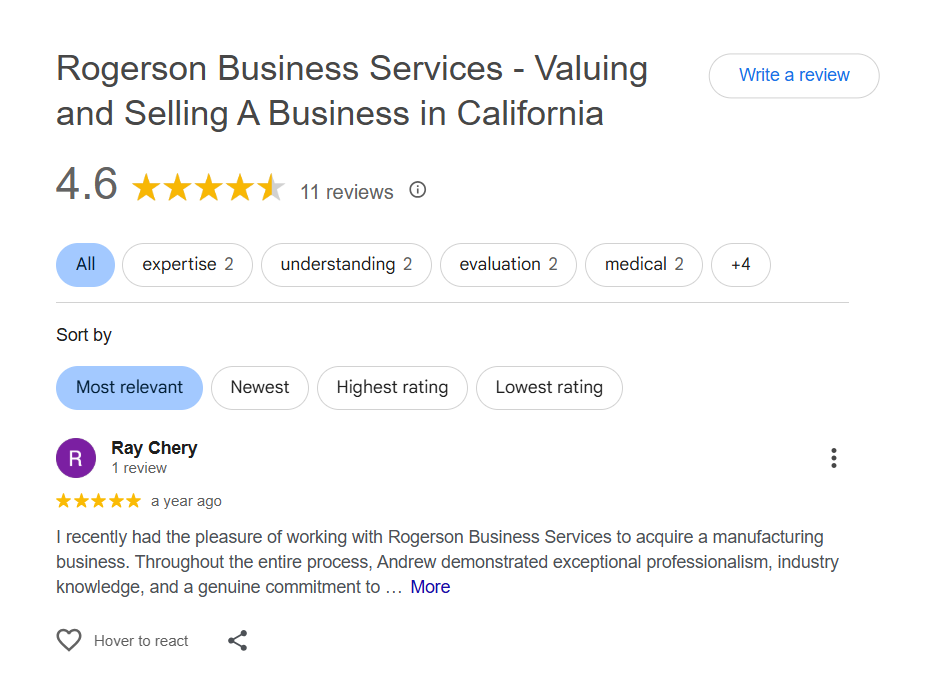
“We sincerely appreciate Andrew’s help and support throughout the process of selling our business. His knowledge and intuition when dealing with the various buyers was invaluable. While we did not have a large, complicated transaction, Andrew still made us feel important, always communicating and making sure we were as comfortable as possible with the process. We highly recommend Andrew to anyone in need of a business broker. We enjoyed working with him and are glad he came highly recommended to us!“
Mike and Sue Hickok –
See more reviews and testimonials.
Andrew Rogerson, the founder of Rogerson Business Services, understands these stakes firsthand. As a 5-time successful business owner, Certified Mergers & Acquisition Professional (CM&AP), and Mergers & Acquisition Master Intermediary (M&AMI), Andrew has authored four books on business ownership. He specializes in navigating the complexities of the California market. His expertise ensures that TICC owners don’t just list their businesses—they exit them successfully.
Is your business currently operating at the top of its game? Send a free inquiry today! Call Andrew Rogerson, Rogerson Business Services, toll-free (844) 414-9700 | Leave a message – I’ll call you right back
Why Preparation Matters

In the TICC industrial services industry, your value resides in your reputation for accuracy and your adherence to strict standards. Buyers do not just purchase your equipment; they also acquire your certifications, recurring contracts, and compliance history. Preparation directly impacts how TICC businesses are valued in California.
The Cost of Disorganization
Imagine this scenario: You find a qualified buyer ready to pay a premium multiple. However, during the due diligence phase, you cannot produce the last three years of accreditation audit trails or standardized client contracts. This “standoff” triggers immediate buyer concern. Missing documentation signals hidden risk, leading to deal delays, “re-trading” (lowering the price), or total deal failure.
Driving Higher Multiples
When you organize your business before hitting the market, you shift the narrative from risk to reliability. A prepared seller demonstrates a “plug-and-play” operation that a buyer can scale without fear of a Cal/OSHA audit or the loss of ISO certification. By addressing these gaps early, you effectively increase your TICC business valuation and command a position of strength during negotiations.
Key Takeaway: In California’s K-shaped M&A market, high-quality, well-prepared firms attract the majority of capital and interest in megadeals. Conversely, unprepared firms often face valuation gaps and execution risks that stall transactions.
Organizing Contracts & Compliance
Contracts and compliance serve as the backbone of a TICC (Testing, Inspection, Certification, and Compliance) firm’s value. In California, where regulatory oversight remains among the strictest in the nation, buyers scrutinize these documents to ensure the business operates on a firm legal and operational foundation. Andrew Rogerson leverages his experience as a Master Intermediary to help sellers identify and rectify “deal-killers” within their paperwork before they reach the negotiation table.
Audit Your Client Contracts
Standardization creates predictability, and predictability drives higher multiples. If your contracts vary wildly between clients, you increase the buyer’s perceived risk. You must review your service agreements for assignability clauses. In California, many TICC contracts require explicit consent for a change of ownership. If you do not address these clauses early, you may face significant delays while seeking third-party approvals during the closing process.
- Standardize Terms: Harmonize your liability limits, payment terms, and renewal dates across your client base.
- Verify Recurring Revenue: Buyers pay a premium for “sticky” revenue. Ensure your contracts clearly define multi-year inspection cycles or mandatory certification renewals.
- Mitigate Liability: Consult with a legal professional to ensure your contracts comply with California’s Unfair Competition Law (UCL) to protect against future litigation.
Master the California Regulatory Landscape
Compliance in the TICC sector often involves multiple governing bodies, such as the California Air Resources Board (CARB) or the Department of Toxic Substances Control (DTSC). A missing permit or an expired environmental certification can halt a transaction instantly. You must compile a “Compliance Bible” that organizes all permits, licenses, and safety records relevant to your niche.
| Document Category | Importance to Buyer | California Regulatory Context |
| Environmental Permits | Critical for “Right to Operate” | Must comply with CalEPA standards. |
| Labor Compliance | Reduces legal exposure | Must adhere to California Labor Code (wage and hour laws). |
| Safety Records | Lowers insurance premiums | Requires up-to-date Cal/OSHA logs and training records. |
| Waste Disposal | Mitigates long-term liability | Verification of hazardous waste manifest chains (if applicable). |
Strategic Resource: Utilize the Governor’s Office of Business and Economic Development (GO-Biz) portal to verify your business remains in good standing with all state agencies.
The “Paper Trail” Advantage
When you present a clean, organized compliance history, you project professional competence. Because California buyers often use SBA 7(a) financing, your documentation must satisfy not only the buyer but also the buyer’s lending institution. Andrew Rogerson guides his clients through this rigorous “pre-flight” check to ensure their businesses pass the scrutiny of even the most conservative underwriters.
Takeaway: Well-documented contracts and rigorous compliance records transform a business from a “risky bet” into a “secure asset.” By standardizing your legal framework today, you remove the friction that often kills deals tomorrow.
Accreditation Readiness
In the TICC sector, your accreditations serve as your “license to print money.” They represent the technical moat that prevents competitors from easily entering your market. Because California maintains high environmental and safety standards, buyers prioritize firms with “clean” accreditation histories. Andrew Rogerson, drawing on his background as a Certified Mergers & Acquisitions Professional (CM&AP), advises sellers that even a minor lapse in certification can slash a business’s valuation overnight.
Audit Your Quality Management System (QMS)
Buyers look for a robust Quality Management System (QMS) that operates independently of the owner. You must demonstrate that your lab or inspection firm follows rigorous, documented procedures. Before listing your business, perform a “gap analysis” to identify any deviations from ISO or state-mandated standards.
- Review Proficiency Testing (PT) Results: Ensure your facility consistently passes PT rounds—frequent failures or “re-tests” signal operational weakness to a sophisticated buyer.
- Update Standard Operating Procedures (SOPs): Scrutinize your SOPs for technical accuracy. Outdated manuals suggest a lack of investment in modern methodologies.
- Verify Equipment Calibration: Maintain an impeccable log of equipment maintenance. In California, where precision is paramount for agencies like the South Coast AQMD, uncalibrated sensors can lead to catastrophic compliance failures.
Essential TICC Accreditations in California
Depending on your niche, certain certifications carry more weight. Buyers looking to plan your TICC exit strategy will verify these credentials during the first phase of due diligence.
| Accreditation/Agency | Scope of Authority | Relevance to California Buyers |
| ISO/IEC 17025 | General requirements for testing labs | The global gold standard for technical competence. |
| ELAP (Environmental Lab Accreditation Program) | California-specific water & soil testing | Essential for firms working with the California State Water Resources Control Board. |
| IAS (International Accreditation Service) | Inspection and building departments | Critical for firms operating in the California construction and engineering sectors. |
| ISO 9001 | Quality Management Systems | Demonstrates a scalable business model with standardized workflows. |
Securing the Technical “Moat”
Accreditation stays with the entity, not necessarily the person, provided you manage the transition correctly. You must ensure that your Quality Manager and Technical Director plan to remain with the firm post-sale. If the accreditation relies solely on your personal credentials, the buyer faces a significant “re-accreditation” risk.
Expert Resource: Review the NIST Handbook 150 for the latest requirements in laboratory accreditation to ensure your facility meets national benchmarks.
Takeaway: Your accreditation is not just a certificate on the wall; it is a financial asset. Clean audit trails and a “culture of compliance” directly increase your TICC business valuation by reducing the buyer’s risk of operational downtime.
Deep Dive: Preparing Environmental Testing Labs for Sale in California
While the broader TICC sector values consistency, Environmental Testing Labs face unique hurdles due to California’s aggressive climate and public health mandates. Buyers looking to work with a TICC M&A advisor prioritize labs that manage the intersection of technical precision and rigorous state reporting. Andrew Rogerson often emphasizes that in this sub-sector, your data integrity is your product. If a buyer identifies a single breach in your chain of custody, the perceived value of your entire historical database evaporates.
Navigating California-Specific Lab Regulations
In California, the Environmental Laboratory Accreditation Program (ELAP) sets the standard. Recent updates to ELAP regulations require labs to adopt the TNI (The NELAC Institute) Standard, which mandates a sophisticated level of quality management. Consequently, you must ensure your lab is not just “compliant,” but “TNI-ready.”
- Secure Your Chain of Custody (CoC): Buyers will audit your CoC procedures to ensure no samples were compromised. They want to see a seamless, digital trail from the field to the final report.
- Manage Hazardous Waste: Because testing often generates toxic byproducts, you must prove your lab follows the DTSC (Department of Toxic Substances Control) guidelines for waste disposal.
- Update Your LIMS: A modern Laboratory Information Management System (LIMS) automates data entry and reduces human error. If you still rely on manual spreadsheets, invest in a digital upgrade before the sale to show scalability.
Equipment Inventory and Life Cycle
Environmental labs rely on expensive, sensitive hardware. A buyer will calculate the “useful life” of your mass spectrometers and chromatographs to determine future capital expenditure (CapEx) requirements. If your equipment is nearing obsolescence, it may trigger a downward adjustment in your sale price.
| Equipment Type | Common Use in CA Labs | Valuation Impact |
| GC-MS / LC-MS | Testing for PFAS and pesticides | High- state-of-the-art units attract premium buyers. |
| ICP-OES / ICP-MS | Heavy metals testing in soil/water | High; essential for public utility contracts. |
| Auto-Samplers | Increasing lab throughput | Medium: demonstrates operational efficiency. |
| Fume Hoods/Safety | Maintaining Cal/OSHA compliance | Critical; failing safety infrastructure is a deal-killer. |
Strategic Tip: Compile a comprehensive maintenance log for every piece of equipment. Proving that you have regularly serviced your hardware under California’s strict operating conditions gives the buyer confidence that they won’t face immediate replacement costs post-closing.
Leveraging the “Green” Market
California’s commitment to environmental remediation means labs specializing in PFAS (“Forever Chemicals”) or drought-related water testing are in high demand. If your lab holds specific certifications for these emerging contaminants, highlight them as a primary value driver. These high-margin services differentiate your firm from generic testing facilities and help you sell a TICC business successfully in a competitive M&A landscape.
Takeaway: Environmental labs are highly specialized assets. By mastering ELAP standards and maintaining a modern equipment fleet, you position your lab as a leader in the California market, allowing you to command a higher EBITDA multiple.
Reducing Key-Person Risk
A business that cannot function without its owner is not a transferable asset; it is a high-paying job. In the TICC sector, “key-person risk” often centers on the Technical Director or the owner who holds the specific California licenses required for operation. If you perform every final review or maintain every key client relationship personally, you decrease the pool of eligible buyers and lower your valuation.
Andrew Rogerson, a Mergers & Acquisition Master Intermediary (M&AMI), stresses that “transferability” drives the final sale price. To secure a premium multiple, you must prove that the business thrives because of its systems, not just its founder.
Institutionalize Your Knowledge
You must transition from being the “player” to the “coach.” Start by documenting every process that currently lives only in your head. Because California has strict labor laws and professional standards, your documentation must be precise and accessible.
- Appoint a Deputy: If you act as the Technical Director, you should train or hire a qualified successor who meets California’s professional licensing requirements.
- Decentralize Client Relationships: Introduce your senior project managers to your top accounts. Buyers fear that “client churn” will follow the owner’s exit; however, showing that your team manages these relationships mitigates that fear.
- Automate Reporting: Use your LIMS or CRM to deliver compliance reports automatically. When the “system” delivers the value, the owner becomes replaceable.
The Value Gap: Owner-Led vs. Management-Led
Buyers use different valuation models depending on how involved the owner remains. While a small lab might sell on a multiple of Sellers’ Discretionary Earnings (SDE), larger TICC firms with a management layer command higher EBITDA multiples.
| Factor | Owner-Dependent (Higher Risk) | Team-Driven (Higher Value) |
| Daily Operations | Owner makes all technical decisions. | Department heads manage daily workflows. |
| Sales/Growth | Revenue relies on the owner’s network. | A dedicated sales team or inbound system drives leads. |
| Technical Sign-off | Only the owner holds the CA license. | Multiple staff members hold necessary certifications. |
| Buyer Pool | Only “owner-operators” can buy. | Private equity and strategic firms can buy. |
Strengthening Your Management Team
To plan your TICC exit strategy effectively, you might need to implement “stay bonuses” or “phantom equity” for your key employees. In California’s competitive talent market, losing a Lead Inspector during a sale can jeopardize the entire deal. Work with a Certified Business Broker, such as Andrew Rogerson, to structure agreements that keep your leadership team incentivized throughout the transition.
Expert Resource: Review the California Secretary of State’s Business Search to ensure your “Statement of Information” correctly reflects your current officers and directors, as buyers will verify this during their initial scan.
Takeaway: You increase your business’s value by making yourself redundant. A TICC firm with a robust, independent management team represents a “turnkey” investment that attracts higher-quality buyers and strategic acquirers.
Financial Cleanup
Financial transparency acts as the ultimate “trust signal” during a TICC transaction. Because the industry relies on data integrity, any discrepancy in your bookkeeping suggests operational sloppiness to a potential buyer. Andrew Rogerson, drawing on his experience as a 5-time business owner and Certified Business Broker, knows that “recasting” your financials is the most effective way to reveal your firm’s true earning power.
The Recasting Process (Normalization)
Most small- to mid-sized TICC firms in California operate on a “tax-minimization” strategy. While this reduces your immediate tax bill, it also suppresses your reported profit, which can lower your valuation. To increase your TICC business valuation, you must “recast” your financial statements to show what the business would look like under new ownership.
- Analyze Discretionary Expenses: Identify personal expenses run through the business, such as vehicle leases, club memberships, or non-working family members on the payroll.
- Identify One-Time Costs: Eliminate non-recurring expenses from your profit and loss statement, such as a one-time lab equipment repair or a specific legal fee for a settled dispute.
- Standardize Accounting: Transition from “Cash” to “Accrual” accounting if your revenue exceeds $5M. Buyers and lenders prefer Accrual because it matches revenue with the period in which you performed the testing or inspection.
Common “Add-Backs” in TICC Valuations
When you calculate your Sellers Discretionary Earnings (SDE) or EBITDA, you must document every “add-back” with precision. In California, where the cost of living and labor is high, these adjustments significantly impact your final walk-away number.
| Expense Category | Examples for TICC | Recasting Logic |
| Owner’s Salary | Salary, bonuses, and health insurance. | Add back the total compensation of one full-time owner. |
| Facility Upgrades | One-time build-out of a cleanroom or lab expansion. | These are capital investments, not recurring operational costs. |
| Excess Rent | Paying above-market rent to a self-owned LLC. | Adjust the rent to the current California fair market value. |
| Interest/Depreciation | Interest on equipment loans or Section 179 deductions. | Non-cash or financing-specific charges are added back to show cash flow. |
Navigating California Tax and Labor Audits
California buyers perform deep dives into your Franchise Tax Board (FTB) filings and Employment Development Department (EDD) records. If you have misclassified “1099 contractors” who should be “W-2 employees” under California’s AB5 law, you face a massive hidden liability. You must settle any outstanding tax liens or labor disputes before going to market, as these will inevitably surface during the lien search phase.
The “Clean Books” Premium
Firms with three years of clean, CPA-reviewed financial statements often command a 10% to 15% premium over firms with disorganized, “shoebox” accounting. Professionalism in your books suggests professionalism in your lab.
Preparing for the SBA 7(a) Underwriter
Since many California TICC sales involve SBA 7(a) financing, your financials must satisfy a third-party lender’s “debt service coverage ratio.” Andrew Rogerson helps sellers organize their IRS Tax Transcripts and 4506-C forms early in the process. This preparation ensures that once you find a buyer, the bank doesn’t stall the deal due to missing or inconsistent tax data.
Takeaway: You cannot sell what you cannot prove. By cleaning your financials and documenting your add-backs today, you provide the “proof of concept” that buyers need to justify a premium offer.
TICC Readiness Checklist (CTA)
Preparation transforms a stressful transaction into a streamlined exit. Before you engage with potential buyers, use this comprehensive checklist to evaluate your firm’s standing. Because the California market moves quickly, having these items ready allows you to maintain momentum during the high-stakes due diligence phase.
1. Compliance & Legal
- [ ] Standardize Service Agreements: Ensure all client contracts include clear assignability clauses.
- [ ] Verify Permits: Confirm all California Environmental Protection Agency (CalEPA) and local municipal permits remain active.
- [ ] Labor Audit: Review employee classifications (W-2 vs. 1099) to ensure compliance with California’s AB5 law.
- [ ] Corporate Standing: File any outstanding Statements of Information with the California Secretary of State.
2. Accreditation & Quality Control
- [ ] Audit QMS: Verify that your Quality Management System meets current ISO 17025 or TNI standards.
- [ ] Proficiency Testing: Organize the last three years of PT results into a single, accessible digital folder.
- [ ] SOP Update: Ensure every laboratory or field inspection process has a corresponding, up-to-date Standard Operating Procedure.
- [ ] Equipment Logs: Compile maintenance and calibration certificates for all primary technical hardware.
3. Financial Transparency
- [ ] Recast Financials: Work with a specialist to calculate your Sellers Discretionary Earnings (SDE) or EBITDA.
- [ ] Document Add-Backs: Create a detailed ledger justifying every personal or non-recurring expense added back to the profit.
- [ ] Tax Reconciliation: Ensure your internal P&L statements match your filed IRS and Franchise Tax Board returns.
- [ ] Aging Accounts Receivable: Clear out any “bad debt” or overdue invoices to present a clean balance sheet.
4. Operational Transferability
- [ ] Management Retention: Identify key technical staff and consider “stay-bonus” agreements.
- [ ] Operations Manual: Create a “Business Playbook” that allows a new owner to understand workflows without your direct input.
- [ ] Client Diversification: Ensure no single client represents more than 15–20% of your total annual revenue.
Final Take
Preparing a California TICC business for sale requires a meticulous approach to both technical data and financial documentation. Because the regulatory environment in the Golden State is so complex, a DIY approach often leads to “deal fatigue” and lower offers.
By following these steps, you directly increase your TICC business valuation and position your firm as a premium asset. When you take the time to clean up your books and stabilize your management team, you ensure you successfully sell a TICC business.
Andrew Rogerson and the team at Rogerson Business Services provide the specialized expertise needed to plan your TICC exit strategy with confidence. If you want to maximize your walk-away proceeds and protect your legacy, you must work with a TICC M&A advisor who understands the California landscape.
Internal Resources
- Learn more about TICC Business Valuation Strategies
- Explore the Rogerson Guide to TICC Exit Planning
Ready to see where your business stands?