
By Andrew Rogerson, Founder, Rogerson Business Services
Certified Business Broker (CBB), M&A Master Intermediary (MAMI)
Last updated: April 30, 2026
Author Note: This guide reflects common SMB sell-side practice in California Testing, Inspection, Certification, and Compliance (TICC) business transactions. It is not legal, tax, or investment advice.
Disclaimer: This tutorial provides general information for California sellers in the Testing, Inspection, Certification, and Compliance (TICC) niche. Requirements and forms vary by jurisdiction. Confirm current rules with your regulators and consult qualified legal counsel and environmental professionals for your specific deal.
Understanding the true value of a Testing, Inspection, and Certification (TICC) firm in California requires more than a simple look at the balance sheet. While many owners hear rumors of premium multiples, the reality often depends on the quality of the underlying revenue and the robustness of operational documentation.
Testimonials
Galen Power
“Andrew was amazing and very knowledgeable. He completed a professional business valuation for me, and I was very impressed with his detail, and the amount of work he put into it. It was definitely worth every penny. Even afterward Andrew was willing to chat with me on the phone a number of times and answer follow-up questions I had via email for no extra charge. All around he is a really nice guy, super professional, knowledgeable, and from what I have seen the best in the business. He has many resources on his website that I also found to be very helpful. Thank you, Andrew!“
Galen Power – CEO/President – Powers Roof Service
See more reviews and testimonials.
Is your business currently operating at the top of its game? Send a free inquiry today! Call Andrew Rogerson, Rogerson Business Services, toll-free (844) 414-9700 | Leave a message – I’ll call you right back
How TICC Firms Are Valued
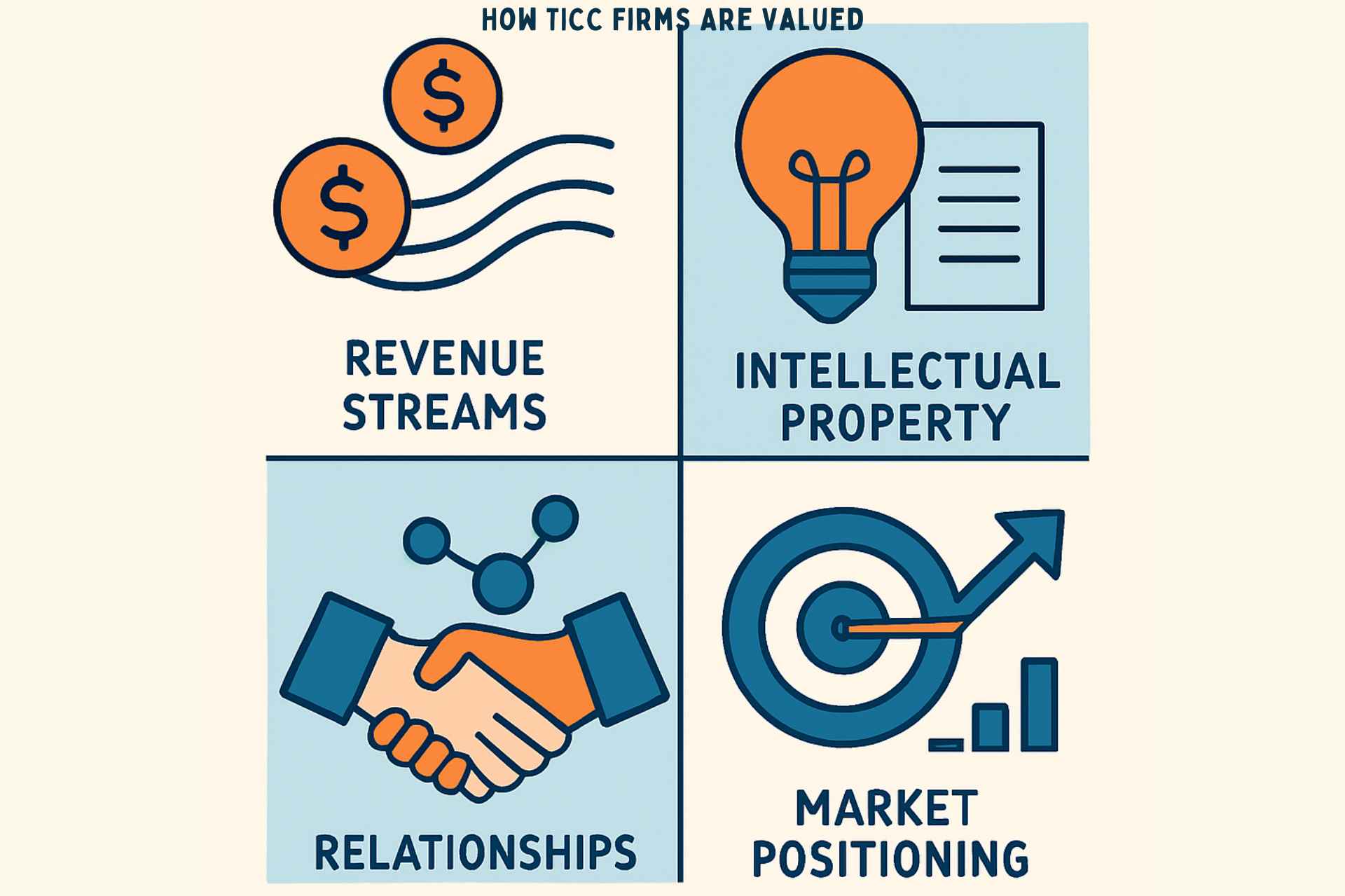
In the California market, investors and strategic buyers value TICC businesses primarily through a multiple of Earnings Before Interest, Taxes, Depreciation, and Amortization (EBITDA) or Seller’s Discretionary Earnings (SDE). However, the specific multiple varies significantly based on the firm’s niche—whether you specialize in environmental testing in the Central Valley, construction inspections in Los Angeles, or medical device certification in the Bay Area.
Andrew Rogerson, the founder of Rogerson Business Services, draws on his experience as a 5-time successful business owner and Certified Mergers & Acquisitions Professional to help owners navigate these complexities. He understands that a California TICC firm isn’t just a collection of equipment; it is a critical gatekeeper in the supply chain.
The Tale of Two Firms: A Valuation Standoff
To illustrate how valuation works in practice, consider two inspection firms operating in Northern California, both generating similar annual revenue:
- Firm A: This company maintains strong, recurring compliance contracts with a clear three-year backlog. Their documentation is meticulous, and no single client represents more than 10% of their revenue.
- Firm B: This company relies on project-heavy revenue. While they win large contracts, their documentation remains disorganized, and their workflow lacks visibility.
When these firms went to market, Firm A received multiple competitive offers at the higher end of industry multiples. Firm B struggled to find a buyer willing to take on the perceived risk. If you’re planning to sell, start with selling a TICC business in California to ensure you don’t end up like Firm B.
Typical Valuation Multiples in the TICC Sector
While every deal is unique, the following table represents a general benchmark for TICC firms in the current California landscape:
| Business Size (EBITDA) | Typical Multiple Range | Primary Value Drivers |
| Micro ($500k – $1M) | 3.0x – 4.5x | Owner involvement, local reputation, SDE. |
| Lower Mid-Market ($1M – $5M) | 5.0x – 7.5x | Recurring revenue, technical team depth and ISO certifications. |
| Upper Mid-Market ($5M+ ) | 8.0x – 12.0x+ | Scalability, multi-state presence, proprietary technology. |
Takeaway: Buyers pay a premium for “sticky” revenue. If your TICC firm provides mandatory compliance testing required by California law, your valuation naturally tends to be higher because your services are a non-discretionary expense for your clients.
Key Value Drivers
In the California TICC sector, buyers do not simply purchase your past earnings; they invest in the reliability of your future cash flow. Several specific drivers determine whether your firm commands a top-tier multiple or settles for a market-average offer.
As a Mergers & Acquisition Master Intermediary, Andrew Rogerson emphasizes that many improvements happen when you prepare your TICC business before going to market. By focusing on the following drivers, you solidify your firm’s position as a premium acquisition target.
1. Recurring Compliance Revenue
In California, stringent regulatory frameworks—such as those managed by the California Air Resources Board (CARB) or OSHA—mandate regular inspections. Buyers prize firms that hold long-term contracts for mandatory testing because these agreements guarantee revenue regardless of economic fluctuations. Consequently, a high percentage of recurring revenue significantly de-risks the investment for a buyer.
2. Accreditation Stability (ISO, ANSI, NIST)
Your certifications act as the “moat” around your business. Maintaining pristine standing with organizations such as the International Organization for Standardization (ISO) and the American National Standards Institute (ANSI) is non-negotiable. Furthermore, ensure that these accreditations belong to the entity itself rather than a single departing employee. If a certification walks out the door with a technician, your valuation will plummet.
3. Backlog Visibility and Work-in-Progress (WIP)
A healthy, documented backlog proves that your firm has a “runway.” Sophisticated buyers analyze your WIP reports to understand your capacity and future earnings. Clear visibility into upcoming projects suggests operational maturity and market demand, which directly translates into a higher enterprise value.
4. Customer Diversification
Relying on one or two major “whale” clients creates significant concentration risk. In California’s competitive landscape, savvy buyers prefer a broad client base where no single customer accounts for more than 10-15% of total revenue. If you lose a client, your business should remain stable; if losing one client collapses your margins, buyers will demand a steep discount.
5. Depth of the Technical Team
California’s labor market is notoriously tight, particularly for specialized engineers and certified inspectors. A business that operates independently of the owner—supported by a tiered management structure and a highly skilled technical team—is far more valuable. Buyers look for “institutional knowledge” that stays with the company post-sale.
California Regulatory Highlight
Expert Note: California often leads the nation in environmental and safety mandates. Firms that specialize in Title 24 energy inspections or wildfire mitigation certifications currently see increased interest due to state-specific legislative tailwinds. Staying ahead of NIST standards and California-specific codes ensures your firm remains relevant and valuable.
Risk Factors That Lower Valuation
While strong drivers push multiples upward, certain “red flags” drag your business’s market value down. Buyers in the California TICC space perform rigorous due diligence; consequently, they look for reasons to justify a lower offer or walk away from the deal entirely.
Andrew Rogerson, an expert with a Mergers & Acquisition Master Intermediary designation, identifies several common pitfalls that erode value during the appraisal process. If you want to maximize your sale price, you must align your valuation with your exit strategy well before hitting the market.
1. Accreditation and Talent Concentration
Many TICC firms fail because their technical certifications or key client relationships rest solely with the owner or a single “star” employee. If a business cannot operate without a specific individual’s license, a buyer views the acquisition as a high-risk gamble. In California, where the talent market remains fiercely competitive, this “key person risk” creates a significant valuation discount.
2. High Reliance on Project-Based Revenue
If your revenue mirrors a roller coaster, your valuation will likely follow suit. “Lumpy” income from one-off projects makes financial forecasting difficult. Buyers prefer the predictability of multi-year inspection contracts. Unless you can prove a consistent win rate for new projects, investors will penalize your firm for its lack of stability.
3. Regulatory and Legal Vulnerabilities
California operates under some of the nation’s strictest environmental and safety laws. Any history of non-compliance with Cal/OSHA or California Department of Public Health (CDPH) regulations acts as a “poison pill.” Even a single pending lawsuit or a lapsed accreditation can stall a transaction.
4. Poor Financial and Technical Documentation
Buyers demand “clean” books. If your firm mixes personal expenses with business operations or lacks a digital trail for inspection reports, you lose leverage. Weak documentation forces buyers to assume the worst-case scenario, leading to lower multiples and more aggressive “earn-out” structures.
Comparison: High-Value vs. Low-Value TICC Firms
| Feature | High-Value Firm (Premium Multiples) | Low-Value Firm (Discounted Offers) |
| Revenue Stream | 80%+ recurring compliance contracts. | 80% one-off project bids. |
| Certifications | Held by the entity/multiple staff. | Held only by the owner. |
| Geography | Scaled across CA (e.g., LA, SF, SD). | Limited to a single town or niche. |
| Systems | Cloud-based, automated reporting. | Paper-based or manual workflows. |
🛑 Critical Warning: The “California Penalty”
California businesses often face higher overhead costs due to labor laws and taxes. If your profit margins fall below the national industry average for TICC firms (typically 15-25%), buyers will scrutinize your operational efficiency. Work with a Certified Business Broker to audit your margins before beginning the sale process.
Resources for Risk Mitigation
- Safety Standards: Review Cal/OSHA Enforcement to ensure your team meets all state mandates.
- Accreditation Check: Verify your standing with the IAS (International Accreditation Service).
How to Increase Your Valuation
To command a premium multiple in the California TICC market, you must transform your business from a “job” into a “scalable asset.” Buyers pay for certainty, so your goal is to remove friction and prove that your firm thrives without your daily intervention.
Andrew Rogerson, drawing on his experience as a 5-time business owner and Mergers & Acquisition Master Intermediary, advises owners to focus on these high-impact areas at least 12 to 24 months before a sale.
1. Shift Toward Recurring Revenue
Actively transition your sales strategy away from “one-and-done” projects. Instead, pursue multi-year service agreements for mandatory inspections. If your firm provides environmental testing for California refineries or fire safety inspections for Bay Area high-rises, lock those clients into three-year rolling contracts. A predictable revenue stream directly correlates to a higher EBITDA multiple.
2. Institutionalize Quality Management
Move your accreditations from individuals to the company entity. If you haven’t already, pursue ISO 9001 or ISO/IEC 17025 certification. These global standards signal to a buyer that your firm follows a rigorous, repeatable process that produces reliable data. Furthermore, digitize your field reporting. A cloud-based system that generates instant, compliant reports for clients creates immense operational value.
3. Strengthen the Middle Management Layer
If every technical question requires your input, your business carries a high risk. Hire or promote a Technical Director or a Lead Inspector to oversee daily operations. When you show a buyer that your team manages the Cal/OSHA compliance and client relationships independently, you justify a significantly higher price point.
4. Normalize Your Financials
Work with a specialist to “recast” your earnings. This process involves adding back one-time expenses, excess owner compensation, or non-business-related costs. In California, where the cost of living and taxes are high, proper financial recasting ensures you receive credit for the true profit your business generates.
The “Premium Valuation” Checklist
- [ ] Accreditation: All licenses and certifications are in the company name.
- [ ] Contracts: At least 60% of revenue comes from recurring compliance work.
- [ ] Software: A centralized ERP or CRM tracks all inspections and billing.
- [ ] Facilities: Lease agreements for labs or offices are transferable and long-term.
- [ ] Talent: Key technicians have signed non-compete and non-solicitation agreements.
Get a Valuation
Valuing a TICC firm in the Golden State requires more than just a calculator; it requires a deep understanding of California’s unique regulatory landscape and the current appetite of private equity buyers. You need a partner who understands the nuances of the “Testing, Inspection, and Certification” industry.
Andrew Rogerson is a Certified Business Broker, Certified Mergers & Acquisition Professional, and one of the few individuals to hold the Mergers & Acquisition Master Intermediary designation. His authored books and decades of experience in California business brokerage provide the ethical, expert guidance you need to secure your legacy.
Don’t leave your hard-earned equity to chance. Before you move forward, ensure your valuation aligns with your exit strategy to maximize your results.
👉 Request a Customized Valuation Today
Resources for Owners:
- Market Trends: Stay updated on TICC acquisitions through TIC Council Global.
- CA Business Laws: Review recent updates at the California Secretary of State.