
Discover the process of valuing a metal fabrication business in California. Understand key factors, calculation methods, and how to maximize your business’s worth.
Thinking about selling your metal fabrication business in California?
It’s a big step, and knowing it’s worth it is the first part. This guide breaks down what goes into valuing your business, from industry trends to your equipment. We’ll help you understand the numbers and what buyers are looking for, so you can secure the best possible price. It’s not just about what you make, but how you run things and what you own.
See a sample business valuation report.
Send a free inquiry – chat with an expert.
Table of Contents
- Key Takeaways
- Understanding Metal Fabrication Business Valuation in California
- Calculating the Value of Your Metal Fabrication Business
- Maximizing Your Metal Fabrication Business’s Worth
- Critical Considerations for Equipment Valuation
- Avoiding Common Valuation Pitfalls
- Ensuring a Smooth Business Transition
- The Role of Professional Expertise
- Wrapping Up Your Metal Fabrication Business Valuation
- Frequently Asked Questions
Key Takeaways
- Understanding the specific factors that affect the valuation of the metal fabrication business in California, including industry trends and local market multiples, is crucial for an accurate assessment.
- Standard valuation methods, such as Adjusted EBITDA and the market approach, are employed; however, financial performance data must be carefully reviewed and adjusted to accurately reflect true profitability.
- Maximizing your business’s value involves building a strong reputation, diversifying your client base to reduce reliance on a single customer, and investing in modern, efficient equipment.
- Accurately valuing equipment requires considering its condition and age and using appropriate methods, such as asset-based or market approaches, as these significantly impact the overall business value.
- Avoiding common valuation pitfalls, such as relying solely on revenue multiples or overlooking the importance of standardized procedures and client relationship management, is vital for a successful sale.
Prefer to watch a video? Hit play and watch below!
Understanding Metal Fabrication Business Valuation in California
Figuring out what your metal fabrication business in California is worth isn’t just about looking at the numbers on a spreadsheet. It’s a mix of financial performance, market conditions, and how well your shop is set up for the future.
For owners considering the sale of a metal fabrication company in CA, getting a handle on this valuation process early on is crucial. It helps you understand what buyers are looking for and where you might need to make improvements.
Key Factors Influencing Valuation
Several factors significantly impact the value of a metalworking business sale in California. Your financial history is a big one, of course. But so is your reputation in the industry. A long track record of consistent service and quality work often makes a business more attractive. Think about it: buyers want stability. They’re looking at how long you’ve been around, the quality of your client base, and how much of your business relies on just a few big accounts. Diversifying your client concentration is a smart move to reduce risk and boost appeal.
The Importance of Industry Trends
Where does the metal fabrication industry stand right now, especially in California? Knowing this helps set expectations. While the overall manufacturing sector can see ups and downs, metal fabrication remains a backbone for many other industries. Keeping an eye on trends, such as demand for specific types of fabrication or shifts in technology, can impact your business’s prospects and, consequently, its current valuation. Understanding how your shop fits into the broader economic picture is vital for a realistic California metal shop appraisal.
California Market Multiples for Fabricated Metal Businesses
When pricing things, founders and entrepreneurs often use multiples. These are basically ratios that compare a business’s financial performance to its market value.
For fabricated metal businesses, these multiples can vary based on several factors, including your niche, profitability, and the overall economic climate in California. You’ll find different metal fabrication services in California, depending on the source and the specific type of business. It’s not a one-size-fits-all situation.
For instance, a business focused on high-volume, low-margin work might have different multiples than one specializing in custom, high-precision parts. Getting a handle on these can be complex, which is why many manufacturers in California seek out business valuation services.
A common mistake is relying too heavily on just revenue when valuing a business. Profitability, customer relationships, and operational efficiency are just as, if not more, important. Ignoring these aspects can lead to an inaccurate valuation and potentially a lower sale price than your business is truly worth.
See a sample business valuation report.
Send a free inquiry – chat with an expert.
Here’s a general idea of how multiples might look across different manufacturing sectors, though specific metal fabrication multiples in California will vary:
| Industry Sector | Typical Cash Flow Multiple | Typical Sales/Revenue Multiple |
|---|---|---|
| Metal Products | 2.78 | 0.75 |
| Industrial Machinery | 2.32 | 0.50 |
| Chemical Products | 3.17 | 1.19 |
Remember, these are just general figures. A detailed analysis is needed for an accurate business valuation for metal fabricators. If you’re considering selling a metal fabrication company in CA, understanding these market dynamics is a crucial first step.
It’s often wise to consult with metal manufacturing business brokers in CA who have a deep understanding of these local market nuances. They can help you navigate the complexities of how to value a manufacturing business in California and prepare for a successful metalworking business sale in California. This process often involves thorough due diligence, a critical step when buying a business.
Calculating the Value of Your Metal Fabrication Business
Figuring out what your metal fabrication business is actually worth involves more than just looking at the money coming in. It’s about understanding the whole picture. When valuing a manufacturing business, several valuation methods come into play, each offering a different perspective on your company’s financial health and future potential.
Common Valuation Methods for Manufacturers
Several approaches can be used to determine the value of a manufacturing business. Each method has its strengths and weaknesses, and often, a combination is used to provide a more comprehensive picture. For metal fabricators in California, understanding these methods is key to knowing what buyers will focus on.
- Income Approach: This looks at the business’s ability to generate income. Methods like Discounted Cash Flow (DCF) project future earnings and discount them back to present value. This method is suitable for businesses with predictable cash flows.
- Market Approach: This compares your business to similar companies that have recently been sold. Finding truly comparable metal fabrication businesses in California can be challenging, but it provides a good reality check.
- Asset-Based Approach: This method values a business based on its net asset value – essentially, the value of its assets minus its liabilities. This is often a baseline valuation, particularly for businesses with substantial tangible assets, such as machinery.
Leveraging Financial Performance Data
Your financial statements are the backbone of any valuation. Buyers will scrutinize your income statements, balance sheets, and cash flow statements to understand your historical performance and profitability. Clean, well-organized financial records are non-negotiable. They show a well-managed operation and build buyer confidence. A consistent track record of revenue and profit growth is always a plus.
Accurate financial reporting is not just good practice; it’s a direct driver of your business’s perceived value. Buyers want to see a clear, verifiable history of financial success.
See a sample business valuation report.
Send a free inquiry – chat with an expert.
The Role of Adjusted EBITDA
Earnings Before Interest, Taxes, Depreciation, and Amortization (EBITDA) is a widely used metric in business valuations. However, for a more accurate picture, especially in manufacturing, you’ll often see Adjusted EBITDA. This involves normalizing earnings by adjusting for non-recurring or non-operational items.
For example, unusual one-time repair costs or owner perks not directly related to running the business might be adjusted out. This gives a clearer view of the ongoing operational profitability. Many valuations will use a multiple of this Adjusted EBITDA to determine a business’s value. For instance, multiples for fabricated metal businesses can vary, but understanding where your business fits requires a detailed look at its specific performance and market position.
You can find general industry multiples, but your specific business’s strengths and weaknesses will ultimately influence the final number. For more information on how cash flows are assessed, consider examining operating cash flows.
Here’s a general idea of multiples, though actual figures vary widely:
| Industry Sector | Typical EBITDA Multiple Range | Typical Revenue Multiple Range |
|---|---|---|
| Fabricated Metal Products | 4.0x – 6.0x | 0.7x – 1.2x |
| Industrial Machinery | 3.5x – 5.5x | 0.5x – 1.0x |
Note: These are illustrative ranges, and actual multiples depend heavily on specific business factors.
Maximizing Your Metal Fabrication Business’s Worth

To get the best possible price for your metal fabrication business, focus on a few key areas. Buyers look for stability and growth potential, so strengthening these aspects before you sell can make a big difference. It’s about making your company more attractive and less risky for potential acquirers.
Enhancing Business Reputation and Longevity
In the metal fabrication industry in Los Angeles County, California, a long history of business often translates into greater value. Established companies demonstrate a track record of reliability and customer satisfaction. Buyers are particularly interested in businesses that have weathered market changes and maintained a steady presence. Building a solid reputation over many years demonstrates resilience and a stable customer base, both significant assets. Consider how long your business has been operating; longevity can be a strong selling point.
- Demonstrate consistent quality and service.
- Build strong relationships with suppliers and clients.
- Maintain a positive public image.
Strategies for Diversifying Client Concentration
Concentrating too much revenue with a few clients can be a red flag for buyers. A significant portion of your business comes from a single customer, which introduces risk; if that client were to leave, your revenue stream would be severely impacted. It’s wise to actively expand your client base.
Regularly analyzing your revenue sources and actively seeking new, smaller clients can help build a more balanced, secure business model. This diversification reduces buyers’ perceived risk, making your business a more appealing investment. A balanced client portfolio is key to a smoother business transition.
Investing in Modern and Efficient Equipment
Your equipment is the backbone of your metal fabrication operation. Keeping your machinery up to date is not just about efficiency; it also directly impacts your business’s valuation. Modern, well-maintained equipment can lead to increased productivity, improved quality output, and reduced operating costs.
Buyers see updated machinery as a sign of a forward-thinking company and a reduced need for immediate capital expenditure on their part. Regularly servicing and, where possible, upgrading your equipment demonstrates a commitment to operational excellence and can significantly boost your business’s appeal.
Buyers often assess the condition and modernity of your equipment as a direct reflection of your management practices and the business’s future earning potential. Investing in newer technology can pay dividends when it comes time to sell.
See a sample business valuation report.
Send a free inquiry – chat with an expert.
Critical Considerations for Equipment Valuation

When it comes to valuing your metal fabrication business in California, don’t overlook the machinery and equipment appraisal. This isn’t just about counting machines; it’s about understanding their contribution to your bottom line and their appeal to potential buyers. The condition, age, and technological relevance of your equipment can significantly impact your business’s overall worth.
Approaches to Valuing Manufacturing Equipment
There are several ways to assign a value to your manufacturing equipment. Each method offers a different perspective:
- Asset-Based Approach: This method assesses the current market value of your tangible assets, such as machinery and tools. It’s particularly beneficial if your business has substantial physical assets. We’d identify all your equipment, determine its current market value, and then subtract any outstanding debts tied to it.
- Market Approach: Here, we compare your equipment to similar items that have been sold recently in the market. This gives us a sense of what buyers are willing to pay for comparable machinery.
- Income Approach: This approach considers the amount of revenue your equipment is expected to generate in the future. It’s more complex, often involving methods such as capitalization of earnings or discounted cash flow, and is best suited for equipment that directly generates consistent profits.
Need an equipment appraisal? Go to the equipment appraisal page for detailed information.
Call Andrew Rogerson, Rogerson Business Services – California’s top business brokers for manufacturing businesses, toll-free (844) 414-9700 | Leave a message – I’ll call you right back
The Impact of Equipment Condition and Age
Think about your own car. An older car in great shape is worth more than a newer one that’s been neglected, right? The same applies to your fabrication equipment. Regular maintenance, proper upkeep, and a history of timely repairs mean your machines are likely in better condition.
This translates into lower, more immediate capital expenditure for a buyer, making your business more attractive. Conversely, outdated or poorly maintained equipment can signal future problems and costs, potentially lowering your valuation. We need to assess how well the equipment functions and whether it remains competitive.
Asset-Based vs. Market Approaches
Choosing between an asset-based and a market approach often depends on the specific equipment and the overall business context. The asset-based method provides a floor value based on the equipment’s physical value. It’s a straightforward way to account for your machinery.
The market approach, however, attempts to gauge what someone would actually pay for that equipment in the current market, taking into account demand and availability. For specialized fabrication machinery, finding direct market comparables can sometimes be challenging. In such cases, a detailed asset appraisal, perhaps using methods outlined by professional appraisal organizations, becomes more critical.
Understanding the actual value of your assets is key to a solid business valuation.
When valuing equipment, it’s not just about its purchase price. We need to consider its current market value, its operational efficiency, and its remaining useful life. Any upgrades or significant repairs should also be factored in, as they can increase its perceived worth and functionality for a potential buyer.
Call Andrew Rogerson, Rogerson Business Services, toll-free (844) 414-9700 | Leave a message – I’ll call you right back
Avoiding Common Valuation Pitfalls
When it comes to valuing your metal fabrication business in California, it’s easy to stumble into common mistakes that can significantly misrepresent your company’s worth. Being aware of these pitfalls is the first step toward a more accurate and beneficial valuation.
Why Simple Revenue Multiples Are Insufficient
Many owners initially think a simple multiple of revenue will tell them what their business is worth. However, this approach is often too basic for a manufacturing operation. It doesn’t account for the cost of goods sold, operational expenses, or profit margins, all of which are critical in fabrication. Relying solely on revenue can lead to an inflated or deflated valuation, setting unrealistic expectations.
A more detailed look at profitability is necessary. For instance, comparing your business to others in the metal products industry might show:
| Industry | Cash Flow Multiple | Sales/Revenue Multiple |
|---|---|---|
| Metal Products | 2.78 | 0.75 |
| Industrial Machinery | 2.32 | 0.50 |
This shows that revenue multiples are generally lower than cash flow multiples, highlighting the importance of profitability.
The Danger of Over-Reliance on Single Customers
Having a few large clients can provide a sense of security, but it also poses a significant valuation risk. Buyers see a heavy dependence on one or two customers as a significant vulnerability. If that customer leaves, the business’s revenue stream could disappear overnight. A diversified customer base demonstrates stability and reduces perceived risk, thus increasing your business’s attractiveness and valuation. Consider the duration of key client relationships and the contracts that support them.
The Importance of Standard Operating Procedures
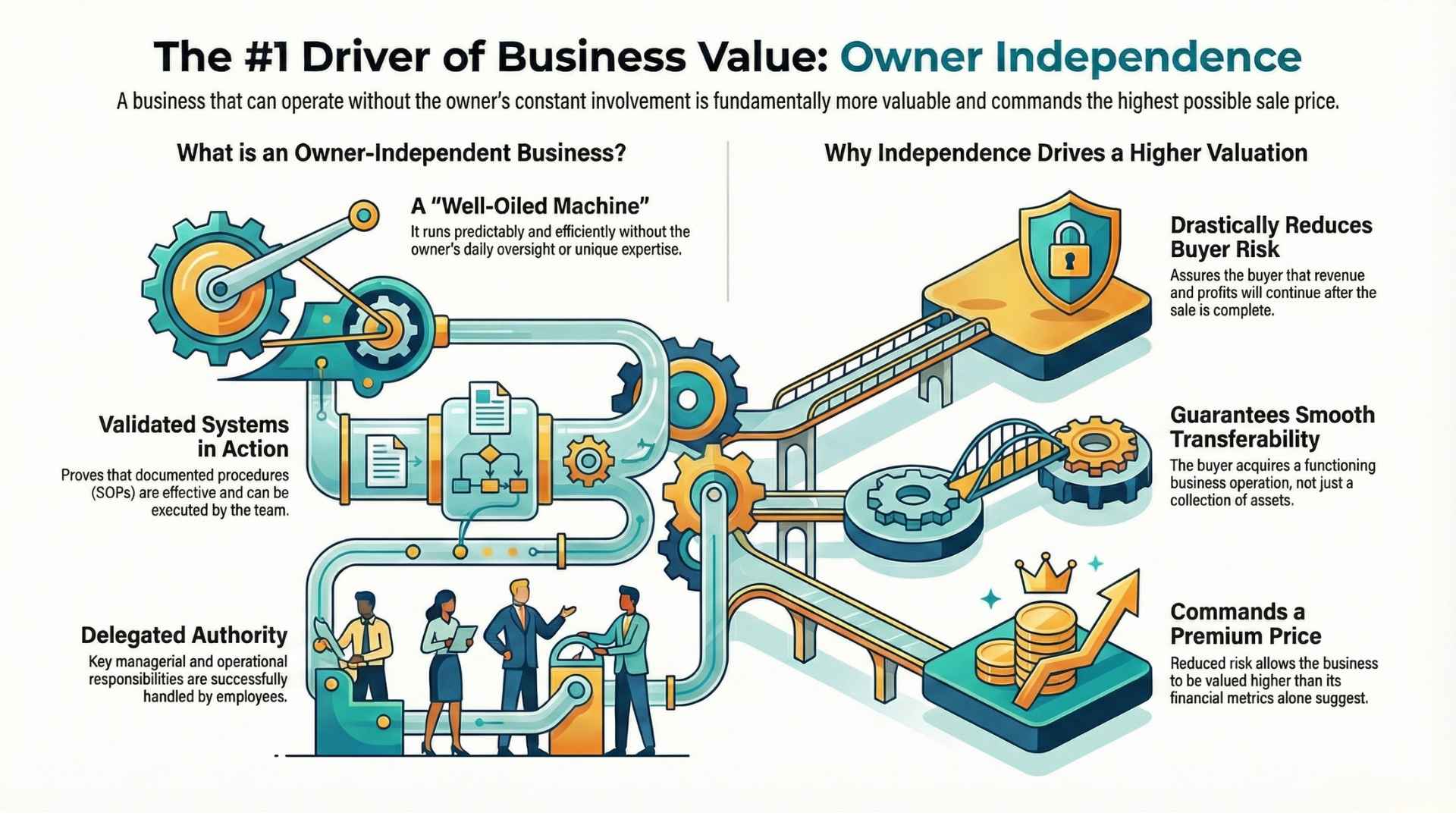
Buyers aren’t just purchasing assets; they’re buying a functioning business. Without clear, documented Standard Operating Procedures (SOPs), a business can appear chaotic and challenging to manage. This lack of structure can make a buyer hesitant, as they fear they will have to spend considerable time and resources organizing their operations.
Well-defined SOPs for everything, from production to quality control, signal efficiency, and a well-run operation, which translates to higher value. This also helps in selling a business in California smoothly.
A business that runs predictably, even without the owner’s constant presence, is far more valuable. Documenting processes ensures consistency and reduces the buyer’s perceived risk, making them more willing to pay a premium.
Call Andrew Rogerson, Rogerson Business Services, toll-free (844) 414-9700 | Leave a message – I’ll call you right back
Ensuring a Smooth Business Transition

When it comes time to sell your metal fabrication business, preparing it for acquisition is your first step. A buyer will want to see that the company can keep running smoothly after you step away. This means showing them that operations won’t fall apart just because the owner is gone. Making the transition easy for a new owner is a significant selling point.
Delegating Owner Responsibilities
As the owner, your role should be about managing the business, not getting bogged down in day-to-day tasks. Start handing off responsibilities to your key managers now. This demonstrates to buyers that your business is well-organized and can operate independently. It helps them see themselves stepping into a well-oiled machine, not a project that needs complete rebuilding. Consider which tasks you can delegate so you can focus on higher-level strategy rather than shop-floor details.
Structuring Departments for Buyer Confidence
Buyers look for businesses with solid internal structures. Each department should be able to operate effectively without your constant input. This demonstrates stability and reduces the buyer’s perceived risk. A well-organized structure signals that the business is a sound investment and has a good chance of continued success.
Transferring Client Relationships Effectively
In metal fabrication, client relationships are often built over years. If you’re the primary point of contact for your key clients, you need to transfer those relationships to your sales team before you make a sale. Buyers worry that clients are loyal to you personally, not the company. By having your sales staff manage these relationships, you reduce that concern.
This makes the transition smoother and reassures buyers that your customer base will remain intact. It’s about showing that the business has value beyond just the owner’s personal connections. A strong client base is a significant draw for potential buyers, especially those seeking to expand their presence in the California market. Learn how Rogerson Business Services sold a $36 million manufacturing business in the Bay Area.
- Analyze customer balances regularly.
- Identify and address high revenue concentration from single clients.
- Train sales staff to manage and nurture client relationships.
- Document all client communication protocols.
Buyers are often concerned about losing key clients after a sale. Proactively managing client relationships and demonstrating their loyalty to the business, not just the owner, is vital. This involves empowering your sales team and ensuring they have the skills and trust to maintain these connections post-acquisition.
Call Andrew Rogerson, Rogerson Business Services, toll-free (844) 414-9700 | Leave a message – I’ll call you right back
The Role of Professional Expertise
When to Seek Expert Valuation Services
Determining the value of your metal fabrication business is crucial, especially if you’re considering selling, bringing on partners, or securing financing. While you know your business inside and out, an objective, third-party valuation is often necessary. This is particularly true when dealing with complex assets or unique market positions.
Engaging a professional valuation expert early can prevent costly mistakes down the road. For instance, if you’re considering a sale, a professional appraisal provides a solid foundation for negotiations and helps you understand the market value of your operations. It’s not just about a number; it’s about understanding the drivers behind that number.
Benefits of a Professional Business Appraisal
A professional appraisal offers more than just a valuation figure. It provides a detailed report that outlines the methodologies used, analyzes your financial performance, and considers industry-specific factors relevant to metal fabrication in California.
This thorough analysis can highlight areas of strength you might not have fully appreciated and identify potential weaknesses that could affect value. It also helps in understanding how your business compares to industry benchmarks. A well-documented appraisal can also be invaluable for tax purposes, estate planning, or even for internal strategic planning.
Choosing a Qualified Valuation Professional
Selecting the right valuation professional is key. Look for individuals or firms with specific experience in valuing manufacturing businesses, particularly in the metal fabrication sector. Certifications, such as Certified Business Appraiser (CVA) or accreditations from recognized appraisal organizations, indicate a level of training and adherence to professional standards. Consider their experience with businesses of similar size and complexity to yours. A good professional will be transparent about their process, fees, and timeline. They should also be able to clearly explain their findings, helping you understand the valuation and its implications for your business goals.
- Experience in manufacturing valuations
- Relevant professional certifications
- Clear communication and reporting
- Understanding of the California market
A professional valuation isn’t just a report; it’s a strategic tool. It provides clarity on your business’s current worth and can guide future decisions, whether that involves growth, acquisition, or exit planning. It’s about getting an accurate picture to make informed choices.
Andrew Rogerson is a Certified Business Broker and the founder of Rogerson Business Services, a leading California business brokerage service in Sacramento, CA. Andrew helps business owners in California value and then sell their businesses. If you are a business owner with a business that generates Gross Revenue between $2 million and $100 million, and are ready to sell within 6 to 12 months, call me toll-free at (844) 414-9700 | Leave a message – I‘ll call you right back or send him a message – contact us.
When you need to understand your business’s actual worth, having skilled professionals guide you is key. They bring a deep understanding and experience that can make all the difference. Don’t guess about your business’s value; get expert insights.
Wrapping Up Your Metal Fabrication Business Valuation
So, you’ve looked into what it takes to figure out what your metal fabrication business in California is really worth. It’s not just about counting machines or looking at last month’s sales numbers. You need to consider how long you’ve been in business, who your customers are, and whether your equipment is up to date.
Avoiding common mistakes, such as using a simple revenue calculation, is also a significant part of securing a fair price. The manufacturing world, including metal fabrication, appears promising for the future, and buyers are definitely interested.
Obtaining a professional valuation is the best way to determine your business’s actual value and be prepared when you decide to sell or make other significant moves. It’s about being prepared and making wise choices for your business’s next chapter.
Frequently Asked Questions
What makes a metal fabrication business valuable in California?
Several things make a metal fabrication business valuable. The longer the business has been around and the better its reputation, the more buyers will like it. Additionally, having a diverse customer base rather than relying on just a few large ones is crucial. Having modern, well-kept machines and a solid plan for how the business runs also helps a lot.
How do you figure out the worth of a metal fabrication business?
You can determine the worth by examining the business’s revenue and its earnings after deducting expenses. Experts often use something called ‘Adjusted EBITDA’ to measure a business’s earning power. They also look at what similar businesses have sold for. It’s not just about how much money comes in, but also how much profit is left over.
Why is it bad to rely too much on just one or two customers?
Relying too heavily on a few customers is risky because if one of them leaves, it can significantly harm the business. Buyers worry about this. They prefer businesses with a diverse customer base, so they don’t depend too heavily on any single sale. This makes the business more stable and reliable.
Does the equipment a metal fabrication business owns affect its value?
Yes, absolutely. The machines and tools a business uses are a big part of its value. If the equipment is new, works well, and is up to date, it makes the business more efficient and attractive to buyers. Older or poorly maintained equipment can lower the business’s worth.
What are common mistakes people make when valuing their business?
A common mistake is focusing solely on the total money a business brings in (revenue) without paying enough attention to the profit. Another mistake is failing to consider the importance of loyal customers or the effectiveness of the business’s organization. Using a basic formula without accounting for all the details can lead to a flawed understanding of the business’s actual value.
When should I get a professional to help value my business?
It’s a good idea to get professional help when considering selling your business, applying for a loan, or determining its true worth for planning purposes. Professionals know the right ways to value a business, understand market trends, and can give you a more accurate number than you might figure out on your own. They help make sure you get a fair price.