
Explore exit strategy options for metal manufacturing business owners in California. Learn about succession planning and prepare your metal fabrication business for a smooth transition.
Thinking about selling your metal manufacturing business? It’s a big step, and honestly, most owners don’t start planning early enough. You’ve put in the work, built something significant, and now it’s time to figure out how to move on.
Whether you want to pass it down to family, sell it to employees, or find an outside buyer, having a clear exit strategy for a metal manufacturing business is crucial. This isn’t just about getting the best price; it’s about ensuring a smooth transition that works for you and the future of the company you built.
Is your business currently operating at the top of its game? Send a free inquiry today!
Call Andrew Rogerson, Rogerson Business Services – California’s top business brokers for manufacturing businesses, toll-free (844) 414-9700 | Leave a message – I’ll call you right back
Table of Contents
- Key Takeaways
- Understanding Your Exit Strategy Options
- Exploring External Sale Opportunities
- Internal Succession and Ownership Transfers
- Preparing Your Business for Sale
- Considering Alternative Exit Routes
- Navigating the Sale Process
- Wrapping Up Your Exit Plan
- Frequently Asked Questions
Key Takeaways
- Planning your exit strategy for a metal manufacturing business well in advance is vital for maximizing value and controlling the transition process.
- External sale to strategic buyers or private equity firms are common, each offering different benefits and requiring distinct preparations.
- Internal succession, such as family transfers or management buyouts, can preserve a legacy but often presents unique financing and management challenges.
- Preparing your business for sale involves improving operations, strengthening financials, and addressing any growth limitations to make it more attractive to buyers.
- Exploring alternative routes, such as IPOs or mergers, and understanding the roles of advisors and the associated tax implications, are crucial aspects of the exit process.
Prefer to watch a video? Hit play and watch below!
Understanding Your Exit Strategy Options
Considering how to exit your metal manufacturing business is a significant decision. It’s not just about selling; it’s about planning for your future and the future of what you’ve built. For business owners here in California, understanding your options is the first step toward a successful transition. The most successful transitions are rarely spontaneous; they result from deliberate, long-term planning.
Evaluating Potential Transition Paths
There are several ways to move on from your factory business. Each path has its own set of considerations. You might consider passing the business to family members, selling to your employees, or finding an outside buyer. Each option requires a different approach and timeline.
- Family Succession: This often involves a gradual handover, giving the next generation time to learn the ropes and earn respect. It’s more than just changing ownership; it’s about transferring knowledge and leadership.
- Management Buyouts (MBOs) & Employee Transitions: Selling to your team can ensure continuity. This typically occurs over time, enabling managers to transition from operators to owners and secure financing.
- Strategic Acquisitions: Selling to a competitor, supplier, or customer can be a strong option. Competitors may want to expand their market share, suppliers may seek to control their supply chain, and customers may aim to secure their own supply.
The Importance of Advance Planning
Many owners become so caught up in daily operations that they put off exit planning. However, waiting too long can limit your choices and reduce the value you can get. Planning gives you control over the process and helps you achieve your personal and financial goals. It’s about ensuring the transition occurs on your terms, not under pressure.
Planning for life after the business is just as important as planning the sale itself. Consider your personal financial needs, lifestyle, and even the psychological shift of no longer being the owner. Having a plan for what comes next can prevent a difficult adjustment period.
Is your business currently operating at the top of its game? Send a free inquiry today!
Call Andrew Rogerson, Rogerson Business Services, toll-free (844) 414-9700 | Leave a message – I’ll call you right back

Maximizing Business Value for Transition
To get the best outcome, you need to make your business as attractive as possible. This involves closely examining your operations, finances, and market position. Identifying and addressing weaknesses or bottlenecks early can significantly boost your company’s value. For those looking to sell a business in California, this preparation is key to a profitable exit.
Here are some areas to focus on:
- Operational Efficiency: Streamlining production processes and updating equipment can significantly improve efficiency.
- Financial Health: Consistent profitability and strong cash flow are always attractive to buyers.
- Market Position: Understanding your market and how your business fits in is vital. Addressing growth constraints, such as limited capacity or supply chain issues, will make your business more appealing.
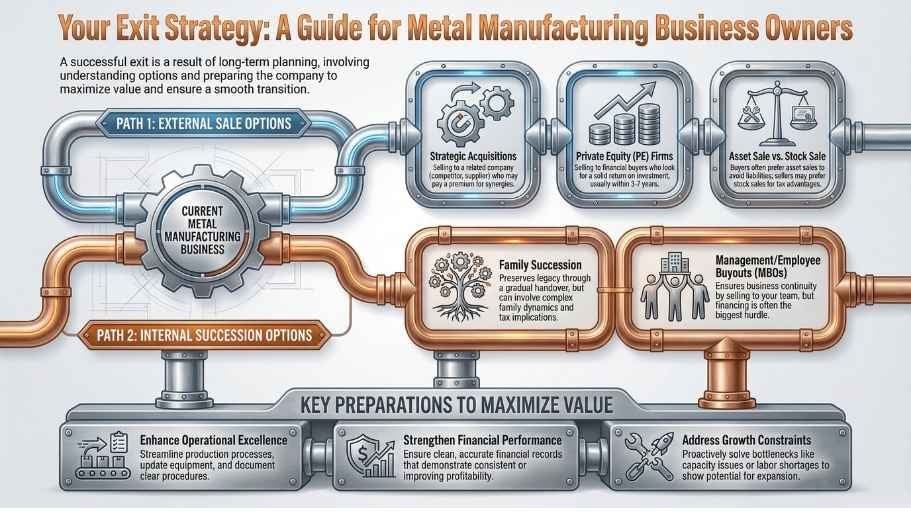
Considering your exit strategy for a metal manufacturing business now, even if a sale is years away, is a smart move. It allows you to shape your company’s future and your own retirement.
Exploring External Sale Opportunities

When considering an exit, selling your metal fabrication business to an outside party is a common path. This often involves either a strategic acquisition or involvement from a private equity firm. Each route has distinct advantages and requires a different approach to attract the right buyer.
Strategic Acquisitions and Their Benefits
A strategic acquisition involves selling to another company that is already operating in a related industry. Consider a larger metal fabricator seeking to expand its capacity, increase market share, or acquire specific technologies. They might also be a supplier wanting to integrate backward or a customer looking to secure their supply chain.
These buyers often see value beyond your financials; they’re interested in your customer base, specialized equipment, and skilled workforce. A well-executed strategic acquisition can fetch a premium price because the buyer can realize significant synergies, meaning the combined entity is worth more than the sum of its parts. This is particularly relevant in the fragmented metal fabrication sector, where mergers and acquisitions are common for growth.
Private Equity Firm Involvement
Private equity (PE) firms seek various opportunities. They often focus on consolidation, buying multiple smaller companies in an industry and merging them into a larger, more efficient operation. PE firms can be attractive buyers because they typically have access to significant capital. However, their involvement often comes with strings attached.
You might be asked to retain a stake in the business and stay on for a period to manage operations during the transition. While they might offer a firm valuation, expect them to closely scrutinize your operational efficiency and growth potential. They’re looking for a solid return on their investment, usually within a 3-7 year timeframe.
Understanding Asset vs. Stock Sales
When you sell your business, you’ll generally do so in one of two ways: an asset sale or a stock sale. In an asset sale, the buyer purchases specific assets of your business – equipment, inventory, customer lists, etc. – rather than the entire legal entity. Buyers often prefer this as it allows them to avoid inheriting your company’s liabilities. For the seller, it can sometimes mean a less favorable tax outcome.
In a stock sale, the buyer acquires all of your company’s stock, effectively taking over the entire legal entity, including all its assets and liabilities. This can be simpler from a transfer perspective and may offer tax advantages for the seller, but it also means the buyer assumes all existing obligations. The choice between these two structures has significant financial and legal implications, so consulting with legal and tax advisors is vital.
The metal fabrication industry in California, like elsewhere, sees a lot of activity in mergers and acquisitions. Buyers are often looking for established operations with a solid reputation and a clear path for future growth. Preparing your business to be attractive to these external parties means focusing on operational consistency and financial clarity well before you start talking to potential buyers.
Is your business currently operating at the top of its game? Send a free inquiry today!
Call Andrew Rogerson, Rogerson Business Services, toll-free (844) 414-9700 | Leave a message – I’ll call you right back
Internal Succession and Ownership Transfers
When it comes time to step away from your metal fabrication business, you’ve got options beyond selling to an outside party. Considering an internal succession plan is a smart move, especially if you want to maintain your legacy or recognize the individuals who contributed to the company’s growth. This is where succession planning for manufacturers really comes into play.
Family Succession Planning
Many California metal businesses have deep roots, and passing the company to family members is a natural thought. It’s not just about handing over the keys, though. It requires a structured approach. You’ll want to identify a successor early, give them time to learn the ropes, from the shop floor to the front office, and build their own credibility with your team and clients.
This often means a gradual handover over several years, not an overnight switch. It can preserve family values and avoid the complexities of finding an external buyer, but it can also stir up family dynamics if not handled carefully. Tax implications are also a significant consideration here.
Management Buyouts and Employee Transitions
Another option is to sell to your existing management team or employees. This keeps the business in familiar hands, rewarding those who know your operations. A management buyout (MBO) typically involves a staged transfer of ownership, enabling managers to grow into their new roles and secure financing over time. T
his approach can lead to a smoother transition, as the new leaders already understand the business’s intricacies and relationships. However, negotiating the terms and arranging the financing can be challenging and might distract from daily operations for a while.
Financing Challenges in Internal Transfers
Regardless of whether you’re looking at a family member or a management team taking over, financing is often the biggest hurdle. Internal transfers, especially MBOs, frequently rely on debt to fund the purchase. This means the buyer needs to secure loans, which can be tough depending on their financial standing and the business’s current debt load.
Lenders will scrutinize the business’s financials and the buyer’s ability to repay the loan. Sometimes, the seller might need to offer seller financing, essentially acting as their own bank, to make the deal work. This requires trust and a clear repayment plan.
Planning for internal succession isn’t just about who takes over; it’s about ensuring the business remains strong and viable for years to come. It requires foresight, clear communication, and a solid financial strategy to make the transferring ownership metal business process successful for everyone involved.
Is your business currently operating at the top of its game? Send a free inquiry today!
Call Andrew Rogerson, Rogerson Business Services, toll-free (844) 414-9700 | Leave a message – I’ll call you right back
Preparing Your Business for Sale

Getting your metal fabrication company ready for a sale isn’t something you can do overnight. It takes time and a clear plan. Think of it like getting a complex machine ready for a significant overhaul – every part needs to be in top shape. For owners in California, where the market is highly competitive, this preparation is crucial to achieving the best outcome when selling a metal fabrication company.
Enhancing Operational Excellence
Buyers look for businesses that run like a well-oiled machine. This means streamlining your processes to ensure your equipment is up-to-date and well-maintained, and establishing clear, documented procedures for everything from order intake to final delivery. Reducing waste and improving efficiency directly impacts your bottom line and makes your business more attractive. Consider these areas:
- Quality Control: Implement robust checks at every stage to minimize defects and ensure customer satisfaction.
- Production Flow: Map out your workflow to identify and eliminate bottlenecks. This might involve reorganizing your shop floor or investing in new technology.
- Maintenance Schedules: Proactive maintenance prevents costly breakdowns and downtime, which can scare off potential buyers.
Strengthening Financial Performance
Clean, accurate financial records are non-negotiable. Buyers will scrutinize your financial records to assess your business’s financial health. This involves:
- Accurate Bookkeeping: Ensure your accounting is up to date and reflects the reality of your operations. This is vital for business valuation in the metal industry.
- Profitability Trends: Demonstrate consistent or improving profitability over the last three to five years. Buyers want to see a proven track record of success.
- Cost Management: Demonstrate a solid understanding of your expenses and effective operational efficiency.
Buyers are essentially purchasing future earnings. Therefore, presenting a clear, upward trend in revenue and profit, supported by solid documentation, significantly boosts your company’s appeal and potential selling price. This financial clarity is a cornerstone of successful business succession in the metal manufacturing sector.
Is your business currently operating at the top of its game? Send a free inquiry today!
Call Andrew Rogerson, Rogerson Business Services, toll-free (844) 414-9700 | Leave a message – I’ll call you right back
Addressing Growth Constraints and Bottlenecks
What’s holding your business back from growing even faster? Buyers want to see potential for future expansion. Identify any limitations, such as:
- Capacity Issues: Are you turning away business because you lack the necessary equipment or staff to handle it?
- Skilled Labor Shortages: Develop a plan to attract and retain skilled workers, as this is a common challenge in the metal industry.
- Market Reach: Explore opportunities to expand your customer base or geographic service area. This is a crucial aspect of planning a business sale in the metal industry.
Addressing these points proactively shows a buyer that you’ve thought about the future and have a vision for continued success, making the process of selling a metal fabrication company smoother and more profitable.
Considering Alternative Exit Routes

Beyond the typical sale or internal transfer, manufacturing business owners in California have a few other paths to consider when planning their exit. These routes may not be suitable for everyone, but they can offer unique advantages depending on your business’s specific situation and personal goals.
Initial Public Offerings (IPOs)
Going public through an Initial Public Offering (IPO) is a significant undertaking, usually reserved for larger, high-growth companies. It involves selling shares of your company to the public on a stock exchange. While it can generate substantial capital and provide liquidity for owners, it also entails significant regulatory scrutiny, ongoing reporting requirements, and pressure to meet public market expectations. For most metal fabrication businesses, this is a less common, though not impossible, route.
Liquidation as a Last Resort
Liquidation is generally considered the least desirable exit strategy. This involves selling off the company’s assets piecemeal to cover debts. It typically yields the lowest returns for owners and signals the end of the business’s operational life. This path is typically pursued only when other options have been exhausted or the business is no longer viable.
Mergers and Acquisitions Dynamics
While we touched on strategic acquisitions earlier, it’s worth noting the broader dynamics of mergers and acquisitions (M&A). A merger involves combining two companies into a new entity, often to achieve greater scale or market presence. Acquisitions, on the other hand, are when one company buys another. Understanding these dynamics is crucial, as your business may be a target for acquisition by a larger competitor, a supplier seeking to integrate vertically, or even a private equity firm looking to consolidate operations. Preparing your business to be an attractive M&A target involves demonstrating strong financials, a solid customer base, and clear growth potential. Working with experienced advisors, such as those at Rogerson Business Services in California, can help you navigate complex transactions and identify the best opportunities for your specific situation.
Navigating the Sale Process
Selling your metal fabrication business is a significant undertaking, often the largest financial transaction of your career. It’s not just about finding a buyer; it’s about managing the entire journey from initial discussions to closing the deal. This phase requires careful attention to detail and a clear understanding of the steps involved.
The Role of Business Brokers and M&A Advisors
Engaging professionals early on can make a substantial difference. Business brokers and mergers and acquisitions (M&A) advisors, such as Rogerson Business Services, based in Sacramento, serving California State, bring specialized knowledge to the table.
They help with critical tasks such as valuing your business, identifying suitable buyers, and structuring the deal terms. Their experience can help you avoid common pitfalls and maximize the sale price.
For many owners, especially those in California dealing with complex regulations, having an advisor who understands the local landscape is invaluable. They can guide you through the intricacies of California bulk sale and ensure compliance with relevant regulations.
Due Diligence and Documentation
Once a buyer expresses serious interest, the due diligence phase begins. This is where the buyer thoroughly examines your business’s financials, operations, legal standing, and customer contracts. Having your documentation organized and readily accessible is key. This includes:
- Clean financial statements (P&Ls, balance sheets, cash flow statements)
- Tax returns for the past 3-5 years
- Key customer and supplier contracts
- Employee records and organizational charts
- Equipment lists and maintenance records
- Permits and licenses
Transparency here fosters trust and can expedite the process. Any surprises uncovered during due diligence can derail a deal or lead to renegotiations.
Understanding Tax Implications
The way your business is sold can significantly impact the net proceeds you receive. Whether it’s an asset sale or a stock sale, each has different tax consequences. Consulting with a tax advisor and an M&A attorney before you even begin negotiations is highly recommended.
They can help you structure the transaction in the most tax-efficient way for your specific situation. Understanding these implications early allows you to set realistic financial expectations for your retirement or next venture.
The sale of your business is more than just a transaction; it’s the culmination of years of hard work. Approaching the sale process with thorough preparation and professional guidance ensures you achieve the best possible outcome, securing your financial future and legacy.
Is your business currently operating at the top of its game? Send a free inquiry today!
Call Andrew Rogerson, Rogerson Business Services, toll-free (844) 414-9700 | Leave a message – I’ll call you right back
Selling your business can feel like a big puzzle. We’re here to help you put all the pieces together smoothly. From start to finish, we guide you through each step. Ready to see how easy it can be? Visit our website today to learn more about how we can help you sell your manufacturing business.
Wrapping Up Your Exit Plan
So, you’ve looked at a bunch of ways to exit your metal manufacturing business. Whether it’s passing it down to family, selling to employees, or finding a bigger company to buy you out, each path has its own set of things to think about.
It’s not a one-size-fits-all situation. The main thing is to start thinking about this stuff early. Don’t wait until you absolutely have to make a decision. Taking the time now to get your business in good shape and understand your options will make a huge difference later on.
It helps you achieve the best outcome, whatever that may look like for you.
Got burning questions? Send free inquiry today.
Frequently Asked Questions
Why is it important to plan my business exit strategy early?
Planning your exit strategy well in advance is crucial because it gives you more time to make your business as attractive as possible to potential buyers. This planning allows you to control the process, maximize the value of your business, and ensure the transition happens on your terms, rather than being forced by unexpected events.
What are the primary methods for selling my metal manufacturing business?
You have several options for selling your business. You can sell it to another company in the same industry (a strategic buyer), sell it to a financial group such as a private equity firm, or transfer ownership to someone within your company, such as management or employees. Each method has its own benefits and challenges.
What is the difference between an asset sale and a stock sale?
In an asset sale, the buyer purchases specific assets of your business, such as equipment or inventory, rather than the entire company. In a stock sale, the buyer acquires the company’s shares of ownership and assumes all its assets and liabilities. Buyers often prefer asset sales because they can avoid inheriting past problems associated with the business.
How can I make my business more valuable before selling it?
To increase your business’s value, focus on running your operations smoothly and efficiently. This includes documenting all your processes, ensuring consistent quality, and optimizing how your business generates revenue. Strong financial records over several years also significantly boost value.
What are the benefits of selling to a strategic buyer?
A strategic buyer, like a competitor or a supplier, might pay a higher price because they can see how your business fits into their existing operations. They might want your technology, customer list, or to expand their market reach. This can lead to a more profitable sale for you.
When might liquidation be the right choice for my business?
Liquidation is generally considered a last resort. It involves selling off all the business’s assets to pay off debts. This is typically done when a business is struggling financially or facing bankruptcy and cannot be sold as a going concern. It’s a way to recover some value, but usually less than selling the business outright.