
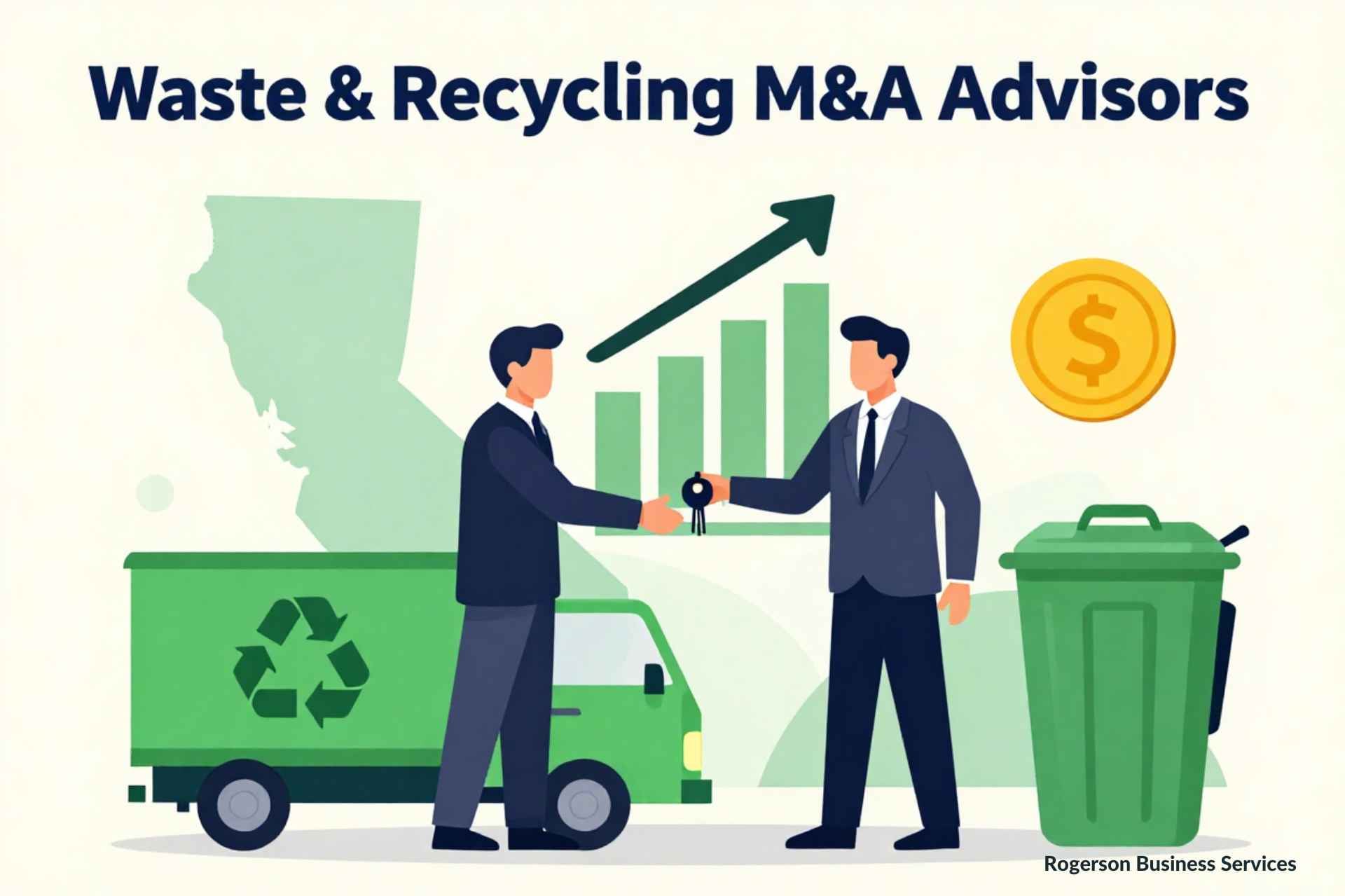
By Andrew Rogerson, Founder, Rogerson Business Services
Lifetime Certified Business Broker (LCBB), M&A Master Intermediary (MA&MI)
Last updated: July 2026
Author Note: This guide reflects common SMB sell-side practice in California Waste & Recycling business transactions. It is not legal, tax, or investment advice.
Disclaimer: This tutorial provides general information for California sellers in the Waste & Recycling niche. Requirements and forms vary by jurisdiction. Confirm current rules with your regulators and consult qualified legal counsel and environmental professionals for your specific deal.
Waste & Recycling M&A Advisors California | Industry Specialists
California mandates aggressive environmental compliance, and the state’s waste and recycling sector operates under complex regulatory frameworks. For example, Senate Bill (SB) 1383 requires immediate reduction of organic waste, and this mandate creates lucrative consolidation opportunities for well-managed operations. If you own a waste hauling or recycling company in California, you possess a highly valuable asset. Yet, when you decide to sell your company, you must choose your representation carefully.
Many owners initially consider using a general business broker because they assume any licensed professional can manage a mid-market transaction. Although generalists handle standard retail or manufacturing sales competently, they often lack the specialized knowledge needed to position environmental assets effectively. Consider a recent, cautionary standoff: a California waste management owner hired a general business broker to market his company. The broker failed to communicate the company’s route density and the long-term quality of its municipal franchise contracts effectively to potential buyers. Because the broker did not understand the specific metrics that drive valuations in the waste industry, institutional buyers undervalued the business, and the transaction stalled entirely.
To maximize your exit value, you need an advisor who understands the intricacies of CalRecycle mandates, transfer station permits, and exclusive hauling territories. Industry specialists speak the exact language of strategic buyers and private equity firms. When your representative clearly articulates your strengths in compliance and operational efficiency, they instantly create a competitive environment for your business.
Expert Takeaway: Do not entrust a complex waste management exit to a generalist. Buyers in this sector base their EBITDA multiples strictly on route density, fleet compliance, and contract longevity. If your advisor fails to highlight these specific factors, you will leave significant money on the table.
If you’re planning to sell in 6 or 12 months from reading this article, start with our guide to selling a waste and recycling business in California.
Testimonials
John and Roxanne Foti
“Thank you so much for your patience and professionalism as you worked through the selling of our business.This was an incredibly difficult and emotional transaction but you did it with class. You picked up this file from another Agent and so we had no relationship with you, but you did all that we wanted and more.We also understand how difficult it was working with the buyer’s agent but your professionalism allowed the transaction to continue and ultimately close.“
John and Roxanne Foti – Auburn, CA
See more reviews and testimonials.
Is your business currently operating at the top of its game? Send a free inquiry today! Call Andrew Rogerson, Rogerson Business Services, toll-free (844) 414-9700 | Leave a message – I’ll call you right back
General Business Brokers vs. Specialized M&A Advisors
When you decide to sell your waste and recycling business, the representative you choose directly impacts your final enterprise value. Owners frequently misunderstand the critical differences between general business brokers and specialized M&A advisors. While both professionals facilitate business sales, their methodologies, buyer networks, and valuation frameworks differ significantly.
The Generalist Approach
General business brokers typically manage straightforward asset sales for smaller companies, often those valued under $5 million. A business broker lists a company for sale on public marketplaces and waits for a buyer to appear. They use passive marketing techniques and rely on basic rules of thumb or Seller’s Discretionary Earnings (SDE) multiples to price a business. Although this approach works well for small retail shops or restaurants, it completely breaks down for complex environmental service operations. Generalists often struggle to articulate the specific value of critical industry assets, such as exclusive municipal franchise agreements or transfer station permits. Because they lack deep sector knowledge, they routinely underprice waste management operations and fail to attract institutional capital.
The Specialist Advantage
Conversely, specialized M&A advisors build a structured, confidential process designed to create competitive tension among a curated group of pre-qualified buyers. They handle complex mid-market transactions, typically involving companies valued between $3 million and $100 million. An M&A advisor employs institutional valuation frameworks, benchmarking EBITDA multiples against precedent transactions and public comparables.
In the California waste sector, buyers pay premium multiples for predictable revenue. A specialized advisor understands exactly how to model and present your route density, measured in lifts per hour, and your contract stability. For example, if you hold a 7-to-10-year exclusive municipal contract with automatic Consumer Price Index (CPI) rate adjustments, a specialist can use this data to justify a significant valuation premium.
Comparing Representation Models
To clarify the structural differences, review how brokers and advisors execute a sale:
| Feature | General Business Broker | Specialized M&A Advisor |
| Marketing Strategy | Employs passive marketing and lists on public marketplaces. | Conducts proactive outreach and builds competitive auctions. |
| Valuation Framework | Relies on basic rules of thumb and SDE multiples. | Uses institutional EBITDA multiples and strategic synergy models. |
| Target Deal Size | Focuses on simple asset sales below $5 million. | Manages complex transactions from $3 million to $100 million. |
| Industry Nuance | Lacks expertise in environmental compliance and route density metrics. | Leverages CalRecycle standing, franchise contracts, and permit transferability. |
By hiring an industry specialist, you ensure that every competitive advantage your California business holds—from CARB-compliant fleets to exclusive hauling territories- directly drives up your purchase price. For further context on industry standards, the International Business Brokers Association (IBBA) provides resources on preparing waste management companies for sale.
Unlocking Premium Buyer Network Access
General brokers wait for buyers to find your listing, but specialized M&A advisors proactively bring your business to a closed network of premium acquirers. In the waste and recycling sector, this network consists of large strategic operators and well-funded private equity (PE) sponsors. Today, infrastructure funds and PE firms actively deploy capital into the lower-middle-market waste sector because they prize the industry’s recurring revenue and non-cyclical demand.
However, these institutional buyers do not browse public business-for-sale websites. Instead, they rely on trusted M&A advisors to source high-quality, off-market acquisition targets. When you hire an industry specialist, they immediately leverage established relationships with active buyers who specifically seek California assets. Because California’s stringent environmental regulations create high barriers to entry, established operators with strong compliance records command extreme buyer interest.
A specialized advisor knows precisely which PE firm needs route density in Southern California, or which strategic buyer wants to acquire a compliant transfer station in the Central Valley. They package your financial data, structure a confidential blind auction, and force these well-funded buyers to compete against each other. This competitive tension frequently results in higher purchase prices and better post-sale terms.
For current insights into how private equity drives consolidation and valuations in the waste industry, you can review recent M&A market trend reports from industry authorities like Waste Dive.
Expert Takeaway: Access to the right buyer pool dictates your final valuation. Andrew Rogerson leverages his elite M&AMI designation and deep industry network to ensure your California waste business reaches the exact private equity groups and strategic buyers who possess the capital to close the deal at a premium multiple.
Unlocking Premium Buyer Network Access
General brokers wait for buyers to find your listing, but specialized M&A advisors proactively bring your business to a closed network of premium acquirers. In the waste and recycling sector, this network consists of large strategic operators and well-funded private equity (PE) sponsors. Today, infrastructure funds and PE firms actively deploy capital into the lower-middle-market waste sector because they prize the industry’s recurring revenue and non-cyclical demand.
However, these institutional buyers do not browse public business-for-sale websites. Instead, they rely on trusted M&A advisors to source high-quality, off-market acquisition targets. When you hire an industry specialist, they immediately leverage established relationships with active buyers who specifically seek California assets. Because California’s stringent environmental regulations create high barriers to entry, established operators with strong compliance records command extreme buyer interest.
A specialized advisor knows precisely which PE firm needs route density in Southern California, or which strategic buyer wants to acquire a compliant transfer station in the Central Valley. They package your financial data, structure a confidential blind auction, and force these well-funded buyers to compete against each other. This competitive tension frequently results in higher purchase prices and better post-sale terms.
For current insights into how private equity drives consolidation and valuations in the waste industry, you can review recent M&A market trend reports from industry authorities like Waste Dive.
Expert Takeaway: Access to the right buyer pool dictates your final valuation. Andrew Rogerson leverages his elite M&AMI designation and deep industry network to ensure your California waste business reaches the exact private equity groups and strategic buyers who possess the capital to close the deal at a premium multiple.
The Result: How Industry Specialization Drives Buyer Competition
If you recall the initial standoff, the business owner nearly lost millions because a general broker failed to communicate route density and contract quality to potential buyers. To rescue the transaction, the owner fired the generalist and retained a specialized M&A advisor in waste and recycling. This strategic pivot changed everything.
The specialized advisor immediately audited the company’s CalRecycle compliance logs, mapped the precise route density, and validated the long-term municipal franchise agreements. Instead of passively listing the business on public websites, the advisor structured a highly confidential, blind auction. Unless you present verifiable, California-specific metrics to a curated network of private equity groups and strategic acquirers, you will not generate intense competitive tension. Because the advisor executed this precise strategy, they generated massive interest.
The result proved dramatic: specialized representation improved buyer competition, so three separate institutional buyers submitted aggressive bids. Although the standoff initially threatened the deal, the owner secured highly favorable post-sale terms because the advisor orchestrated the auction flawlessly.
To achieve this level of leverage, you must partner with an elite industry expert. Andrew Rogerson, the founder of Rogerson Business Services, provides unparalleled representation for California business owners. As a 5-time successful business owner and the author of four books on business ownership, he intimately understands the complex financial and emotional stakes of your exit. Furthermore, he holds the industry’s highest credentials, including Certified Business Broker (CBB), Certified Mergers & Acquisition Professional (CM&AP), and Mergers & Acquisition Master Intermediary (M&AMI). His rigorous, ethical approach has earned him wide recognition throughout the California business brokerage industry.
When you prepare to sell your waste management company, you cannot afford to leave money on the table. You need an expert who speaks the language of institutional capital and understands how to monetize your environmental compliance.
Expert Takeaway: Do not attempt to navigate a complex California waste industry exit with a generalist. Specialized M&A advisors protect your confidentiality, validate your environmental metrics, and force well-funded buyers to compete aggressively for your assets.