

By Andrew Rogerson, Founder, Rogerson Business Services
Lifetime Certified Business Broker (LCBB), M&A Master Intermediary (MAMI)
Last updated: September 2026
Author Note: This guide reflects common SMB sell-side practice in California Waste & Recycling business transactions. It is not legal, tax, or investment advice.
Disclaimer: This tutorial provides general information for California sellers in the Waste & Recycling niche. Requirements and forms vary by jurisdiction. Confirm current rules with your regulators and consult qualified legal counsel and environmental professionals for your specific deal.
Waste & Recycling Due Diligence Checklist | Seller Guide
Selling a waste and recycling business in California requires meticulous preparation because buyers will heavily scrutinize every facet of your operations. As buyers review contracts, permits, and environmental records, they look for hidden liabilities that could jeopardize their investment. Without organized documentation, you invite intense negotiations or risk killing the deal entirely.
In fact, missing permit documentation frequently delays closings and erodes buyer confidence. Buyers halt multi-million-dollar transactions when sellers cannot produce updated solid waste facility permits or current emissions logs. This standoff happens regularly in California, but you can prevent it with proactive preparation. Prepared sellers maintain deal momentum and close on their terms.
Real-World Standoff: You reach the final stages of your business sale, yet the buyer pauses all momentum because you cannot locate a specific local zoning variance. Missing permit documentation delayed closing, forcing the seller to scramble for records while the buyer re-evaluates the offer.
To navigate these complexities, you need expert guidance to prepare your business for market. Andrew Rogerson, the founder of Rogerson Business Services, brings unparalleled expertise to this rigorous process. As a five-time successful business owner and author of four books on business ownership, he understands the emotional and financial stakes of selling a company. Furthermore, Andrew holds elite credentials as a Certified Business Broker (CBB), Certified Mergers & Acquisition Professional (CM&AP), and Mergers & Acquisition Master Intermediary (M&AMI). His strict ethical approach and specialized knowledge earn him top recognition in the California business brokerage industry.
Key Takeaways for Sellers
- Momentum requires preparation: Organize your environmental, financial, and operational records before going to market if you want to survive the due diligence phase intact.
- California demands compliance: Buyers place extreme weight on state-specific regulatory compliance, so your paperwork must reflect flawless operational history.
If you’re planning to sell in 6 or 12 months from reading this article, start with our guide to selling a waste and recycling business in California.
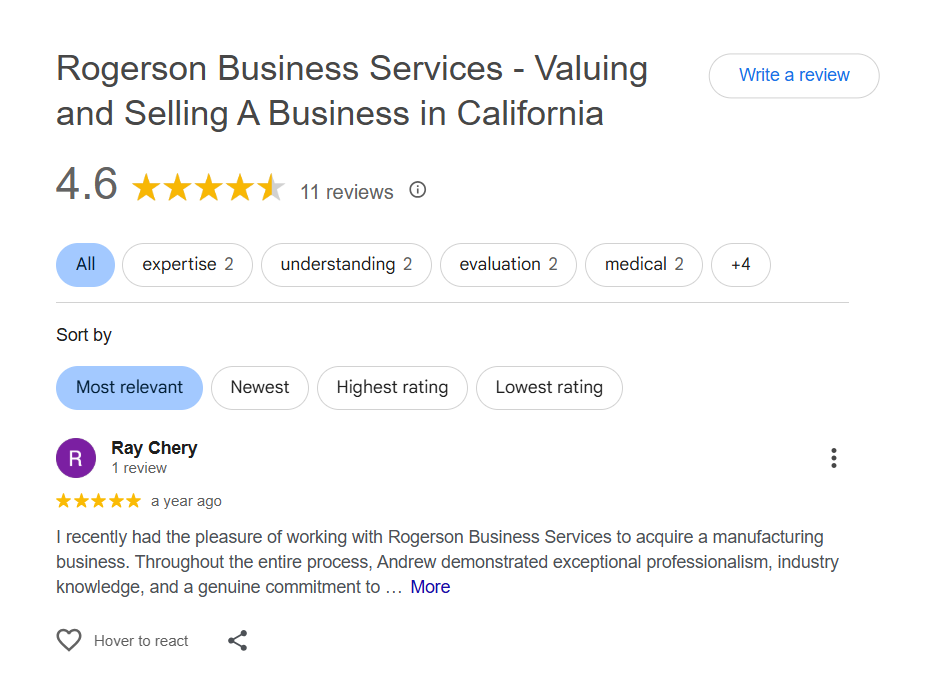
Testimonials
Teresa Anderson
“A big thank you from me. I know I gave you a hard time every once in a while and you took it well. Thank you so much for your patience and your willingness to teach us. It was a wonderful experience working with you and I wish you the best. Andrew is professional, thorough, organized, and accountable. From conducting a business valuation through signing escrow documents he was deeply involved in every step of the process, providing an impeccable level of service at all times. I would strongly recommend him if you are looking to sell your business.“
Teresa Anderson –
See more reviews and testimonials.
Is your business currently operating at the top of its game? Send a free inquiry today! Call Andrew Rogerson, Rogerson Business Services, toll-free at (844) 414-9700 | Leave a message – I’ll call you right back
California Permit Verification & Environmental Review
Buyers of waste and recycling businesses prioritize risk mitigation, so they aggressively scrutinize your environmental compliance and operating permits. California enforces some of the strictest environmental regulations in the world, and buyers expect flawless documentation. If you operate a transfer station, a recycling center, or a hauling route, you must prove that your business operates entirely within state and local legal frameworks. You cannot successfully close the transaction unless you provide comprehensive environmental clearances.
Solid Waste Facility Permits and CalRecycle
Your Local Enforcement Agency (LEA) issues and monitors your Solid Waste Facility Permit (SWFP) under the guidance of CalRecycle. Buyers check this permit first because it dictates exactly what materials you can process, how much tonnage you can accept daily, and which operating hours you must follow.
If your facility processes more waste than your SWFP allows, you face severe fines, and buyers will heavily discount their offer. Audit your daily tonnage logs against your permit limits, because a buyer’s due diligence team will quickly catch any discrepancies. Also, verify that you maintain the correct permit tier: Full Permit, Standardized Tier, or Registration Tier, because operating under the wrong classification signals significant operational risk to potential investors. Your operations may run smoothly day to day, but buyers still require exhaustive documentation.
Navigating CEQA and Hazardous Waste Approvals
California expands environmental oversight through the California Environmental Quality Act (CEQA). Any significant modification to your operations often triggers a CEQA review. Buyers want to know if you recently expanded your facility without completing the necessary environmental impact reports. Buyers do not overlook missing documentation, and they do not forgive concealed regulatory violations.
If you handle specialized materials, you must also provide valid permits from the Department of Toxic Substances Control (DTSC), because unpermitted hazardous waste processing introduces catastrophic liability into a transaction. These stringent requirements can feel overwhelming, but early preparation prevents costly delays.
Environmental Site Assessments (ESA)
Sophisticated buyers always require an independent evaluation of the physical property, even if you lease the facility. You must anticipate the Phase I and Phase II Environmental Site Assessment process.
| Assessment Phase | Primary Focus | Potential Transaction Impact |
| Phase I ESA | Historical records, visual inspections, and regulatory databases | Identifies potential contamination risks; a clean report maintains deal momentum. |
| Phase II ESA | Soil, groundwater, and soil vapor sampling | Required if Phase I finds risks; contamination discoveries force price reductions or kill deals. |
Although a Phase I ESA strictly reviews historical data and visible conditions, a Phase II ESA actively samples the soil and groundwater. You should proactively hire an environmental consultant to conduct a preliminary Phase I ESA before you list the business so that you can address any Recognized Environmental Conditions (RECs) out of the buyer’s sight.
Due Diligence Resource: Do not wait for a buyer to uncover environmental violations. Organize your LEA inspection reports, DTSC permits, stormwater pollution prevention plans (SWPPP), and recent CEQA notices into a secure virtual data room. This proactive transparency builds immediate trust with serious buyers.
Contract Review & Financial Diligence
Buyers dissect your financial foundation and legal obligations during due diligence. You must present airtight contracts and verifiable financials, for a single unrecorded liability can unravel months of negotiations.
Municipal Franchise Agreements and Customer Contracts
In California, many waste hauling operations rely entirely on municipal franchise agreements. Local jurisdictions grant exclusive or non-exclusive franchises that give contractors the right to collect and process solid waste. Buyers scrutinize these government agreements before they evaluate your private commercial accounts, because municipal franchises dictate your legal right to operate.
Review your franchise contracts for “change of control” or assignment clauses. If your agreement requires city council approval before you transfer ownership, you must secure that pathway early, or the buyer will walk away. Also, consolidate your commercial customer contracts. Buyers analyze customer concentration, auto-renewal terms, and pricing escalators. If five large commercial clients generate most of your revenue, buyers will perceive high risk, so you should secure long-term, transferable agreements with those key accounts before you list the business.
Financial Rigor: SDE and EBITDA Verification
Financial due diligence exposes the true operational health of your waste business. Buyers evaluate main street businesses using Seller’s Discretionary Earnings (SDE), but they utilize Earnings Before Interest, Taxes, Depreciation, and Amortization (EBITDA) multiples for middle-market transactions. You must provide immaculate financial records, for investors will rigorously challenge every personal expense you claim as an “add-back.”
Unsubstantiated add-backs destroy seller credibility, and they inevitably lower your final business valuation. Buyers will cross-reference your tax returns, bank statements, and accounts receivable aging reports to verify your cash flow.
California Labor Laws and DIR Compliance
Labor compliance introduces significant transactional risk in California. You cannot classify your waste drivers as independent contractors unless your operations pass the strict “ABC test” under state labor laws. Buyers will audit your payroll history to ensure you properly classify all workers, because inherited misclassification penalties can financially devastate a new owner.
Moreover, if you service municipal routes or public facilities, you must comply with the California Department of Industrial Relations (DIR). The DIR requires contractors on public works to pay prevailing wages and post these wage determinations at job sites.
| Labor Compliance Area | Buyer Due Diligence Focus | Required Seller Documentation |
| Worker Classification | Verifying employees vs. independent contractors under AB 5 | Payroll records, W-2s, 1099s, and employment agreements |
| Prevailing Wage | Ensuring proper pay rates for municipal/public contracts | DIR public works registration and certified payroll records |
| Workers’ Compensation | Assessing premium costs and historical claim frequency | Loss run reports (3-5 years) and active policy certificates |
Financial Preparation Takeaway: Do not wait for a buyer’s accountant to find discrepancies. Hire a third-party financial firm to conduct a Quality of Earnings (QoE) report before you go to market. A clean QoE report supports your asking price and speeds up the due diligence timeline.
For details on wage requirements and public works contractor registration, review the official resources from the California Department of Industrial Relations (DIR).
Fleet Inspection & Asset Readiness
When prospective buyers evaluate a waste and recycling business, they scrutinize the physical assets just as rigorously as the financial statements. Your trucks and processing equipment represent the lifeblood of your operations, so buyers need absolute confidence in their condition. In California, fleet due diligence extends far beyond checking odometers, because state regulators strictly govern commercial vehicle emissions and safety standards. If you operate an aging or non-compliant fleet, you face severe valuation discounts, or the buyer might walk away entirely.
Navigating CARB Regulations and ZEV Mandates
California enforces the nation’s most aggressive emissions standards, and buyers actively assess your fleet’s compliance with the California Air Resources Board (CARB). Under the Advanced Clean Fleets (ACF) regulation, regulators expect waste and recycling fleets to transition steadily toward Zero-Emission Vehicles (ZEVs). Although political and administrative shifts occasionally alter specific enforcement timelines, buyers still evaluate your internal combustion engine (ICE) trucks against these looming mandates.
You must also maintain impeccable records for the state’s heavy-duty emissions testing programs. Regulators require periodic emissions compliance so that buyers will request your up-to-date certificates. If a buyer inherits trucks that cannot pass current CARB standards, they must immediately inject capital to upgrade the fleet, and they will subtract that capital expenditure directly from your purchase price.
CHP BIT Inspections and Maintenance Logs
Beyond emissions, buyers demand proof of mechanical safety. The California Highway Patrol (CHP) mandates the Basic Inspection of Terminals (BIT) program for commercial fleets. You must pass these regular inspections because a history of BIT violations signals poor management and creates major operational liability.
Buyers employ independent diesel mechanics to inspect your refuse trucks, roll-offs, and transfer trailers. You must provide comprehensive, organized maintenance logs for every vehicle, because undocumented maintenance implies neglect. Don’t rely on verbal assurances; unless you provide proof of a transmission rebuild with a detailed work order and invoice, the buyer assumes the work never happened.
Equipment Valuation: Book Value vs. Fair Market Value
Sellers often misunderstand how buyers value heavy equipment. Your balance sheet shows the depreciated “book value” of your assets, but buyers care only about the “fair market value” (FMV) and remaining useful life.
| Asset Category | Buyer Inspection Focus | Value Impact |
| Refuse Trucks (Front/Rear/Side Loaders) | Engine hours, hydraulic system integrity, and CARB compliance status. | Well-maintained, compliant trucks hold high FMV; aging trucks facing ZEV mandates drastically reduce the purchase offer. |
| Roll-Off Trucks & Trailers | Frame condition, hoist mechanisms, and CHP BIT inspection records. | Documented preventative maintenance preserves value, whereas deferred maintenance triggers immediate price reductions. |
| Facility Processing Equipment | Balers, sort lines, and compactors; Cal/OSHA safety compliance. | Obsolete or unsafe equipment requires immediate replacement, so buyers deduct replacement costs from the final valuation. |
Fleet Readiness Takeaway: Conduct your own independent fleet appraisal before you list the business. When you identify and repair hydraulic leaks or brake issues proactively, you prevent buyers from using minor defects as leverage to renegotiate the deal downward.
For the most current information on heavy-duty vehicle compliance, review the official guidelines provided directly by the California Air Resources Board (CARB).
Securing Your Sale Through Proactive Transition Planning
Completing due diligence successfully demands time, meticulous organization, and relentless attention to detail. When you address environmental reviews, permit verifications, contract terms, financial audits, and fleet inspections early, you eliminate surprises that can derail your transaction. Prepared sellers maintain control over deal terms by neutralizing buyer hesitation before it starts.
Moving from Due Diligence to a Successful Closing
Due diligence bridges an accepted offer and a finalized transaction. Once you satisfy a buyer’s detailed inquiries, you must pivot toward final legal execution and post-sale handoff. Thorough preparation during diligence directly accelerates your timeline into → Closing & Transition Planning.
If you fail to plan for the post-closing transition, you risk operational friction that could harm customer retention or trigger post-sale indemnity claims in your purchase agreement. Therefore, you must establish a clear post-closing management framework that outlines your temporary consulting role, key employee retention incentives, and customer transition communications.
Essential California Regulatory Resources
To ensure your business maintains compliance throughout the sales process, reference these authoritative state resources:
- Environmental & Permit Rules: Verify solid waste facility permit statuses and regulations through CalRecycle.
- Fleet Emissions & Compliance: Audit heavy-duty vehicle regulations and fleet mandates via the California Air Resources Board (CARB).
- Hazardous Waste Guidance: Review hazardous material handling permits directly with the Department of Toxic Substances Control (DTSC).
- Labor & Public Works Rules: Check prevailing wage rates and contractor registrations at the Department of Industrial Relations (DIR).
Final Takeaway for Sellers: Due diligence is not merely a hurdle to clear; it is your best opportunity to defend your valuation. Sellers who do a preliminary self-audit six to twelve months before going to market consistently command higher multiples and close faster.
Protect Your Wealth and Command Top Value
Navigating California’s complex regulatory environment while running a waste and recycling business requires specialized knowledge. Don’t leave your life’s work to chance or let missing documentation destroy your deal at the last minute.
Andrew Rogerson and the team at Rogerson Business Services guide business owners through every stage of valuation, marketing, and due diligence. With elite credentials (CBB, CM&AP, M&AMI) and decades of California-specific M&A expertise, Andrew ensures your records, contracts, and fleet withstand aggressive buyer scrutiny.
👉 Prepare for Buyer Due Diligence — Contact Rogerson Business Services today to schedule your confidential consultation and protect your financial legacy.