
Is it time to value and sell your business?
Selling and buying a business requires only one set of circumstances. Those circumstances require that both the seller and buyer must have the motivation to work through the difficult process of selling a business. That is, unless the seller has the motivation AND unless the buyer has the motivation, escrow will not close. Period.
If you have a motivated seller but an interested buyer, the sale of the business will not happen. If you have a seller who wants to consider it and a motivated buyer, then the sale of the business will not occur.
It is not unusual in the residential real estate market for it to be a buyers’ market, as there are many houses on the market, or a sellers’ market when there is a lack of inventory or houses available to buy.
It is unusual to have a buyers’ market or a sellers’ market for a privately held business, as there are many more factors at play than just supply and demand or the amount of inventory.
Factors
- Before buying a business, most buyers want to feel ready. That is, they don’t want to relocate and go through all the hassles of selling a house, buying a house and then buying a business as all this change is disruptive. Most business buyers, therefore, are looking to purchase a business in a location close to where they currently live. In addition, they don’t have the interest to travel more than about 20 minutes to their business, as they know they will be spending a lot of time there.
- Almost all buyers begin the buying process seeking the perfect business. Their criteria include proximity to where they live, an industry they are familiar with, and the value of the business, which must align with their investment criteria, including their down payment. How much they expect the business to generate, so it provides the total owner benefit they want from owning and operating a business. If they can find a business that meets all these criteria and lacks the right motivation, they will continue looking. For example, sales may be flat and not growing, there may be too many employees, the rent is too high, the location is not quite right, the seller knows so much about the business and the industry that the buyer feels intimidated, and so on.
The above helps explain why only about 25% of businesses ever sell, as the buyer or the seller can lose the motivation to close the sale.
Statistics from BizBuySell.
If you’re interested in statistics, consider the following from BizBuySell.
From my perspective, statistics on the sale of a business can be misleading, as there is a temptation, if you are a seller, to apply them to your situation. In contrast, if you are a buyer, you apply them to your situation. As I mentioned earlier, there is only one set of circumstances that allows a business sale to close: when a motivated seller meets a motivated buyer, with all conditions of the sale fully disclosed to both parties.
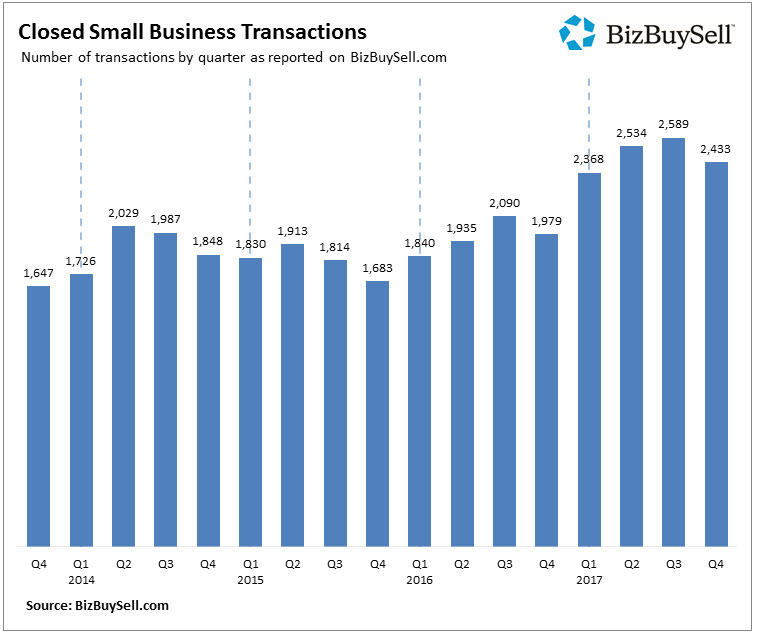
Sales of small businesses have been the strongest since 2013.
According to the graph below, the sale of privately held businesses for each quarter of 2017 was higher than for the same quarter in 2014.
Median revenue and median cash flow of businesses sold.
The graph below is interesting as it shows that in 2017, the median revenue of businesses sold was approximately $500,000, while the median cash flow was approximately $120,000.

An interesting aside I have learned over the years is that business sellers put a great deal of weight on the gross revenue of their business. From my perspective, this is the wrong place to put a focus. The Net Income, or Sellers’ Discretionary Earnings, is much more important than the business’s gross revenue. Which business would you prefer to buy? The business making $1 million per year in gross revenue and losing $100,000, or the business making $1 million in gross revenue and the owner’s Net Income or SDE of $500,000?
Small business sales by industry sector.
This graph shows those businesses that sold and the industry in which they operate.
- 40% of the businesses sold were in the service industry.
- 29% of businesses sold were in the restaurant industry.
- 18% of businesses sold were in the retail industry.
- 10% were in other industries and
- 3% were in manufacturing

Median Days on the Market for sold businesses.
This graph shows that in 2017, the median number of days a business was on the market, ranging from just over 180 days to a low of about 145 days.
Once again, it is essential to be cautious with median numbers, as they do not guarantee that they will apply to your business if you decide to put it on the market for sale.

Value and Sell Your Business – Is It Time?
If you are considering selling your business, is now the time to obtain an accurate business valuation so that the business can be put on the market?
From my perspective, that answer is simple.
If you are a motivated seller, then the time is right. It’s not an easy process, even at the best of times, to sell or, indeed, buy a business. However, if you own a business and doing something else is more attractive to you than owning and operating it, then getting it valued and listing it on the market to see if there is a motivated buyer makes perfect sense to me.
If you plan to sell, make sure your financial statements are accurate and up to date. Poor quality financial statements are the number one reason a buyer inquires and then walks away from completing the sale. A motivated buyer is simply not willing to accept financial statements that make them uncomfortable. I see this time and time again.
If you have questions about valuing and selling your business, or the steps involved in the selling process,
Andrew Rogerson is a certified business broker based in Sacramento, California. Call Toll-Free at (844) 414-9700. If you prefer, email him at support@rogersonbusinessservices.com. Andrew services the whole state of California.