

By Andrew Rogerson, Founder, Rogerson Business Services (California M&A advisory)
Last updated: 2026-03-05
Change log (high level):
- Updated guidance references for California market-based sourcing rule amendments effective for tax years beginning in 2026.
- Refined installment-sale language to emphasize timing vs. sourcing and the need for CPA-led modeling.
- Added disclosure language around checklist CTAs.
How to use this guide: This article is educational and is not tax, legal, or accounting advice. Deal structures and California sourcing rules are fact-specific—review your plan with qualified advisors.
Disclosure: The exit-readiness checklist references in this article are offered by a service provider. You can use any comparable checklist that fits your situation.
If you are the owner of a firm that handles compliance, remediation, or testing in California and you want the fastest close or biz sale of your environmental services company with the lowest execution risk, this guide is for you. We’ll map buyer types, show how deal mechanics really work, and outline the exact files to assemble so a qualified buyer can underwrite your business quickly and close with confidence.
We’ll also explain California tax nuances, especially installment sales and nonresident sourcing, so that you can coordinate with your CPA early. Consider this your practical exit strategy for your environmental services business when speed and certainty matter most.
Testimonials
Erin Higgins
“After 10 years of owning and operating a service company I was burned out and ready to move on. Luckily I met Andrew Rogerson at a business meeting and expressed my interest in his services.
From day one, Andrew was always polite, patient, and professional. Shortly after I listed the business with Andrew a buyer expressed interest in my company. The buyer was very demanding, had many questions, and required a lot of information from me. Not only did Andrew work endless hours as a liaison between the buyer and me, he helped me put the buyers requests in perspective and work through his demands. He always kept a positive outlook and kept things moving forward. He was supportive and thoroughly understands that selling a business that you built from the ground up is an emotional experience. It helps that Andrew has built and sold his own businesses throughout his life so he can definitely relate. He also really understands “the people part” of the business transaction, not just the transaction.
Some of the amazing work that he did:
- Andrew was there every step of the way. He set agendas, attended, and moderated all the meetings I had with the buyer which helped me feel more prepared and comfortable.
- He promptly relayed important information from the buyer and took the time to discuss any requests and made sure I understood exactly what I needed to do.
- He worked endlessly to answer questions from the buyer for five months without any guarantee of a sale.
- We had lunch and evening meetings to discuss the buyer’s offer and he helped me negotiate terms.
- He supported me throughout the process but was really there for me during the last week before we closed. With the demands of running my business, the requests from the buyer, his attorney, and my own attorney, I was feeling very stressed and felt like I was sinking. Andrew came to my office and helped me with the requests from the buyer – he even took some of the work off my hands, took it home, and worked on it.
- He was with me to the end and attended the closing at the buyer’s attorney’s office. It felt good to have him there because I knew he was looking out for me.
- Andrew continued to follow up with me while I worked for the buyer for the required time to make sure things were going well.
- I always felt that he was genuine and truly cared about what was best for me, every step of the way.
In the end, my business was sold for the asking price plus three years of royalties. I have been able to move on an start a new business that is more enjoyable than my last. If I ever need to sell a business in the future, there is nobody I would rather have represent me than Andrew Rogerson. I could not have sold my business on my own.
Erin Higgins – Sacramento, CA
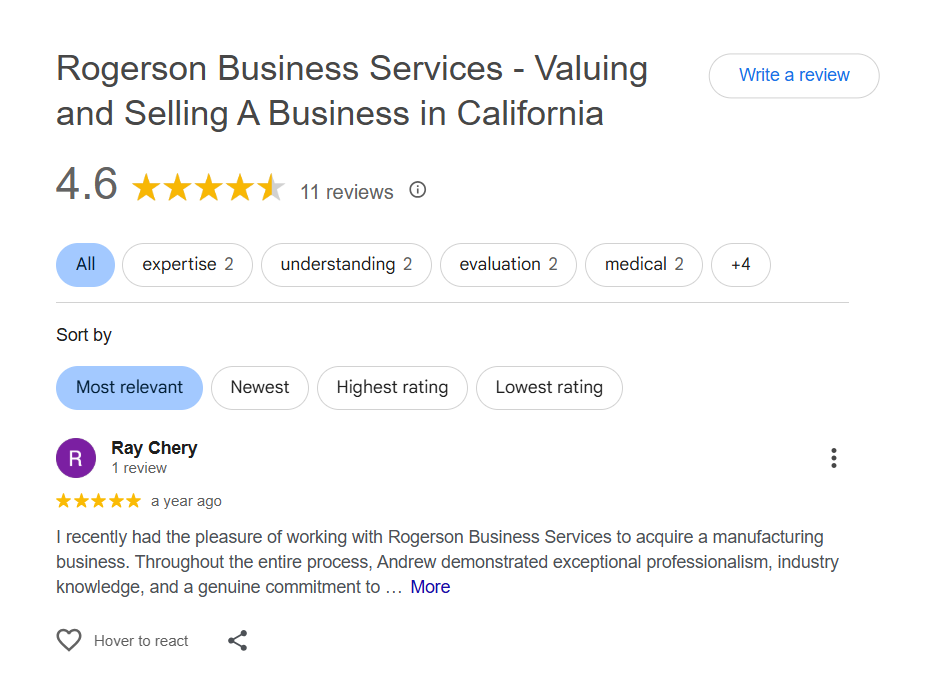
See more reviews and testimonials.
Is your business currently operating at the top of its game? Send a free inquiry today! Call Andrew Rogerson, Rogerson Business Services, toll-free (844) 414-9700 | Leave a message – I’ll call you right back
Key takeaways
- Strategic engineering and construction consolidators are often the speed leaders when diligence files are clean, QA/QC is documented, and licenses/accreditations are current.
- For the primary goal—fastest close/lowest execution risk—prioritize standardized buyer playbooks, clear liability allocation, and a ready-to-audit data room.
- California tax planning is not just about rate—it’s about timing and sourcing. Installments spread recognition; they don’t change the California-sourced share of gain determined at sale, as outlined in California guidance and 2025 practitioner summaries.
- Excellent readiness for ELAP labs, CSLB licensing/HAZ certifications, EPA/DTSC IDs, and contract terms accelerates underwriting and shortens closing timelines.
- Alternatives like PE platforms/add-ons, national roll-ups, ESOPs, and partial recaps can fit different goals; for speed, weigh cash-at-close norms, rollover expectations, and earnout complexity.
Want an exit-readiness checklist you can hand your team this week? You can request a California-focused checklist from Rogerson Business Services to benchmark your data room, licensing file, and diligence package before you go to market.
Prefer to watch a video?
Hit play and watch below!
Environmental Services Business Exit Strategy Fundamentals

Environmental services buyers scrutinize risk that’s unique to this sector: regulatory exposure, documented methodologies, and accreditation continuity. Expect buyer lawyers and technical teams to review:
- Compliance history, open enforcement actions, and remediation obligations.
- QA/QC systems, chain-of-custody, calibration logs, and training records—especially for testing labs.
- Licensing posture for remediation/abatement, hazardous substance work, and any specialized certifications.
- Contract terms that may transfer liability, restrict assignment, or require change-of-control consent.
Think of it this way: buyers aren’t just purchasing revenue streams; they’re inheriting the duty of care. The more you can prove your controls work, the faster they’ll move. That’s the core of a strong exit strategy for a strong environmental services business.
Quick self-check: If a buyer asked today, could you produce (within 48 hours) a clean compliance history summary, your current QA/QC manual, and a simple list of licenses/accreditations with renewal dates?
Note: Rogerson Business Services supports California owners with business brokerage (buy/sell), business valuations, and value-building consulting—often starting with a practical readiness checklist like the one above.
Is your business currently operating at the top of its game? Send a free inquiry today! Call Andrew Rogerson, Rogerson Business Services, toll-free (844) 414-9700 | Leave a message – I’ll call you right back
Buyer paths for a fast, low-risk close
Strategic engineering and construction consolidators
For the speed-first seller in compliance, remediation, or testing, strategic consolidators in engineering, construction, and multidisciplinary environmental services are the anchor path. Why do they often close faster:
- They run standardized diligence and integration playbooks across geographies and service lines.
- They typically offer high cash at close to secure capacity and clients; contingent terms bridge any forecast uncertainty.
- They know how to evaluate technical risk and accreditation issues without reinventing the wheel.
Deal mechanics you’ll commonly see:
- Consideration: Mostly cash at close; targeted earnouts to protect against post-close variability; limited seller notes.
- Integration: Name, systems, and labor compliance standards were adopted quickly; client transition plans were executed with little downtime.
- Timeline: When diligence is turnkey and liabilities are scoped, 60–120 days from LOI is achievable.
Quick self-check: Do you already have a one-page “known liabilities and how we control them” memo (open items, reserves/insurance, and remediation status) that a buyer can underwrite without a long email thread?
Supporting landscape context: Industry media and sponsor updates continue to document consolidation across environmental and industrial services through 2024–2025, with platform growth and frequent tuck-ins highlighting standardized processes that can speed closings—see sector roundups by reputable outlets in that window.
National roll-ups in compliance, testing, and labs
Roll-ups—often backed by private equity—pursue buy-and-build strategies with frequent tuck-ins. Speed advantages include repeatable diligence checklists, integration templates, and experienced underwriting. Common patterns:
- Consideration: All-cash or cash plus modest earnouts; occasional short seller notes.
- Governance: Add-ons are folded into a platform with centralized systems and brand; owners may stay on for a defined transition.
- Timeline: Similar to strategics when files are clean; add-on playbooks can make underwriting even more predictable.
Quick self-check: If you sold to a roll-up, could you explain in plain English what would change on Day 1 (billing systems, QA/QC reporting, branding, and who owns client communications)?
Private equity platform vs. add-on
- Platform majority sale: Often cash plus rollover equity (20–40% is common in lower middle market norms). More governance negotiation and standing up shared services can slightly slow the path versus a pure strategic approach.
- Add-on sale to an existing platform: Often faster and heavier on cash, with limited rollover and simpler governance because integration is predefined.
ESOP feasibility snapshot
Employee ownership can preserve culture, aid retention, and deliver potential federal tax efficiencies for certain structures. It’s typically not the fastest-close route because it requires a feasibility study, trustee process, financing, and communications planning. Practical primers from organizations like the National Center for Employee Ownership and advisory analyses in 2023–2025 explain how to assess fit and timelines; see the NCEO’s ESOP tools in the pre‑feasibility toolkit and RSM’s overview on ESOPs for business and professional services firms (2023).
- Feasibility: Evaluate cash flow for debt service and repurchase obligations; run a formal study before committing.
- Timeline: Commonly 4–6 months from feasibility through close (longer with prep). Good for legacy priorities; less ideal when speed is paramount.
Partial recapitalizations
A minority investment can provide 30–70% liquidity now while keeping control and setting up a cleaner, larger exit later. It can de-risk operations and deepen leadership—but it adds governance negotiations and capital stack complexity, which can lengthen the immediate timeline compared to a straightforward sale.
California tax structuring for speed and certainty
Your goal is a timely, low-friction close while understanding how payment timing and residency affect taxes owed to California. Here are the essentials to frame with a CPA experienced in the state’s rules.
Installment sale vs. cash at close
California generally conforms to the federal installment method under IRC §453, so sellers recognize gain as payments are received. For some sellers, installments help match taxes to cash flow. However, California’s share of the gain is determined at the time of sale; that percentage then applies to each installment. In other words, timing doesn’t change sourcing.
California’s instructions discuss installment reporting and how to report installment sales using FTB forms (including FTB 3805E). For a clear, deal-relevant overview, see the Franchise Tax Board’s 2025 Schedule D 540 instructions on installment sales (FTB, 2025). Nonresidents can also review the 2024 540NR booklet guidance (FTB, 2024) for timing and reporting concepts.
Practical move: Build side-by-side models showing net cash at close versus after-tax cash on an installment plan, including §453A interest and any earnout scenarios. Choose the path that balances certainty, liquidity, and audit posture within your environmental services business exit strategy.
Quick self-check: Have you and your CPA modeled three cases—(1) all cash, (2) installments, (3) installments plus an earnout—and stress-tested whether the business will still have enough working capital after closing costs and taxes?
If you want a concrete starting point, request an exit-readiness checklist from Rogerson Business Services and use it to organize the tax-model inputs, diligence documents, and timeline owners that are commonly scrambled for after an LOI.
Is your business currently operating at the top of its game? Send a free inquiry today! Call Andrew Rogerson, Rogerson Business Services, toll-free (844) 414-9700 | Leave a message – I’ll call you right back
Nonresident sourcing of gain and goodwill
If you’re a nonresident selling a business with California activity, market-based sourcing rules can apportion a portion of your gain to California even if you’ve moved. The Franchise Tax Board has published proposed updates for Regulation 18 CCR §25136‑2 (draft text) and a related Notice of Proposed Rulemaking (FTB regulatory activity, accessed 2026).
The FTB has also issued Tax News updates on amended market-based sourcing rules (FTB, 2025), which practitioners have summarized as impacting look-through mechanics and effective dates beginning in 2026.
Because regulatory adoptions and applicability dates can change, confirm the current status and effective date through the FTB’s regulatory activity page and your tax advisor before you sign an LOI.
Discuss residency timing and the treatment of entity vs. personal goodwill with a tax advisor before signing an LOI.
Quick self-check: Can you document what portion of customer relationships is tied to you personally versus the company (contracts, non-solicits, key-person dependencies), and do you have the apportionment inputs your tax advisor will ask for (where services are delivered, where customers are, and where revenue is sourced)?
Stock vs. asset sale trade-offs
Stock deals can be faster and cleaner for sellers, with fewer consent and transfer issues and often lower escrow needs when paired with representations and warranties insurance. Asset deals can provide buyers with tax benefits but may trigger additional permits, license transfers, and contract consents, adding time and risk.
For fundamentals, see a neutral explainer that compares the mechanics of asset and stock sales; then tailor it to your facts with counsel.
The fast-close playbook for environmental services
This playbook focuses on what materially accelerates underwriting and closing when selling an environmental compliance, remediation, or testing firm in California.
Licensing, accreditations, and IDs
- ELAP for labs: Confirm current accreditation, FOA scopes, proficiency testing results, and the date of the last assessment. Prepare a change-of-ownership plan using the ELAP program’s accreditation amendment and reference the ELAP program overview (California State Water Boards, current pages).
- CSLB licensing and HAZ certifications: Validate the correct classifications—such as the C‑22 asbestos abatement license—and eligibility for the Hazardous Substance Removal and Remedial Actions certification per 2024–2025 CSLB rules and newsletters.
- EPA/DTSC identifiers: For hazardous waste generator sites, update the RCRA Site ID information promptly upon an ownership change using the EPA Form 8700‑12 guidance (EPA Region 2 FAQ; federal process) and coordinate with California DTSC on any state-specific steps.
QA/QC, SOPs, and chain-of-custody
- Assemble a clearly indexed QA/QC manual, sampling and calibration SOPs, chain-of-custody templates, and recent audit findings with remediation status.
- Maintain training logs and competency records for technicians and scientists, with expiration dates highlighted.
Contracts, insurance, and liabilities
Summarize key contract mechanics and risk files in prose to minimize list sprawl and keep the focus on execution speed. Prioritize anti-assignment and change-of-control language, limitation-of-liability and indemnity provisions, and customer notice windows across your top contracts.
Pull five years of loss runs for professional, general, and pollution liability, and prepare a short enforcement and dispute history with documented mitigations and outcomes. This narrative, paired with exhibits, lets buyers triage risk faster and reduces back-and-forth.
Data room and buyer workflow alignment
- Index your data room to mirror common buyer checklists. Use consistent file naming and include a README that points to critical evidence (licenses, ELAP scopes, permits, insurance, top contracts, org charts).
- Include a proposed transition plan that covers client communications, key employee retention, and accreditation continuity.
Use R&W insurance to compress negotiations.
Representations and warranties insurance can reduce or replace a portion of escrow/holdback and speed up term resolution by giving buyers a third-party backstop. Start broker conversations early so underwriters can review your diligence as it’s assembled. Brokers explain how R&W can streamline negotiations and support cleaner exits; see, for example, Woodruff Sawyer’s perspective on right‑sizing RWI limits (2024).
Quick self-check: Could you hand a buyer (or R&W underwriter) a “clean diligence pack” with (a) licenses/accreditations, (b) top contracts and a change-of-control tracker, (c) five years of loss runs, and (d) a short enforcement/dispute history—without chasing people for missing files?
Note: If you want help pressure-testing that pack, Rogerson Business Services provides business valuations and consulting to strengthen the story and documentation buyers rely on, along with brokerage support for acquisitions and sales in California.
Deal mechanics at a glance
Below is a qualitative snapshot of what speed-focused sellers commonly encounter by buyer type. Exact terms vary by size, risk profile, and market.
| Buyer type | Cash at close | Rollover equity | Earnout usage | Escrow and R&W insurance |
| Strategic consolidator | High | Low to moderate | Targeted to bridge forecasts | Often reduced escrow if R&W is in place |
| National roll-up | High | Low | Common but standardized | R&W is widely used to streamline |
| PE platform | Moderate to high | Moderate | Used when projections drive value | R&W common; larger escrows possible |
| PE add-on | High | Low | Limited or short | R&W common; fast underwriting |
| ESOP | Not applicable | Employee trust ownership | Not applicable | No buyer R&W; separate trustee diligence |
| Partial recap | Moderate | Minority investor stake | Possible performance hooks | Negotiated protections vs. governance |
Two short case vignettes
- Anonymized example — fast strategic close: A California testing and compliance firm with current ELAP accreditation, clean loss runs, and a tidy client contract matrix received a majority-cash offer from a strategic consolidator. The seller provided a data-room index mapped to the buyer’s checklist, a one-page liabilities-and-controls memo, and an ELAP change-of-ownership packet (including a draft Amendment of Accreditation). With QA/QC records and FOA scopes packaged upfront, the buyer’s lab audit and legal diligence moved quickly, and the deal closed on an accelerated timeline from LOI with a modest earnout.
- Anonymized example — partial recap to set up a later exit: An industrial remediation contractor pursued a minority investment to de-risk and expand. The company standardized SOPs, rebuilt its contract matrix (including change-of-control and indemnity terms), and documented claim history using five years of loss runs and outcomes. When the full sale process ran later, the improved governance, documentation, and risk narrative reduced back-and-forth in diligence and improved cash-at-close competitiveness.
Decision steps for a speed-first seller
- Define your non-negotiables: target close date, minimum cash at close, earnout tolerance, and leadership transition.
- Run a CPA-led model: stock vs. asset outcomes; installment vs. lump sum; residency and sourcing exposure.
- Shortlist buyer paths: prioritize strategic consolidators and qualified roll-ups; consider a PE add-on if integration fit is strong.
- Build the fast-close data room: licenses, ELAP package, QA/QC, insurance loss runs, contract matrix, enforcement summary, retention plan.
- Prewire risk tools: line up R&W insurance indications; propose escrow mechanics in the LOI that reflect your clean files.
- Control the timeline: set weekly diligence agendas, deliver files early, and keep decision logs to avoid re-openers.
Quick self-check: What are your next three “Monday moves” to keep momentum—one data-room deliverable, one advisor/tax modeling step, and one people/operations step that reduces key-person risk?
Want the checklist version of this plan? Request an environmental services exit-readiness checklist from Rogerson Business Services.
Rogerson Business Services helps California business owners with business brokerage (buy/sell), business valuations, and machinery and equipment valuations, plus consulting to strengthen value before a sale. Founder Andrew Rogerson leads the team with an execution-focused, owner-first approach.
Is your business currently operating at the top of its game? Send a free inquiry today! Call Andrew Rogerson, Rogerson Business Services, toll-free (844) 414-9700 | Leave a message – I’ll call you right back
FAQs
- Does an installment sale reduce California tax if I’m moving out of state? No. Installments change timing, not sourcing. The California-sourced percentage is determined at the time of sale and applied to each payment. Work with your CPA on timing versus §453A interest and cash needs, referencing the FTB’s 540 instructions (2025) and 540NR guidance (2024).
- If my lab changes ownership, can ELAP accreditation continue without a gap? Yes—prepare the ELAP Amendment of Accreditation and coordinate early so FOA scopes, quality systems, and assessments remain current through the transition, per the ELAP program overview.
- What closes faster: a stock sale or an asset sale? Stock deals often close faster for sellers due to fewer consent and transfer issues. Asset deals can add steps for permits, licenses, and environmental approvals. Evaluate both with your advisors and prospective buyers.
- Are ESOPs a fast way to exit? They can be effective for culture and potential tax efficiency under certain structures, but they’re usually not the fastest route due to feasibility, trustee review, financing, and communication planning; see NCEO and RSM resources linked above for feasibility factors and timelines.
- Will using R&W insurance really speed my deal? It often helps by reducing escrow friction and focusing negotiations on a policy-backed framework. Start early and maintain a meticulous diligence record to streamline underwriting, as leading brokers have reported in 2024–2025.
Sources and further reading
Methodology note: This guide prioritizes primary California and federal sources (FTB publications and instructions, California regulations, California regulators, and U.S. EPA guidance) and then uses reputable practitioner/industry summaries for plain-English context. Links were accessed as of the “Last updated” date above; confirm changes with your advisors if you’re planning a transaction.
- California FTB — Regulation 18 CCR §25136‑2 draft text and the Notice of Proposed Rulemaking (FTB regulatory activity; accessed 2026), plus the FTB’s Tax News flash on amended market-based sourcing rules (2025) for status context and practitioner interpretation.
- California FTB — 2025 Schedule D (540) instructions on installment sales and the 2024 540NR booklet for installment reporting mechanics and nonresident filing context.
- California State Water Boards — ELAP program overview and ELAP Amendment of Accreditation form (current pages).
- California CSLB — C‑22 asbestos abatement classification (reference classification page).
- U.S. EPA — Hazardous Waste Site Identification guidance (RCRA Form 8700‑12 ownership update process).
- NCEO — ESOP pre‑feasibility toolkit (resource hub) and RSM — ESOPs for BPS firms (2023) for feasibility and timelines.
- Woodruff Sawyer — RWI limit sizing and clean exit considerations (2024).
Disclaimer: This guide is educational and not tax, legal, or accounting advice. Work with qualified advisors to model your fact-specific situation.