

If you want to sell an environmental services company in California, you need a clear plan in the California industrial services industry. Start by organizing your financial records and ensuring compliance with all California regulations.
Update your equipment and invest in employee training to boost value and attract buyers. Secure municipal contracts for stable revenue and maintain consistent financial trends.
Define your exit strategy and set your desired sale terms. Selling a business in California becomes easier when you seek expert guidance and schedule a confidential consultation.
Tip: Work with experienced advisors to maximize your company’s value and ensure a smooth transaction.
Is your business currently operating at the top of its game? Send a free inquiry today! Call Andrew Rogerson, Rogerson Business Services, toll-free (844) 414-9700 | Leave a message – I’ll call you right back
Key Takeaways
- Organize your financial records to show buyers clear and consistent growth. This builds trust and speeds up the sale process.
- Ensure compliance with all California regulations by updating permits and licenses. This prevents delays and reassures buyers.
- Invest in employee training and upgrade equipment to enhance your company’s value. Buyers prefer operationally ready businesses.
- Develop a strong management team and a clear succession plan. This demonstrates stability and reduces buyer risk.
- Define your exit strategy and desired sale terms early. Clear goals help you negotiate better and choose the right path for selling.
- Avoid common pitfalls like relying too much on one person or lacking a growth strategy. Address these issues to increase your company’s appeal.
- Choose a reputable broker to help you navigate the sale process. Their expertise can lead to better offers and a smoother transaction.
- Prepare a strong Confidential Information Memorandum (CIM) to attract serious buyers while protecting sensitive information.
Prefer to watch a video?
Hit play and watch below!
Prepare to Sell Environmental Services Company in California
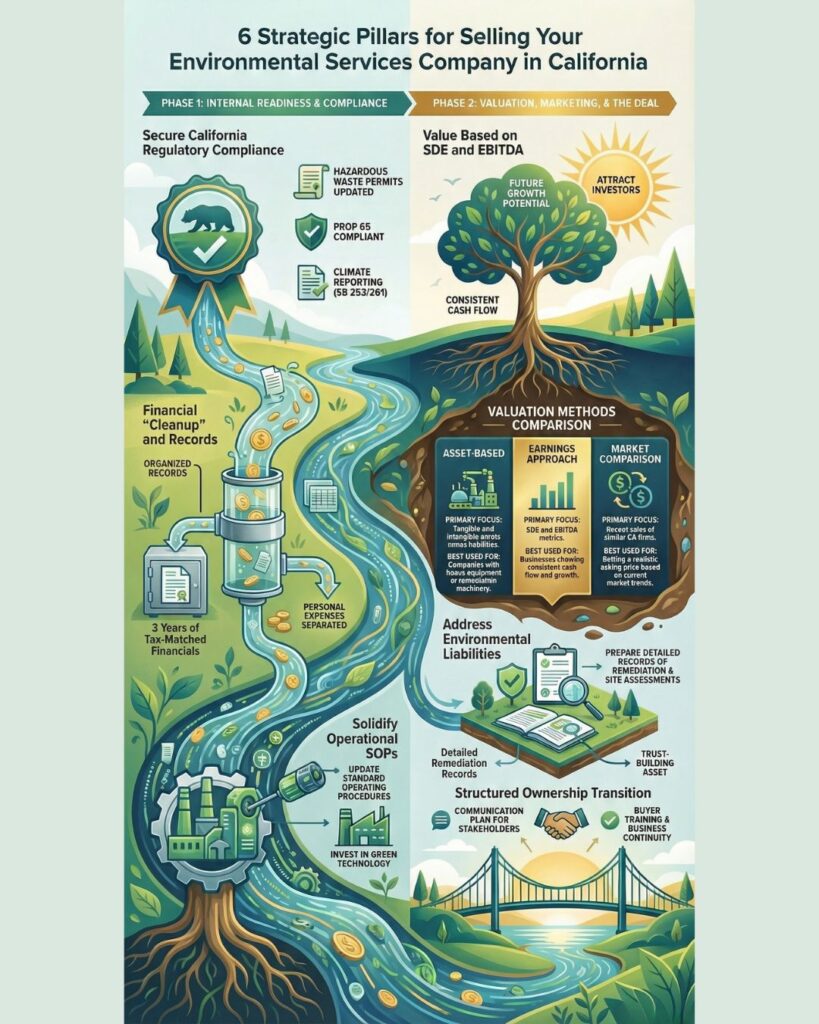
Clean Financials and Records
Organize Statements
You need to organize your financial statements before you sell an environmental services company in California. Gather your income statements, balance sheets, and cash flow reports for at least the past three years. Buyers want to see clear records that show financial consistency and growth. Make sure your statements match your tax returns. This step builds trust and speeds up the due diligence process. You should also separate business and personal expenses to avoid confusion. Accurate records help you prove guaranteed revenue and support a higher valuation.
Address Debts
Review all outstanding debts and obligations. Pay off short-term liabilities if possible, or create a plan to manage them. Buyers often look for companies with manageable debt levels. If you have long-term contracts that generate steady income, highlight these as they can offset concerns about debt. You should also disclose any liens or pending lawsuits. Transparency reduces surprises and keeps negotiations on track.
Regulatory Compliance in California
Permits and Licenses
You must hold all required permits and licenses to operate an environmental services company in California. Missing or expired documents can delay or even stop a sale. Review your state and local permits, hazardous waste transport licenses, and any special certifications. Update or renew them as needed. Buyers want to see that your company meets all California regulations and can continue operations without interruption.
HSE Standards
Health, safety, and environmental (HSE) standards play a major role in California. You should follow both external and internal obligations to protect your team and the environment. The table below outlines key compliance requirements for environmental services companies in California:
Type of Obligation |
Description |
|---|---|
| External Obligations | Rules and regulations set by government bodies to protect public interest and promote fair competition. |
| Internal Obligations | Standards set by the organization to enhance health, safety, and environmental practices. |
| ISO 14001 Compliance | Focuses on environmental management systems, including legal and voluntary obligations. |
You should document your compliance with ISO 14001 and other standards. This shows buyers that your company operates responsibly and meets California’s strict environmental laws.
Operational Readiness
SOPs
Standard operating procedures (SOPs) help your team deliver consistent results. You should review and update all SOPs before you sell an environmental services company in California. Clear procedures make it easier for buyers to understand your operations and maintain quality after the sale. Well-documented SOPs also reduce training time for new owners.
Equipment and Tech
Inspect all equipment and technology. Repair or replace outdated items to show buyers that your company is ready for immediate use. Companies that meet California’s climate transparency laws attract more buyers because they can provide credible emissions data and demonstrate environmental responsibility. You should also highlight any investments in green technology or software. Many buyers seek environmental services companies that use advanced tools to improve efficiency and sustainability.
Note: Consumers in California are willing to pay a premium for sustainable brands. Operational readiness can increase buyer interest and help you secure a better deal.
Team and Succession
Key Employees
You need a strong management team to attract serious buyers and maximize your company’s value. Buyers look for leadership that can drive growth and maintain stability after the sale. When you showcase a capable team, you demonstrate that your business can thrive without your daily involvement. This confidence can lead to higher offers and more interest from qualified buyers.
A strong management team brings several advantages:
- Buyers see less risk when key employees handle daily operations.
- Strategic vision from your leadership team can set your company apart from competitors.
- Companies with proven management often receive more bids and higher valuations, as seen in major industry transactions.
You should identify your key employees early in the sale process. Retain them with incentives or contracts to ensure a smooth transition. Highlight their experience, certifications, and roles in your business documentation. This approach reassures buyers that your company’s success does not depend on one person.
Succession Plan
A clear succession plan ensures business continuity and preserves your company’s value. You should document how knowledge and responsibilities will transfer to new owners or leaders. Effective succession planning includes several strategies:
- Transfer institutional knowledge through process mapping and updated SOPs.
- Use job shadowing and phased retirements to share expertise between outgoing and incoming leaders.
- Integrate knowledge transfer into daily workflows to build a culture of continuous learning.
You should communicate your succession plan to key employees and potential buyers. This transparency builds trust and shows that your company can operate smoothly during and after the sale. A well-executed succession plan reduces risk and increases buyer confidence.
Exit Strategy
Define Goals
You need to define your personal and financial goals before you start the sale process. Decide whether to exit the business completely, stay involved in a limited role, or transition ownership gradually. Clear goals help you choose the right exit strategy and negotiate favorable terms.
Desired Terms
Set your desired sale terms early. Consider factors such as price, payment structure, and post-sale involvement. Many owners in California choose from several exit strategies:
- Employee Stock Ownership Trust (EOT) – Promotes employee ownership and business continuity.
- Perpetual Purpose Trusts – Protects your company’s mission and legacy.
- Mergers and acquisitions – Offers immediate liquidity and access to larger markets.
- Employee ownership trusts – Keep your business in the hands of trusted team members.
Environmental services companies attract buyers because of the growing demand for climate solutions. You should tailor your exit strategy to your goals and your business’s unique strengths.
Common Pitfalls
You can avoid many common mistakes by planning. Watch out for these frequent pitfalls when preparing to sell your environmental services company:
- Relying too much on one person for operations or client relationships.
- Failing to outline a clear growth strategy for future expansion.
- Insufficient cash flow can reduce your company’s value.
- Lacking recurring revenue streams makes your business less attractive to buyers.
- Operating in a highly competitive market without clear differentiation.
Tip: Address these issues early to increase your company’s value and appeal to more buyers.
By focusing on your team, succession plan, and exit strategy, you set the stage for a successful sale and a smooth transition.
Business Valuation for Environmental Services

Why Valuation Matters
You need an accurate business valuation before you sell an environmental services company in California. A precise valuation sets realistic expectations and helps you negotiate with confidence. Buyers want to see clear numbers that reflect your company’s true worth. In California, environmental services companies or industrial services face unique market pressures, regulatory demands, and growth opportunities. You must understand how these factors impact your value.
Consider these primary factors that influence the valuation of an environmental services company in California:
- Financial performance metrics such as SDE (Seller’s Discretionary Earnings) and EBITDA (Earnings Before Interest, Taxes, Depreciation, and Amortization) drive your company’s value.
- Valuation methods—including asset, income, and market approaches—determine how buyers and experts assess your business.
- Due diligence steps assess your company’s operational and financial health.
A strong valuation supports your asking price and attracts serious buyers. It also uncovers areas for improvement before you enter negotiations.
Valuation Methods
You can choose from several proven methods to value your environmental services company in California. Each approach highlights different strengths and risks.
Asset-Based
The asset-based method calculates your company’s value by adding up all tangible and intangible assets, then subtracting liabilities. This approach works well for environmental remediation business owners with significant equipment, vehicles, or property. You should document every asset, including machinery used for environmental cleanup and remediation. Buyers in California want to see a complete list of assets and their current market value.
Earnings Approach
The earnings approach focuses on your company’s ability to generate profit. You use metrics like SDE and EBITDA to show consistent cash flow and future earning potential. This method appeals to buyers who want stable returns and growth. You should present clear financial statements and highlight recurring revenue streams. In California, buyers often prioritize companies with strong earnings and predictable income.
Market Comparison
The market comparison method examines recent sales of similar environmental services companies in California. You compare your business to others based on size, location, and service offerings. This approach gives you a realistic view of what buyers are willing to pay in today’s market. You should research recent transactions and adjust for any unique features or risks specific to your company.
Choosing Valuation Experts
Selecting the right valuation expert ensures you receive an accurate and defensible business value. In California, you need a professional who understands local regulations, industry trends, and the complexities of environmental services.
Rogerson Business Services
Rogerson Business Services stands out as a trusted provider for California business owners. Their team specializes in business brokerage, business valuation, and consulting services tailored to the environmental services sector. Andrew Rogerson leads the firm with deep experience in acquisitions, sales, and machinery and equipment valuations. You benefit from their expert guidance throughout the sale process.
When you evaluate valuation experts, consider the following service offerings:
Service Offerings |
|---|
| Transaction-Related Valuations |
| Financial Reporting |
| Complex Financial Instruments (CFIs) |
| Tax-Related Valuations |
| Asset-Based Appraisal Services |
| Business Sale |
| Equipment Appraisal |
| Quality of Earnings Report |
Choose a partner who brings real-time market intelligence, financial modeling skills, and sector-specific knowledge. This expertise helps you maximize your company’s value and navigate the California market with confidence.
Maximize Value
You want to maximize your company’s value before you sell. Buyers in California look for environmental services firms with strong growth potential, well-organized records, and operational readiness. You can take several steps to position your business for a higher sale price.
Start by highlighting your company’s scalability. Show buyers how they can expand services, enter new markets, or increase revenue streams. Growth potential often persuades buyers more than past performance. You should prepare a clear plan that outlines future opportunities and demonstrates how your business can adapt to changing environmental regulations.
Choose a broker who offers transparent services and fees. A reputable broker guides you through the sale process, connects you with qualified buyers, and helps you negotiate favorable terms. You gain access to industry networks and market intelligence, which can lead to better offers.
Maintain business operations while your company is on the market. Keep your team focused on delivering quality service and meeting client expectations. Disruptions during the sale process can lower your company’s value and create uncertainty for buyers. You should continue to invest in employee training, equipment upgrades, and technology improvements.
How else can I maximize the value of my business?
Organize all records and documentation. Buyers want to see clear financial statements, contracts, permits, and compliance reports. Disorganized records create risk and may result in lower offers. You should review your files, update missing information, and prepare for due diligence. Being “due diligence ready” signals professionalism and increases buyer confidence.
Coordinate with legal and compliance teams to ensure all disclosures are accurate and complete. California’s strict environmental regulations require careful attention to permits, licenses, and health and safety standards. You should address any outstanding issues before listing your company for sale. Proper compliance makes the transfer process smoother and reduces the risk of delays.
The table below summarizes proven strategies for maximizing value:
Strategy |
Description |
|---|---|
| Growth Potential and Scalability | Highlight how buyers can grow the business, not just past performance. |
| Choosing a Broker | Select a broker with transparent services and fees for a successful exit. |
| Running the Company During Sale | Maintain operations and minimize disruption while on the market. |
| Compliance | Organize disclosures and coordinate with legal teams for a smooth transfer. |
| Preparation | Be “due diligence ready” to influence sale price and attract higher offers. |
| Organized Records | Keep records orderly to reduce risk and increase buyer confidence. |
Tip: You should start preparing early. Small improvements in operations, compliance, and documentation can lead to significant increases in your company’s value.
You set yourself apart by demonstrating readiness, transparency, and growth potential. These steps help you attract serious buyers and secure the best possible deal.
Find and Qualify Buyers
Buyer Types
You need to understand the different types of buyers who may show interest in your environmental services company. Each group brings unique motivations and expectations to the table.
Strategic
Strategic buyers usually operate in the same industry or a related field. They look for companies that can help them expand their market share, add new services, or enter new geographic areas. You may recognize these buyers as competitors, suppliers, or large environmental firms. Strategic buyers often pay a premium because they see immediate value in integrating your operations with theirs. They focus on synergies, client lists, and specialized permits.
Investors
Investors seek strong returns and stable cash flow. These buyers include private equity groups, venture capitalists, and family offices. Investors may lack direct experience in environmental services, but they value companies with predictable revenue, growth potential, and strong management teams. You should highlight your recurring contracts, compliance history, and financial performance. Investors often use financial metrics like EBITDA and SDE to assess value and risk.
Entrepreneurs
Entrepreneurs want to own and operate a business. They may come from inside or outside the industry. Many entrepreneurs look for companies with established systems, strong teams, and growth opportunities. You can attract these buyers by showcasing your standard operating procedures, training programs, and succession plans. Entrepreneurs often seek seller support during the transition period.
Attracting Buyers
You need to reach qualified buyers who understand the value of your business. Use multiple channels to maximize exposure and maintain confidentiality.
Brokers and Rogerson Business Services
Business brokers play a key role in connecting you with serious buyers. Rogerson Business Services specializes in environmental services transactions in California. Their team manages marketing, buyer screening, and negotiations. You gain access to a network of pre-qualified buyers and benefit from expert guidance throughout the sale process.
Tip: A reputable broker protects your confidentiality and helps you secure the best possible deal.
Is your business currently operating at the top of its game? Send a free inquiry today! Call Andrew Rogerson, Rogerson Business Services, toll-free (844) 414-9700 | Leave a message – I’ll call you right back
Industry Networks
Industry networks provide another powerful way to attract buyers. You can leverage trade associations, industry events, and professional groups to discreetly spread the word. Many strategic buyers and investors monitor these channels for acquisition opportunities. Build relationships with industry leaders and stay active in relevant forums.
Qualifying Buyers
You must qualify buyers before sharing sensitive information or entering negotiations. Start by requesting a buyer profile, proof of funds, and a signed confidentiality agreement. Review their experience, financial capacity, and motivation for acquiring your company. Qualified buyers ask informed questions and respect your process. This step saves time and reduces the risk of failed deals.
Note: Only share detailed financials and client lists with buyers who demonstrate serious intent and the ability to close.
By understanding buyer types, using the right channels, and qualifying prospects, you increase your chances of a successful sale and a smooth transition.
Confidentiality
You must protect your company’s sensitive information during the sale process. Confidentiality keeps your employees, clients, and competitors from learning about the potential sale before you are ready to announce it. If word gets out too soon, you risk losing key staff, damaging client relationships, or giving competitors an advantage.
Start by requiring every potential buyer to sign a Non-Disclosure Agreement (NDA). This legal document prevents buyers from sharing or using your confidential information for any purpose other than evaluating the purchase. You should never share financial statements, client lists, or proprietary processes without a signed NDA.
Use a staged approach when releasing information. In the first stage, provide only high-level details about your company, such as industry, location, and general financial performance. As buyers prove their seriousness and financial ability, you can share more detailed documents. This method helps you control the flow of information and reduces risk.
Tip: Work with your broker or advisor to create a Confidential Information Memorandum (CIM). This document summarizes your business and screens out unqualified buyers before you share sensitive data.
Is your business currently operating at the top of its game?
Call Andrew Rogerson, Rogerson Business Services, toll-free (844) 414-9700 | Leave a message – I’ll call you right back
You should also limit who inside your company knows about the sale. Share information only with key managers or employees who need to help with the process. This approach keeps morale high and prevents rumors.
If you use online platforms or broker networks, make sure your listings do not reveal your company’s identity. Use generic descriptions and avoid posting photos or details that could give away your business.
Confidentiality protects your company’s value and reputation. You build trust with buyers when you show that you handle sensitive information with care.
Buyer Pitfalls
You need to watch for common pitfalls when dealing with buyers. Not every interested party will have the right intentions or resources. If you do not screen buyers carefully, you may waste time or put your business at risk.
Here are some buyer pitfalls to avoid:
- Unqualified buyers: Some buyers lack the funds or experience to complete the purchase. Always verify proof of funds and business background.
- Tire kickers: These individuals ask for information but do not intend to buy. They may be competitors seeking inside knowledge.
- Aggressive negotiators: Some buyers use pressure tactics to lower your price or change terms at the last minute. Stay firm on your requirements and consult your advisors.
- Confidentiality breaches: Buyers who do not respect NDAs can leak sensitive information. Monitor compliance and address violations quickly.
- Slow decision-makers: Delays can disrupt your operations and reduce momentum. Set clear deadlines for each stage of the process.
Note: You should trust your instincts and rely on your broker’s experience. If a buyer raises red flags, do not hesitate to walk away.
By staying alert and proactive, you protect your company and increase your chances of a successful sale.
Market the Sale Confidentially
Confidential Information Memorandum
You need a strong Confidential Information Memorandum (CIM) to attract serious buyers and protect your company’s sensitive data. The CIM acts as a professional summary of your environmental services business. It gives buyers the information they need to evaluate your company, while keeping your identity and trade secrets secure until they qualify.
A well-crafted CIM for an environmental services company in California should include these key components:
Company Overview:
- Share your company’s history, mission, and vision. Explain what sets your business apart in the environmental sector.
Financial Performance:
- Present historical financials, EBITDA, and future projections. Use clear charts or tables to show trends and profitability.
Products or Services:
- List your core offerings and highlight the main sources of revenue. Describe any specialized services that make your company unique.
Market Position:
- Analyze the industry landscape, identify your main competitors, and explain your unique selling proposition (USP).
Growth Opportunities:
- Identify expansion opportunities, new markets, or untapped revenue streams. Buyers want to see how they can grow the business after acquisition.
Risks:
- Disclose any operational, legal, or financial risks. Transparency builds trust and helps buyers make informed decisions.
Management & Team:
- Outline your organizational structure and showcase the strength of your leadership team.
You should organize the CIM in a logical order and use clear, concise language. Add visuals such as charts, tables, or infographics to make complex data easier to understand. Always update the CIM as your business changes or as you receive new financial results.
Tip: Work with your broker or advisor to ensure your CIM meets industry standards and addresses the specific concerns of California buyers.
Is your business currently operating at the top of its game? Send a free inquiry today! Call Andrew Rogerson, Rogerson Business Services, toll-free (844) 414-9700 | Leave a message – I’ll call you right back
A strong CIM helps you stand out in a competitive market. You show buyers that you run a professional operation and that you value transparency. This document sets the tone for negotiations and can speed up the sale process.
Marketing Mistakes
You need to avoid common marketing mistakes when selling your environmental services company in California. These errors can reduce your company’s value, slow down the sale process, or even cause deals to fall through. Recognizing these pitfalls early helps you protect your interests and maximize your sale price.
The table below highlights frequent marketing mistakes and their impact:
Mistake Description |
Explanation |
|---|---|
Selling without M&A Broker |
Many owners try to sell independently. This often leads to lower sale prices and exposes you to exploitation by larger buyers. Brokers bring expertise, networks, and negotiation skills that help you secure the best deal. |
Dependence on Key Individuals |
If your business relies heavily on one employee, vendor, or customer, buyers see risk. Losing that individual could disrupt operations or revenue. You should diversify relationships and document processes to reassure buyers. |
Lack of Growth Strategy |
Buyers want to see a clear expansion plan. Without a growth strategy, you make it difficult for buyers to envision future potential. Prepare a roadmap that outlines new markets, services, or technology investments. |
Insufficient Cash Flow |
Cash flow drives business value. If your company struggles with inconsistent income, buyers may hesitate or offer less. Strengthen recurring revenue streams and manage expenses to present stable financials. |
One-hit-wonder Products |
Businesses that depend on one-time sales instead of recurring contracts often fetch lower prices. Shift your focus to long-term service agreements or maintenance contracts to attract buyers seeking predictable income. |
Lack of Competitive Barriers |
Companies without barriers to entry face intense competition. Buyers want to see protections like proprietary technology, exclusive contracts, or specialized permits. Build and highlight these barriers to increase your company’s appeal. |
You should address these mistakes before listing your company for sale. Start by partnering with a reputable M&A broker who understands the California market. Brokers help you navigate negotiations, maintain confidentiality, and connect with qualified buyers. Diversify your client base and train multiple employees to handle key tasks. This reduces risk and shows buyers your company can operate smoothly after the transition.
Develop a comprehensive growth strategy. Identify new service lines, geographic expansion, or technology upgrades that set your business apart. Buyers pay more for companies with clear plans and scalable operations. Review your financials and focus on improving cash flow: secure long-term contracts and recurring revenue to demonstrate stability.
Build competitive barriers that protect your market position. Invest in proprietary systems, secure exclusive permits, or negotiate long-term client agreements. These steps make your company more attractive and justify a higher sale price.
Tip: Take time to review your marketing approach. Small changes can lead to significant increases in value and buyer interest. Avoiding these mistakes ensures a smoother sale and a stronger outcome for your environmental services company.
Is your business currently operating at the top of its game? Send a free inquiry today! Call Andrew Rogerson, Rogerson Business Services, toll-free (844) 414-9700 | Leave a message – I’ll call you right back
Negotiate and Structure the Deal
Deal Structures
You need to choose the right deal structure when selling your environmental services company in California. The structure you select shapes the tax impact, legal obligations, and future involvement with the business. Most deals fall into two main categories: asset sales and stock sales.
Asset vs. Stock Sale
In an asset sale, you transfer specific assets and liabilities to the buyer. You keep ownership of the legal entity. Buyers often prefer asset sales because they can pick which assets to acquire and avoid unwanted liabilities. You may find this structure common in California, especially for companies with complex regulatory histories.
In a stock sale, you transfer ownership of the entire company, including all assets and liabilities. Sellers often favor stock sales because they offer a cleaner break and may provide tax advantages. Buyers assume more risk in a stock sale, so they usually conduct more thorough due diligence.
You should consider recent trends in the environmental services sector:
- Large deals, like GFL’s Environmental Services transaction, often involve a mix of cash and retained equity. For example, GFL’s business was valued at $8.0 billion, with $6.2 billion in cash proceeds and $1.7 billion in retained equity. This approach allows sellers to benefit from future growth.
- The industry has seen significant consolidation. Many companies change hands between private equity firms or infrastructure funds. These buyers often use creative deal structures to balance risk and reward.
You should discuss your options with your broker and legal advisor. They help you weigh the pros and cons of each structure and choose the one that best fits your goals.
Price and Terms
Negotiating price and terms requires careful planning and expert guidance. You want to maximize your sale price while securing favorable terms. In California, business brokers play a crucial role in this process. They help you prepare your company, attract multiple offers, and manage negotiations.
You should expect direct discussions with buyers. These conversations cover not only the purchase price but also payment schedules, contingencies, and post-sale commitments. When you receive multiple offers, you gain leverage to negotiate better terms. Brokers help you compare offers and identify the strongest buyers.
Key points to address during negotiations include:
- Total purchase price and payment structure (lump sum, installments, or a mix)
- Timing of payments and any holdbacks for future performance
- Responsibilities for outstanding liabilities or pending contracts
- Non-compete agreements and transition support
Tip: Stay flexible during negotiations. Focus on your priorities, but remain open to creative solutions that benefit both parties.
Earn-Outs and Financing
You may encounter earn-outs and seller financing as part of your deal structure. An earn-out links part of the sale price to future performance targets. This approach bridges the gap between your expectations and the buyer’s risk concerns. Seller financing means you agree to accept part of the payment over time, often with interest. Both options can help close the deal if buyers need extra assurance or funding.
You should review all terms with your advisors. Make sure you understand the risks and rewards before you commit. Well-structured deals protect your interests and set the stage for a successful transition.
Advisors’ Role
You need expert advisors to guide you through the negotiation and deal structuring process. Advisors bring industry knowledge, negotiation skills, and a network of contacts to help you achieve the best possible outcome. In California, environmental services deals often involve complex regulations and financial considerations. Advisors understand these challenges and help you navigate them with confidence.
Advisors offer a range of services. They provide M&A advisory, capital-raising support, and financial guidance. Their experience in the environmental sector allows them to anticipate issues before they arise. You benefit from their ability to structure deals that protect your interests and maximize your company’s value.
During negotiations, advisors help you:
- Analyze offers and compare deal structures.
- Identify risks and suggest ways to reduce them.
- Draft and review contracts to ensure legal compliance.
- Communicate with buyers and keep discussions on track.
- Leverage their networks to attract more qualified buyers.
You should involve advisors early in the process. They can help you prepare your business for sale, set realistic expectations, and develop a negotiation strategy. Advisors also coordinate with your legal and tax professionals to address regulatory and financial issues unique to California.
Tip: Choose advisors with a proven track record in environmental services transactions. Their expertise can make the difference between a smooth sale and a costly mistake.
Negotiation Pitfalls
You must watch for common pitfalls during negotiations. These mistakes can delay your sale, reduce your company’s value, or even cause deals to fall apart. By staying alert, you protect your interests and keep the process moving forward.
Here are some negotiation pitfalls to avoid:
- Focusing solely on price can lead you to overlook important terms such as payment schedules, earn-outs, and non-compete agreements. Always review the full deal structure.
- Failing to conduct due diligence: If you fail to maintain accurate records or disclose key information, buyers may lose trust or walk away.
- Underestimating regulatory issues: California’s strict environmental laws can complicate deals. Make sure you address all compliance requirements early.
- Letting emotions drive decisions can make negotiations stressful. Stay calm and rely on your advisors for objective advice.
- Failing to set deadlines: Without clear timelines, negotiations can drag on and disrupt your business operations.
Note: Prepare for negotiations by organizing your documents, understanding your goals, and working closely with your advisors. This approach helps you avoid costly mistakes and close your sale successfully.
Due Diligence and Legal in California
Buyer Due Diligence
Environmental Liabilities
When you sell an environmental remediation business in California, buyers will closely examine your environmental liabilities. They want to know if your company faces any risks from past projects, ongoing operations, or regulatory actions. You should prepare detailed records of all environmental cleanup and remediation activities. Disclose any known contamination, pending investigations, or unresolved compliance issues. Buyers often request recent site assessments, waste disposal records, and documentation of corrective actions. By addressing these concerns early, you build trust and reduce the risk of last-minute deal breakers.
Contracts and Agreements
Buyers also review your contracts and agreements during due diligence. You need to organize all client contracts, vendor agreements, and service-level commitments. Highlight long-term contracts that provide stable revenue. Make sure you include any government or municipal agreements, as these often carry special compliance requirements in California. Review your contracts for assignment clauses, renewal terms, and termination conditions. Clear, well-documented agreements help buyers understand your obligations and future cash flow.
California Legal Issues
Regulations and Disclosures
California enforces some of the strictest environmental regulations in the country. You must comply with several unique legal requirements when selling your company:
- Proposition 65 requires you to disclose toxic chemicals and provide warnings, which increases regulatory scrutiny and the risk of litigation.
- New climate reporting laws, such as SB 253 and SB 261, require large companies to disclose greenhouse gas emissions and climate-related financial risks. SB 253 applies to companies with over $1 billion in revenue, while SB 261 applies to companies with over $500 million in revenue. Both laws take effect in 2026 and demand operational transparency.
- These regulations not only require disclosure but also encourage you to reduce the use of harmful chemicals actively.
You should review your compliance with these laws and prepare all necessary disclosures before entering negotiations.
License Transfers
Transferring licenses is a critical step in the sale of an environmental services company in California. You need to identify all permits, hazardous waste transport licenses, and professional certifications required for your operations. Work with your advisors to ensure a smooth transfer process. Delays or errors in license transfers can halt the sale or expose you to regulatory penalties.
Documentation
You must provide thorough documentation to satisfy buyer and regulatory requirements. The table below outlines key documents and regulations you should prepare:
Regulation |
Description |
|---|---|
| Federal Endangered Species Act (FESA) | Protects endangered species and their habitats. |
| Migratory Bird Treaty Act (MBTA) | Protects migratory birds from harm. |
| Bald and Golden Eagle Protection Act (BGEPA) | Protects eagles from harm and disturbance. |
| Section 404 of the Clean Water Act (CWA) | Regulates the discharge of pollutants into waters. |
| California Fish and Game Code | Protects various wildlife species and streams. |
| California Endangered Species Act (CESA) | Protects endangered species in California. |
| Federal Aviation Administration (FAA) | Regulates air hazards related to structures. |
| Federal Communications Commission (FCC) | Regulates microwave beam transmissions. |
| US Environmental Protection Agency (EPA) | Conducts All Appropriate Inquiries (AAI) for concerns. |
| California Public Resources Code 5097.995‑996 | Addresses cultural resources protections. |
| Kern County building permits and zoning | Local regulations for construction and land use. |
Organize these documents and keep them up to date. Proper documentation streamlines due diligence and demonstrates your commitment to compliance.
Tip: Start preparing your records early. Well-organized documentation can speed up the sale and increase buyer confidence.
Legal Pitfalls
You must recognize and avoid common legal pitfalls when selling an environmental services company in California. Overlooking these issues can delay your sale, reduce your company’s value, or even cause the deal to collapse. California’s strict regulatory environment makes legal missteps costly and time-consuming.
Here are the most frequent legal pitfalls you should watch for:
- Incomplete Disclosures: If you fail to disclose all environmental liabilities, pending lawsuits, or regulatory actions, you risk legal action after the sale. Buyers expect full transparency. You should prepare a comprehensive disclosure schedule and update it as new information arises.
- Improper License Transfers: Many sellers forget to transfer all required permits and licenses. In California, missing a single hazardous waste transport license or local permit can halt operations. You need to coordinate with your advisors and regulatory agencies early in the process.
- Non-Compliance with State Laws: California enforces unique laws like Proposition 65 and climate disclosure requirements. If you ignore these, you expose yourself to fines and litigation. You should review all state and local regulations with your legal team.
- Unclear Contract Assignments: Some contracts restrict assignment to new owners. If you do not review and address these clauses, you may lose key clients or vendors. You should negotiate consent from all parties before closing.
- Inadequate Recordkeeping: Disorganized or missing records create doubt and delay due diligence. You should maintain clear, accessible files for all compliance, financial, and operational documents.
Tip: Schedule a legal audit before you list your company. This proactive step uncovers hidden risks and gives you time to resolve them.
The table below summarizes the impact of these pitfalls:
Legal Pitfall |
Impact on the Sales Process |
|---|---|
| Incomplete Disclosures | Lawsuits, price reductions, or deal termination |
| License Transfer Issues | Delays, regulatory penalties, or business shutdown |
| State Law Non-Compliance | Fines, litigation, or loss of buyer confidence |
| Contract Assignment Problems | Lost revenue or broken client relationships |
| Poor Recordkeeping | Extended due diligence or lower offers |
You should work closely with experienced advisors who understand California’s environmental sector. They help you identify risks, prepare proper documentation, and ensure compliance at every stage. By addressing legal pitfalls early, you protect your interests and increase your chances of a successful, profitable sale.
Closing and Transition

Final Documents
You need to prepare and review all final documents before closing the sale of your environmental services company. These documents include the purchase agreement, bill of sale, assignment of contracts, and any required regulatory filings. You should work closely with your legal and financial advisors to confirm that every detail matches your negotiated terms. Make sure you address all representations, warranties, and indemnification clauses. You also need to finalize any escrow instructions and confirm the transfer of funds. When you organize these documents, you reduce the risk of last-minute surprises and ensure a smooth closing.
Tip: Double-check all signatures and dates on your closing documents. Missing information can delay the transfer and create unnecessary stress.
Ownership Transition
A successful ownership transition requires careful planning and clear communication. You set the stage for the new owner’s success by providing support and sharing your knowledge.
Training and Support
You should offer structured training and support to the buyer and their team. Create a schedule that covers key operational processes, regulatory compliance, and client management. Walk the new owner through your standard operating procedures and introduce them to critical contacts. You may need to provide hands-on training for specialized equipment or software. Many buyers expect you to remain available for a set period after closing to answer questions and address challenges. This support builds trust and helps the new owner maintain service quality.
Communication Plan
You need a clear communication plan for employees, clients, and vendors. Announce the ownership change at the right time to avoid confusion and maintain confidence. Prepare talking points that highlight the benefits of the transition and reassure stakeholders about business continuity. Meet in person with key employees and provide written updates to the broader team. You should also notify major clients and partners directly. Open communication reduces uncertainty and preserves valuable relationships.
Post-Sale Obligations
After closing, you still have important responsibilities. You must help implement environmental management systems and maintain engineering controls. Conduct periodic audits to confirm compliance and track ongoing risks. You need to ensure the new owner has operational access rights and follows established safety protocols. Manage vapor intrusion mitigation systems and keep detailed records to support liability defenses. Address permit transfers and modifications, especially for emerging contaminants. Engage with regulators to resolve outstanding issues and protect both parties from future liabilities. By fulfilling these obligations, you safeguard your reputation and support a successful transition.
Note: Staying proactive with your post-sale obligations demonstrates professionalism and strengthens your legacy in California’s environmental services industry.
Next Steps
You have completed the sale and transition of your environmental services company in California. Now, you need to focus on your next actions to secure your financial future and maintain your professional reputation. Take these steps to ensure you maximize the benefits of your successful transaction:
-
Schedule a Post-Sale Consultation
Meet with your financial advisor to review the proceeds from the sale. Discuss investment strategies, tax planning, and wealth management. You want to protect your assets and plan for long-term growth.
-
Review Compliance and Regulatory Obligations
Confirm that you have fulfilled all post-sale requirements. Check permit transfers, environmental management systems, and ongoing audits. Stay proactive to avoid regulatory penalties or unexpected liabilities.
-
Update Your Legal and Financial Records
Organize all documents related to the sale. Store purchase agreements, escrow instructions, and regulatory filings in a secure location. Accurate records help you respond to future inquiries and support your liability defenses.
-
Communicate with Stakeholders
Notify clients, vendors, and partners about the ownership change. Use clear messaging to reinforce business continuity and maintain strong relationships. Your reputation depends on transparent communication.
-
Evaluate Future Opportunities
Explore new ventures or investments in the environmental sector. You may choose to mentor other business owners, join industry associations, or invest in sustainable technologies. California offers many opportunities for experienced professionals.
-
Monitor Post-Sale Performance
Track the new owner’s progress and ensure they follow established protocols. You may need to provide additional support or guidance during the transition period. This involvement protects your legacy and strengthens your industry connections.
Tip: Set reminders for key deadlines, such as tax filings or regulatory updates. Staying organized helps you avoid costly mistakes and keeps your transition smooth.
Action Step |
Purpose |
Recommended Timing |
|---|---|---|
| Financial Consultation | Manage sale proceeds and plan investments | Within 30 days post-sale |
| Compliance Review | Confirm regulatory obligations | Immediately post-sale |
| Record Organization | Secure legal and financial documents | Within 2 weeks post-sale |
| Stakeholder Communication | Maintain relationships and reputation | Within 1 week post-sale |
| Opportunity Evaluation | Identify new ventures or investments | Ongoing |
| Performance Monitoring | Support new owner and protect legacy | First 3-6 months post-sale |
You have taken the right steps to sell your environmental services company in California. Now, you can focus on your next chapter with confidence and clarity. If you need expert guidance, schedule a confidential consultation with Rogerson Business Services. Their team helps you navigate post-sale obligations and discover new opportunities in the environmental sector.
You can sell an environmental services company in California with confidence when you follow a clear process. Start by preparing your financials, ensuring regulatory compliance, and building a strong buyer strategy. In California, you must focus on accurate valuation and thorough documentation for your environmental services company. Seek expert guidance from professionals who understand California’s market. Schedule a confidential consultation or request a business valuation to take the next step toward a successful sale.
Ready to maximize your outcome? Contact Rogerson Business Services for expert support in California.
Is your business currently operating at the top of its game? Send a free inquiry today! Call Andrew Rogerson, Rogerson Business Services, toll-free (844) 414-9700 | Leave a message – I’ll call you right back
FAQ
What documents do you need to sell an environmental services company in California?
You need financial statements, permits, licenses, contracts, and compliance records. Its therefore important to organize these documents before listing your business for sale. Buyers expect clear, accurate files to speed up their due diligence and decision making.
How long does the sale process usually take?
Most sales take three to nine months. The timeline depends on business size, buyer interest, and regulatory reviews. You can shorten the process by preparing early and working with experienced advisors.
Do you need a broker to sell your company?
You benefit from using a broker. Brokers connect you with qualified buyers, protect confidentiality, and negotiate favorable terms. They also help you avoid common mistakes and maximize your sale price.
How do you value an environmental services company?
You use asset-based, earnings, and market comparison methods. Accurate valuation considers financial performance, growth potential, and regulatory compliance. Work with valuation experts to set a realistic asking price.
What are the main legal risks when selling in California?
Legal risks include incomplete disclosures, license transfer errors, and non-compliance with state laws. You must review all regulations and coordinate with legal advisors to avoid fines or deal delays.
Can you sell your company if you have outstanding environmental liabilities?
Yes, you can sell your company with liabilities. You must disclose all risks and provide documentation. Buyers may adjust their offer or require indemnification. Transparency builds trust and keeps negotiations on track.
What happens to your employees after the sale?
Most buyers retain key employees to ensure business continuity. You should communicate the transition plan clearly and offer support. Retaining staff increases buyer confidence and protects your company’s value.
How do you keep the sale confidential?
Confidentiality is critical when selling your business as employees, competitors, customers and suppliers may change their behavior if they find the business is for sale. To protect the business, its critical to get buyers to sign NDAs before you share sensitive information. Additionally, use generic descriptions in listings and limit internal communication. Part of the service from your brokers is to help manage confidentiality and screen buyers effectively.