

By Andrew Rogerson, Founder, Rogerson Business Services (California M&A advisory.) When considering an Environmental M&A Advisor vs. a Generic Broker, it’s important to understand the differences between these roles in the context of business acquisitions.
Last updated: March 25, 2026
Author note: This guide reflects common SMB sell-side practice in California environmental services transactions. It is not legal, tax, or investment advice.
Buyers keep asking for documents, and the list grows every week. You can stay ahead if you organize your records around California’s highest‑risk exposures first. This environmental consulting due diligence checklist prioritizes DTSC hazardous waste manifests and Land Disposal Restrictions (LDRs) under Title 22, then moves through stormwater/NPDES, CEQA, Cal/OSHA, CARB/PERP, insurance, contracts, and enforcement.
Use it to prevent avoidable delays, protect valuation, and close on time. Sell an environmental consulting business confidentially in California
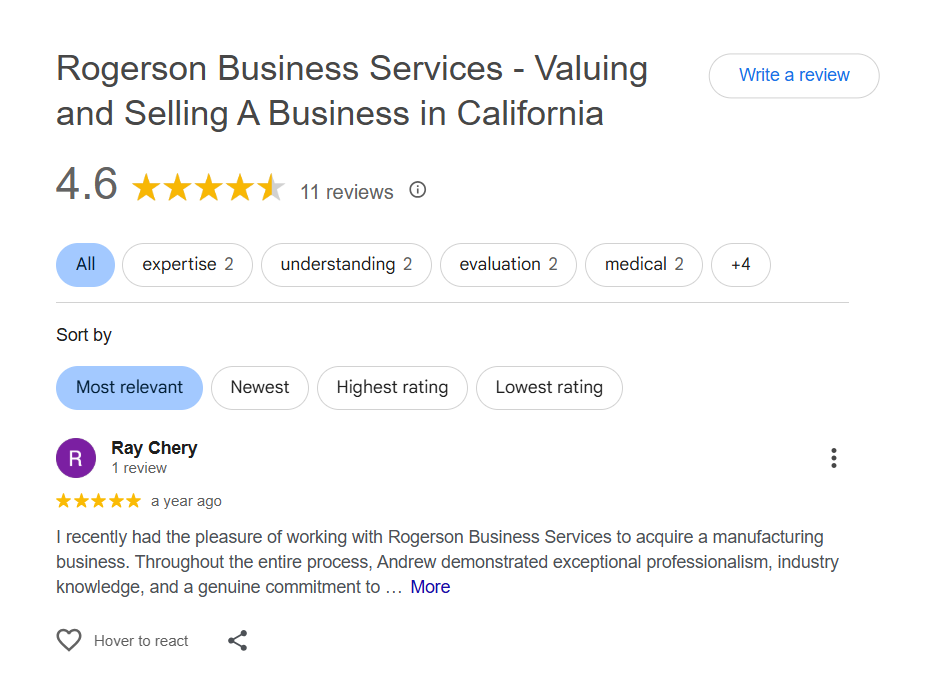
Testimonials
John and Roxanne Foti
“Thank you so much for your patience and professionalism as you worked through the selling of our business. This was an incredibly difficult and emotional transaction but you did it with class. You picked up this file from another Agent and so we had no relationship with you, but you did all that we wanted and more. We also understand how difficult it was working with the buyer’s agent but your professionalism allowed the transaction to continue and ultimately close.“
John and Roxanne Foti – Auburn, CA
See more reviews and testimonials.
Is your business currently operating at the top of its game? Send a free inquiry today! Call Andrew Rogerson, Rogerson Business Services, toll-free (844) 414-9700 | Leave a message – I’ll call you right back
Key takeaways
- Lead with DTSC manifests and LDRs; reconcile them and document exceptions before buyers find gaps.
- Centralize stormwater (SMARTS/IGP), CEQA obligations, Cal/OSHA safety files, and CARB PERP registrations so you can answer permit and NOV questions fast.
- Extract anti‑assignment/change‑of‑control clauses and launch consent requests early; track responses to avoid last‑minute standoffs.
- Confirm professional liability and pollution coverage, including tails, so buyers and lenders see a clean risk transfer.
- Build a 14–30-day sprint plan with owners and deadlines; momentum wins over diligence.
The standoff: a short war story

A California environmental services seller hit day 20 of confirmatory diligence when the buyer’s request list exploded. The team discovered gaps: several 2020–2021 hazardous waste shipments lacked returned Copy B images in the file, and no LDR certifications sat with two waste streams. The buyer paused legal docs.
The seller registered for e‑Manifest, pulled final images, contacted the transporter/TSDF for stragglers, and drafted an exception memo with a clean timeline. They matched each manifest line to an LDR certification and corrected one missing certification with a contemporaneous statement and TSDF confirmation. With the register complete and exceptions documented, the buyer resumed diligence and closed on schedule.
How to use this environmental consulting due diligence checklist
Group documents by regulatory workstream, assign an owner, and verify each item with a simple “evidence + date + source” note. For a broader orientation on sell‑side preparation and data‑room setup, see the detailed sell‑side due diligence checklist. If the buyer requests expansion, counter with your own structured index and point to verified folders.
Module A — DTSC/Title 22: Manifests and LDRs (Mandatory)
California buyers scrutinize hazardous waste generator records. Title 22 requires complete manifests and facility confirmation, and it recognizes LDR notifications/certifications for restricted wastes. See the receiving‑facility responsibilities in Cal. Code Regs. tit. 22, § 66265.71 (Use of Manifest System), and the LDR notification/certification requirements in Cal. Code Regs. tit. 22, § 66268.7. For missing return copies and current processes, use the EPA’s e‑Manifest FAQs.
Item |
Documents to upload |
Recency/Range |
Verify/Action |
Priority |
Owner |
| Manifest register | Spreadsheet with manifest no., dates, waste codes (RCRA/CA), quantities, transporter/TSDF IDs, Copy B/e‑Manifest status | Last 3–5 years (deal‑dependent) | Cross‑check each shipment against the e‑Manifest image; note discrepancies and resolution timeline. | Mandatory | EHS lead |
| LDR notifications/certifications | One‑time and shipment‑specific LDRs mapped to each restricted waste stream | Match to manifest lines | Confirm required certification language; link doc to manifest line ID | Mandatory | EHS lead |
| Missing returns/exception log | Email threads to transporter/TSDF, exception report (if filed), internal memo | 35–45‑day timelines | Document outreach on day 35; if still missing by day 45, record exception steps | Mandatory | Compliance mgr |
| Retention and indexing | Folder taxonomy + naming convention | Deal‑ready | Use YYYY‑MM‑DD_ManifestNo format; store LDR and manifest together | Recommended | Data‑room admin |
Pro tip: If you ship non‑RCRA California-hazardous waste, label and code it correctly so that file reviewers don’t assume a gap.
Module B — Water/Stormwater: IGP, SMARTS, ERA, and NOVs
If your operations or client facilities are subject to the Industrial General Permit (IGP), buyers will ask for SMARTS submissions, SWPPPs, monitoring results, and any ERA Level 1/2 actions. Start with the State Water Board’s Notice of Intent and IGP guide (SMARTS).
Item |
Documents to upload |
Recency/Range |
Verify/Action |
Priority |
Owner |
| IGP coverage | NOI/NEC certificate, permit number, SWPPP | Current cycle | Confirm current signer; verify SWPPP version in SMARTS | Mandatory | Ops lead |
| Monitoring & Annual Reports | Sampling logs, lab results, Annual Report PDFs | Last 2–3 years | Reconcile results to SMARTS submissions; fix missing uploads | Mandatory | QISP/consultant |
| ERA Level 1/2 | Evaluation, Action Plan, Technical Report (as triggered) | Current + prior year | Check deadlines and certifications; track open tasks | Recommended | QISP/consultant |
| NOVs & closures | NOV letters, corrective actions, closure/settlement | 3–5 years | Ensure each NOV has closure proof; summarize penalties paid | Mandatory | Compliance mgr |
Module C — CEQA mitigation and monitoring (MMRP)
If you serve as a consultant of record on active California projects with mitigation measures, show your MMRP obligations and status. CEQA Guidelines require an adopted Mitigation Monitoring or Reporting Program when mitigation is imposed; see the California Resources Agency’s discussion of CEQA Guidelines §15097 MMRP for context.
- Upload the adopted MMRP, tracking logs, and any inspection or monitoring reports.
- Note the responsible party, deadlines, and verification method for each measure.
- Flag any pending challenges or schedule risks so reps and indemnities reflect reality.
Module D — Safety: Cal/OSHA IIPP, HAZWOPER, citations
Cal/OSHA expects a written Injury and Illness Prevention Program (IIPP) with eight core elements; use the DIR’s model guidance as a reference: IIPP guide (8 CCR §3203). Keep HAZWOPER training records and a clean citation/abatement file.
Item |
Documents to upload |
Recency/Range |
Verify/Action |
Priority |
Owner |
| IIPP + records | IIPP, inspections, training logs, corrective actions | Current + 2–3 years | Confirm last review date; verify training rosters | Mandatory | Safety
manager |
| HAZWOPER | 24/40‑hour and 8‑hour refreshers, trainer quals | Current + prior 2 years | Ensure annual refreshers; align worker roles with training | Mandatory | Safety
manager |
| Citations & abatement | Cal/OSHA citations, abatement proof, appeal docs | 3–5 years | Confirm abatement verification submitted on time; track open items | Mandatory | Safety
manager |
Module E — Air and equipment: CARB PERP and local air permits
Field teams often rely on portable engines and equipment. CARB’s Portable Equipment Registration Program authorizes statewide use with conditions—registration, placards/stickers, renewal, and five‑day notifications. Review the CARB PERP program overview.
Item |
Documents to upload |
Recency/Range |
Verify/Action |
Priority |
Owner |
| PERP inventory | Registration certs, placard/sticker IDs with photos | Current | Confirm serials vs certificates; check expiration dates | Mandatory | Fleet mgr |
| Five‑day notifications | Copies of district notices sent | Last 12–24 months | Verify timing vs field logs; capture confirmations | Recommended | Fleet mgr |
| Stationary permits | Local air district permits for non‑portable sources | Current cycle | Reconcile equipment list to permits | Recommended | Ops lead |
Module F — Site and client files: Phase I ESA recency and reliance
Buyers will test whether they can rely on your environmental reports. Under EPA’s All Appropriate Inquiries, key Phase I ESA components “go stale” at 180 days; within a year, you can update them and retain usability. For a concise summary, consult the EPA’s AAI factsheet for ASTM E1527‑21.
- List operational sites and any client sites where reliance letters exist.
- Note Phase I ESA dates and any updates. This includes summarizing RECs and follow‑on actions.
- Store reliance letters and scopes/SOWs with the reports.
Module G — Insurance: Pollution and Professional Liability (with tails)
Confirm that your ‘claims‑made’ policies won’t lapse at closing.
- Pollution Legal Liability (PLL): limits, retro dates, scheduled locations, exclusions, and endorsements; confirm term aligns with post‑close expectations.
- Professional Liability/E&O: limits, deductibles, environmental scope, subcontractor treatment; document any extended reporting period (tail) and duration.
- Certificates: list additional insureds/certificate holders and any primary/non‑contributory wording.
Module H — Contracts and consents: anti‑assignment and change‑of‑control
Extract clauses early, because some clients require consent for assignments or for change‑of‑control transactions.
- Build a consent tracker with contract identifiers, clause excerpts, required consent/notice type, counterparty contacts, request date, status, and conditions.
- Add SOWs that include environmental warranties or indemnities so counsel can shape reps and disclosures.
- For context on how buy‑side asks differ from sell‑side readiness, see buy‑side vs sell‑side diligence expectations.
Module I — Outstanding enforcement and disclosures
Centralize all Notices of Violation (DTSC, Water Boards/RWQCB, Cal/OSHA, CARB/local air district) with closure letters, payments, abatement evidence, and any remaining obligations. Mirror this log in your disclosure schedules and quantify any material contingencies with finance.
A practical workflow example (neutral)
Here’s how an advisor structures speed without shortcuts. Mid‑process, a seller used a manifest/LDR reconciliation tracker: each manifest line linked to the e‑Manifest image, LDR certification, and a discrepancy note with dates of transporter/TSDF outreach. A parallel consent log tracked anti‑assignment/change‑of‑control requests by counterparty and due date. This disciplined pairing lets the buyer quickly verify evidence of hazardous waste and see consent momentum at a glance. A California‑focused advisor such as Rogerson Business Services can help design these trackers and sequence requests in line with local practice—neutrally and efficiently.
14–30-day late‑stage sprint plan
Day window |
Action |
Owner |
Output |
| 1–3 | Stand up data‑room structure; assign module owners; publish index | Deal lead | Folder map + owner list |
| 1–7 | Build manifest register; pull e‑Manifest images; map LDRs | EHS lead | Complete register + exception log |
| 4–10 | Reconcile SMARTS filings; upload SWPPP, monitoring, Annual Reports; summarize ERA status | QISP/Ops | Water packet + ERA summary |
| 5–12 | Compile IIPP/HAZWOPER; assemble citation/abatement file | Safety mgr | Safety packet |
| 6–12 | Inventory PERP/stationary permits; fix expirations; file five‑day notices as needed | Fleet/Ops | Air packet |
| 7–14 | Phase I ESA inventory; confirm recency/updates; collect reliance letters | PM/EHS | ESA table |
| 1–10 | Extract anti‑assignment/CoC clauses; send consent/notice packages; start tracker | Legal/PM | Consent log + sent notices |
| 10–20 | NOV log, closures, and financial quantification | Compliance/Finance | Enforcement packet |
| 14–30 | Clean insurance certs; confirm tails; finalize data‑room index | CFO/Deal lead | Insurance packet + index |
Why this checklist helps California sellers close
This environmental consulting due diligence checklist forces you to prove compliance where California buyers look first: DTSC manifests/LDRs, stormwater, safety, CEQA, and air rules that touch your everyday operations. You provide evidence, dates, and sources so reviewers can quickly confirm facts. However, if a gap exists, document the exception and your remediation plan to reduce friction and protect the timeline.
Note on authorship and expertise: Andrew Rogerson is a Certified Business Broker, Certified Mergers & Acquisition Professional, and Mergers & Acquisition Master Intermediary, a five‑time business owner, and the author of four books on business ownership (Knowledge Base Source). His team focuses on sell‑side readiness for lower-middle-market owners in California.
FAQs
1) What’s the single biggest environmental due diligence for California sellers?
In practice, missing or unreconciled hazardous waste manifests and Land Disposal Restriction (LDR) certifications are among the fastest diligence escalations. Buyers can’t “unsee” gaps in DTSC/Title 22 evidence, so they slow the legal process until you produce the final e‑Manifest image (or returned copy), map it to the correct waste stream, and document any exception timeline.
2) How far back should we build our manifest register and supporting files?
Most buyers will ask for reports going back 3 to 5 years. However, your deal may require a longer lookback period if you had a major facility change, a regulatory event, or a material client relationship associated with higher‑risk waste streams. Start with the last 3 years, then extend only when the request list, your counsel, or a known risk area makes it necessary.
3) What stormwater documents do buyers want to see in California?
If you operate under the Industrial General Permit, expect requests for your SMARTS coverage documents (NOI/NEC), the current SWPPP, monitoring results, Annual Reports, and any Exceedance Response Action (ERA) workpapers. Just as important, package any NOVs with closure proof so the buyer doesn’t have to guess whether the file is “open.”
4) How do CEQA obligations show up in diligence for an environmental consulting business?
CEQA risk often appears through active projects where you serve as the consultant of record and mitigation measures require monitoring or reporting. Buyers typically want the adopted Mitigation Monitoring and Reporting Program (MMRP), your tracking logs, and the latest evidence of status so they can assess disclosure and schedule risk.
5) What insurance and contract items usually trigger last-minute diligence friction?
Two common ones:
Cilams made coverage continuity:
- Buyers and lenders often ask how you’ll avoid gaps in Professional Liability/E&O and Pollution coverage at close, including any extended reporting period (tail).
Client consents:
- Anti‑assignment and change‑of‑control clauses can require client consent before (or immediately after) closing, so you should extract the clause language early and run a consent tracker with dates and statuses.
References and resource pointers.
- DTSC/Title 22 manifests: receiving‑facility confirmation and discrepancy handling in Cal. Code Regs. tit. 22, § 66265.71; LDR notifications/certifications in Cal. Code Regs. tit. 22, § 66268.7; practical retrieval via the EPA’s e‑Manifest FAQs.
- Stormwater/IGP/SMARTS: State Water Board’s Notice of Intent and Industrial General Permit guide.
- CEQA MMRP: Overview of CEQA Guidelines §15097 monitoring and reporting.
- Cal/OSHA IIPP: DIR’s model and explanation in IIPP guidance (8 CCR §3203).
- CARB PERP: Program requirements in CARB’s Portable Equipment Registration Program overview.
- AAI/ASTM E1527‑21: EPA’s All Appropriate Inquiries factsheet.
Are you looking for deeper context on California service company deal norms and environmental indemnity considerations? If so, scan our industrial services sale guide and our overview of what due diligence asks and how to stay ahead of it.
Ready for the next step?
- Prepare your data room, assign owners, and stage the high risk files first and prepare for Buyer Due Diligence.
Is your business currently operating at the top of its game? Send a free inquiry today! Call Andrew Rogerson, Rogerson Business Services, toll free (844) 414-9700 | Leave a message – I’ll call you right back.