

By Andrew Rogerson, Founder, Rogerson Business Services (California M&A advisory) When considering an Environmental M&A Advisor vs. a Generic Broker, it’s important to understand the differences between these roles in the context of business acquisitions.
Last updated: March 26, 2026
Author note: This guide reflects common SMB sell-side practice in California environmental services transactions. It is not legal, tax, or investment advice.
You’re weeks from funding. Pressure rises, questions pile up, and one missed filing could trigger a gap in coverage or a client defection. This finish-line guide shows you exactly how to close the business sale deal with confidence in California, protecting regulated client relationships, permits and IDs, and your post‑close liability position.
This tutorial focuses on industrial cleaning and wastewater operations. You’ll run four tracks in parallel: landlord consent for the yard/operations site, IGP/SMARTS handoff, POTW/industrial wastewater permitting, and risk allocation through an environmental escrow holdback. We’ll also cover NPDES transfers (if they apply), a short war story, and a practical Day‑1/30/90 transition cadence.
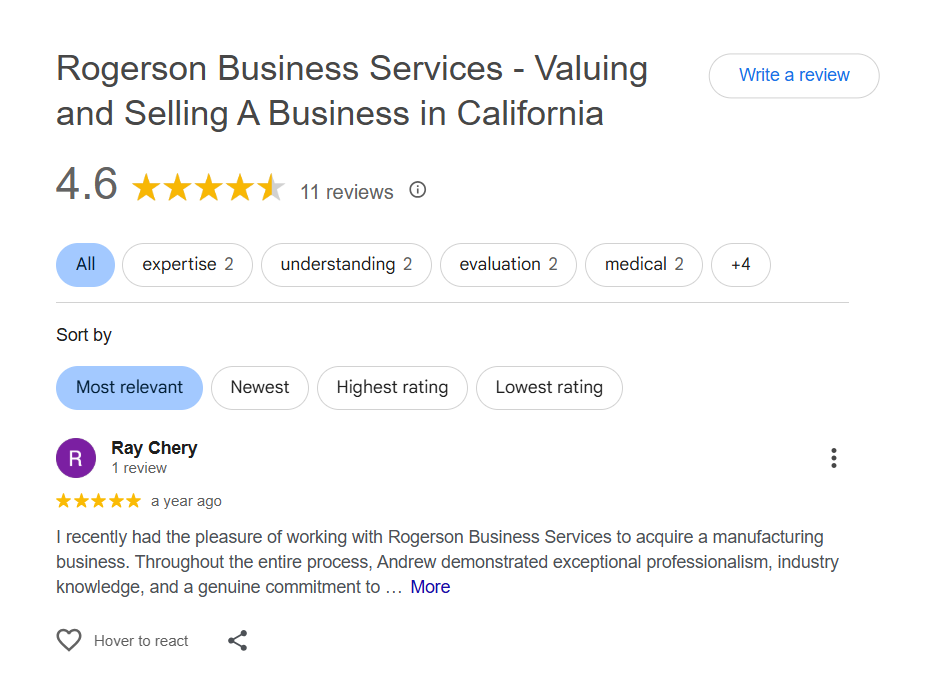
Testimonials
Scott Robert Steward
“Andrew, I wanted to thank you for offering to continue your support of my quest to find a good company. Granted, this business situation is not ideal for you, and I know that. Your honest, prompt and complete feedback has always impressed me. Your integrity is the foundation for your decisions, and that too is keeping me connected to you. For all you’ve done, and for all you will do, I’m thankful for your help.”
“
Scott Robert Steward – Folsom, California
See more reviews and testimonials.
Is your business currently operating at the top of its game? Send a free inquiry today! Call Andrew Rogerson, Rogerson Business Services, toll-free (844) 414-9700 | Leave a message – I’ll call you right back
Key takeaways
- Treat IGP coverage under SMARTS as non‑transferable in practice: the seller files a Notice of Termination (NOT), and the buyer submits a new NOI with PRDs and fee payment before change of control.
- Expect to reapply or modify your local POTW industrial wastewater discharge permit; secure written acknowledgment before funding.
- Run the landlord‑consent track first for your industrial yard/operations site, and tie the closing conditions to the delivered consent and estoppel.
- Use an environmental escrow holdback aligned to rep survival with milestone‑based releases (e.g., “no further action,” remediation completion, permit issuance).
- Verify statuses in SMARTS, confirm landlord consent and any NPDES transfer acceptance, and place the executed holdback exhibit in the closing set before you wire.
Quick orientation for this scenario
- Niche: Industrial cleaning/wastewater (stormwater IGP/SMARTS WDID; POTW industrial wastewater; NPDES if applicable).
- Risk allocation spotlight: Escrow holdback with defined survival periods and release milestones.
- First blocker to solve: Landlord consent for the yard/operations site.
- New to the broader sale process? Review the context in the step‑by‑step pillar: How to Sell an Environmental Services Company in California Step by Step.
Step‑by‑step timeline to finish closing without gaps
You’ll move on four tracks. Assign owners clearly. Seller handles current‑state terminations and landlord relations; Buyer handles new filings; Counsel and your compliance consultant quarterback certifications, exhibits, and timing.
Run the landlord‑consent track first
Start here because a slow landlord can stall everything. Build a clean, complete consent package and submit it early. In California, when a commercial lease is silent on reasonableness, the Supreme Court held that landlords must act on commercially reasonable grounds (financial responsibility, compatible use) in Kendall v. Ernest Pestana, Inc., 40 Cal.3d 488 (1985). However, parties can contract around that with explicit restraints, as confirmed in Carma Developers v. Marathon Dev. Cal., Inc., 2 Cal.4th 342 (1992). Read your lease and plan time accordingly.
Landlord consent packet — submit as one PDF and offer to pay reasonable attorney review fees. Include:
- Assignee financials and ownership summary, industrial use statement specific to cleaning/wastewater, environmental disclosures (Phase I summary, spill/violation history with corrective actions), insurance COIs naming landlord where required, and the signed assignment/assumption with a proposed estoppel.
Negotiate for a reasonable consent timeline. Tie closing conditions and any outside date to executed consent and estoppel. If the lease grants sole discretion or recapture rights, sequence extra time or contingency language so you don’t blow your funding window.
References for standards: See the California Supreme Court decisions in Kendall v. Ernest Pestana and Carma Developers v. Marathon.
Hand off IGP/SMARTS coverage without a lapse
Treat Industrial General Permit (IGP) stormwater coverage as non‑transferable in practice. Execute a clean handoff inside SMARTS.
- Buyer: prepare a new Notice of Intent (NOI) with all Permit Registration Documents (PRDs)—SWPPP, facility/site map, and fee payment—at least seven days before taking over operations. Only the Legally Responsible Person (LRP) or a delegated account can certify. Complete the “Perform Completion Check,” submit, and save the confirmation and fee receipt. Status should read “Submitted to the Water Board.”
- Seller: prepare and certify the Notice of Termination (NOT) with any required final monitoring and attachments. Track the NOT approval; seller coverage ends only when the Water Boards approve the NOT.
Authoritative guides: The State Water Board’s NOI help guide explains PRDs, certification, and verification, and the Organization/Ownership change guidance directs sellers to file a NOT while the new operator files for new coverage. See the Industrial NOI help guide and the Organization Change of Information Guidance. NOT verification steps mirror those in the Industrial NOT help guide.
Reapply or modify your POTW industrial wastewater discharge permit
Local sewer authorities (POTWs) control industrial wastewater discharge permits. Expect a reapplication or modification by the Buyer, often accompanied by a site inspection before reissuance. Typical elements include an updated application, process and flow descriptions, pollutant profiles, and pretreatment equipment details. Because POTW requirements vary by agency, obtain the current instructions directly from your program and secure written acknowledgment of receipt before you fund.
For background on authority and transfer limits within the permitting framework, see the EPA’s NPDES basics and the California Water Boards’ NPDES program. Always confirm details with your local POTW.
Decide NPDES transfer vs. new ROWD, if applicable
If your operation also holds an individual NPDES permit, decide early whether to request a transfer or submit a new Report of Waste Discharge (ROWD). Regional Boards may allow a transfer when facility construction and the nature and amount of discharges remain substantially unchanged; otherwise, they may require a new application.
Coordinate signatures of both old and new owners and align the effective date with the closing. For a concrete example of the process, see the Los Angeles Region’s NPDES permit transfer request form.
War story: the contract‑transfer standoff—and the fix

One week from closing, a top client’s MSA required formal assignment and two site‑specific approvals. Their legal team prioritized quarter‑end contracts. Our closing clock kept ticking. We lost a week—and almost the deal.
The fix: We sent a sequenced pack, an informal heads‑up to the operations lead, then a formal notice with the novation schedule and a clear “no service interruption” message. On day five, we escalated to the client’s executive sponsor with a concise risk memo and offered a short transitional services window to bridge any approval lag. They signed the novation and site approvals the next day. Why does this matter? Because regulated clients hate surprises, and they reward clean, early communication.
Use the same play: pre‑notice, formal notice with a single‑page summary of why the assignment protects compliance, escalation at a set interval, and a pre‑negotiated transitional services clause in your APA as a backstop.
Building an environmental escrow holdback that works for closing an environmental services business sale
You selected an escrow holdback to manage post‑close environmental liabilities. Size it to diligence findings, align duration with the survival of environmental reps, and release funds only against objective milestones.
Design points that work:
- Survival periods: Environmental reps often run longer than general reps. Match the escrow duration to that survival.
- Milestone releases: Tie partial releases to objective events—receipt of a Water Board “no further action,” completion of specified remediation with engineer certification, issuance of the buyer’s permits (e.g., new WDID, POTW permit), and passage of survival with no claims.
- Integration: If you also place RWI, reduce your general escrow but keep a dedicated environmental escrow for known conditions.
For a practitioner’s perspective on escrow mechanics and environmental risk tools, see the overview from SRS Acquiom on M&A escrows. If you want a refresher on California escrow flow, skim this context piece: California business escrow overview.
Transition and seller consulting: Day‑1/30/90 compliance cadence
Day‑1: Announce the close internally to EHS leads and client‑facing teams. Confirm SMARTS access for the Buyer’s LRP and team, verify that the Buyer’s NOI shows “Submitted to the Water Board,” and confirm that the fee payment has posted. Hand the POTW reapplication acknowledgment to operations and calendar any site inspection. If you use a QISP, ensure onboarding starts now, and sampling stays on cadence.
Day‑30: Check on e‑Authorization processing in SMARTS, confirm the first sampling event if required, and respond to any POTW information requests. Verify that any NPDES transfer acknowledgment or ROWD receipt is on file.
Day‑90: Review sampling and reporting quality, confirm the Seller’s NOT approval notice sits in your archive, and track milestone progress for escrow releases, such as the Buyer’s POTW permit issuance or documented remediation completion.
Think of this transition like a relay: you don’t drop the baton if you script handoffs and verify each checkpoint.
A quick, neutral example of coordinated support: Rogerson Business Services helps sellers and buyers sequence SMARTS termination and new NOI timing, assemble a landlord consent packet that anticipates reasonable-review standards, and align escrow milestone language with the deal’s survival schedule so the wire doesn’t outrun approvals. That coordination keeps the closing room calm without over‑promising outcomes.
What to verify before you fund when closing an environmental services business sale
- SMARTS: Buyer’s NOI “Submitted to the Water Board,” fee paid, and e‑Authorization mailed or electronically executed as required. Seller’s NOT certified and tracking toward approval.
- Permits: POTW reapplication receipt and any interim authorization in writing. If applicable, NPDES transfer request filed (or new ROWD receipt on file).
- Landlord: Executed consent and estoppel delivered to escrow.
- Escrow: Environmental holdback exhibit executed with clear survival and milestone language.
You’re closing an environmental services business sale in California, so you confirm these checkpoints in writing. Then you wire.
SMARTS and landlord consent: two compact checklists
SMARTS packets (who does what): Buyer submits NOI with PRDs and fee; Seller certifies NOT with final reporting; Counsel/compliance verify statuses and archive confirmations. Save the “Submitted to the Water Board” screen and fee receipt for the Buyer; save the approval notice for the Seller.
Landlord consent packet (submit early): Assignee financials and ownership summary; industrial use statement; environmental disclosures (Phase I, spill/violation history with corrective actions); insurance COIs; signed assignment/assumption; proposed estoppel with requested consent date.
A note on expertise and ethics
Andrew Rogerson, a five‑time business owner, author of four books, and a Certified Business Broker (CBB), Certified Mergers & Acquisition Professional (CM&AP), and Mergers & Acquisition Master Intermediary (M&AMI), has guided many California owners through the last mile of a sale with a steady, ethics‑first approach. That perspective shapes this finish‑line tutorial, but your transaction deserves its own counsel and compliance team.
Get support closing your sale
You’re almost there. If you want a seasoned closing room to coordinate permits, landlord consent, and an escrow holdback that fits your survival schedule, reach out. Get Support Closing Your Sale.
Is your business currently operating at the top of its game? Send a free inquiry today! Call Andrew Rogerson, Rogerson Business Services, toll-free (844) 414-9700 | Leave a message – I’ll call you right back
Disclaimer: This tutorial provides general information for California sellers in the industrial cleaning/wastewater niche. Requirements and forms vary by Regional Water Board and local POTW. Confirm current rules with your regulators and consult qualified legal counsel and environmental professionals for your specific deal.